Stock Analysis · Primo Brands Corporation (PRMB)
Overview
Primo Brands Corporation operates in non-alcoholic beverages, with a business centered on water. The company sells branded packaged water, provides water dispensers and refill solutions, and serves homes, offices, and retail channels. In practical terms, Primo sits at the intersection of everyday consumer staples and recurring hydration needs: bottled water bought in stores, large-format water delivered or exchanged, and dispenser-based systems used repeatedly over time.
The business model combines product sales with service-like recurring demand. That matters because water consumption is relatively stable, while dispenser installations, exchange programs, and household or workplace delivery can create repeat purchases rather than one-time transactions. Primo’s portfolio has historically included spring water, purified water, sparkling water, self-service refill, and exchange formats, though the exact mix can shift after acquisitions, divestitures, and brand integration.
Based on the company’s recent public reporting structure and the nature of its operations, Primo’s revenue sources can be understood broadly as follows.
- Packaged water sold through retail channels: approximately 60% to 70% of revenue. This includes branded bottled water and related packaged hydration products sold in supermarkets, mass retail, club, convenience, and other stores.
- Water direct / delivery, exchange, and refill services: approximately 20% to 30% of revenue. This includes large-format water delivered to homes and offices, exchange of multi-gallon containers, and self-service refill programs.
- Dispensers, accessories, and other beverage-related activity: approximately 5% to 10% of revenue. This includes water dispensers and adjacent hydration equipment or support items.
The broad financial flow shows a company that has scaled revenue materially over the last several years, with gross profit also expanding. At the same time, selling, general, and administrative expenses remain substantial, and interest expense has taken a meaningful share of operating earnings. That helps explain why revenue growth has looked stronger than bottom-line profitability.
Key Figures
| Metric | Value | Sector ⓘ |
|---|---|---|
| Date | Oct 03, 2026 | |
| Context | ||
| Sector | Consumer Defensive | |
| Industry | Beverages - Non-Alcoholic | |
| Market Cap ⓘ | $6.97B | |
| Beta ⓘ | 0.71 | |
Value (Cheapness) | ||
| P/E Ratio ⓘ | 64.17 | 18.16 |
| P/B Ratio ⓘ | 2.36 | 1.27 |
| FCF Yield ⓘ | 5.43% | 12.39% |
| Dividend Yield ⓘ | 2.26% | 2.83% |
| EBIT / EV ⓘ | 4.74% | 6.45% |
| PEG ⓘ | N/A | |
Growth (Business expansion) | ||
| Revenue Growth ⓘ | 3.80% | 3.80% |
| RPS Growth (5Y CAGR) ⓘ | 8.36% | 6.20% |
| EPS Growth (5Y CAGR) ⓘ | 15.70% | -14.64% |
| BVPS Growth (5Y CAGR) ⓘ | -0.70% | 3.26% |
| Margin Growth (5Y Trend) ⓘ | 3.45% | -0.25% |
| FCF Growth (5Y CAGR) ⓘ | 34.37% | 4.65% |
| DPS Growth (5Y CAGR) ⓘ | 13.65% | 6.86% |
Quality (Business durability) | ||
| ROIC (Latest) ⓘ | 4.95% | 12.58% |
| ROA (Latest) ⓘ | 0.93% | 6.35% |
| ROIC (5Y Median) ⓘ | N/A | 10.36% |
| ROA (5Y Median) ⓘ | 0.55% | 5.44% |
| Net Debt / EBIT (Latest) ⓘ | 9.02 | 1.91 |
| Net Debt / EBIT (5Y Median) ⓘ | 11.34 | 2.32 |
| Net Debt / EBITDA (Latest) ⓘ | 4.40 | 1.36 |
| Net Debt / Assets ⓘ | 50.11% | 21.25% |
| EBITDA / Interest ⓘ | 3.76 | 9.61 |
| Operating Margin (Latest) ⓘ | 8.76% | 8.96% |
| Operating Margin (5Y Median) ⓘ | 7.08% | 9.53% |
| Debt to Equity (Latest) ⓘ | 191.17% | 71.66% |
| Profit Margin (Latest) ⓘ | 1.49% | 5.40% |
| Free Cash Flow (Latest) ⓘ | $378.53M | |
Momentum (Price trend) | ||
| 3Y Return ⓘ | +52.15% | +15.25% |
| 12M Return (excl. last month) ⓘ | -6.33% | +2.63% |
| 6M Return ⓘ | +5.35% | +2.43% |
| Price vs. 200-Day MA ⓘ | -7.96% | +0.43% |
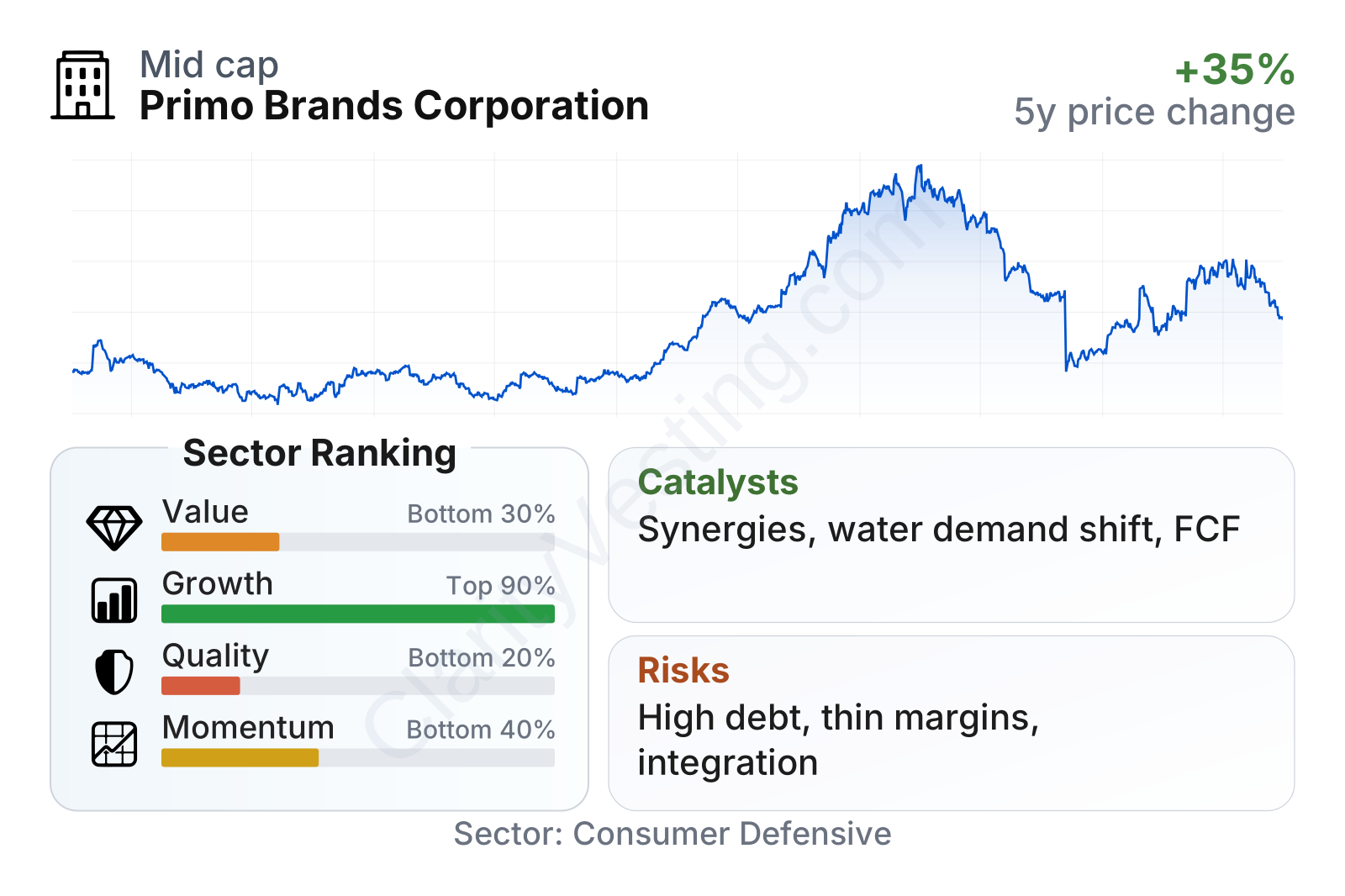
Primo is a mid-sized consumer defensive company with a stock that has been much less volatile than the broader market, as reflected by a beta below 1. The table points to a mixed profile: growth metrics rank strongly versus the sector, but value and quality rank weakly. In simple terms, the company has been expanding faster than many peers, yet that growth has not translated into equally strong profitability, returns on capital, or balance-sheet strength. The market is currently assigning a premium valuation despite those limitations.
Growth
The company operates in a category with durable long-term demand. Bottled water and at-home hydration remain supported by consumer preference shifts away from sugary drinks, convenience needs, and workplace or household demand for repeat-use water solutions. This is not usually a hypergrowth market, but it can offer steady volume growth, pricing opportunities, and consolidation benefits for scaled operators.
Primo’s strategy broadly makes sense for this environment. A water-focused portfolio can benefit from repeat purchases, route density in delivery operations, cross-selling between packaged formats and dispenser-based systems, and procurement scale. If management executes well, a larger network can improve margins over time because distribution and servicing costs become more efficient when spread across more customers and higher throughput.
Recent revenue growth has normalized sharply from the exceptional swings seen around major business changes and integration periods. The latest year-over-year pace is modest, roughly in line with the sector median, which suggests the company is now moving from transformation-driven jumps to a steadier operating phase. Longer-term growth measures still look strong, indicating that scale expansion over the last several years was meaningful even if current growth is less dramatic.
Cash generation is one of the more constructive parts of the picture. Free cash flow improved materially over the last few years and remains positive at a solid level, even after easing from a peak. That is important because a company with meaningful debt needs dependable cash generation more than accounting earnings alone. If Primo can continue converting revenue into cash while integrating operations and managing costs, that would support a stronger financial profile over time.
A notable catalyst is the company’s ability to capture synergies from portfolio reshaping and scale expansion completed in recent years. In a staple category like water, even modest improvements in routing efficiency, plant utilization, procurement, and packaging costs can have an outsized effect on earnings because margins are not very wide to begin with. Another potential catalyst is continued consumer migration toward water and away from other beverages, which supports demand without requiring major category reinvention.
Risks
This article is for informational purposes only and does not constitute financial advice. Some content is AI-generated. See Disclaimer