Stock Analysis · Perimeter Solutions SA (PRM)
Overview
Perimeter Solutions is a specialty chemicals company best known for products used in firefighting and industrial applications. Its most distinctive business is making long-term fire retardants that are dropped from aircraft to slow the spread of wildfires. It also supplies firefighting foams and other products used by fire agencies. Alongside that, the company has an industrial chemicals business that serves customers in areas such as offshore energy, mining, infrastructure, and water-related applications.
For a long-term reader, the key point is that Perimeter is not a broad commodity chemicals producer. It operates in narrower, mission-critical niches where performance, certifications, logistics, and customer relationships matter a lot. That can support pricing power and repeat business, but it also means results can swing depending on wildfire seasons, government spending patterns, and project cycles in industrial markets.
Based on recent annual reporting, revenue is mainly split between two operating segments:
- Fire Safety – about 75% to 80%: This is the largest business. It includes aerial fire retardants, firefighting foams, and related services and equipment. The most important product is PHOS-CHEK retardant, used by federal, state, local, and international firefighting agencies.
- Specialty Products – about 20% to 25%: This segment includes phosphorus-based specialty chemicals used in oil and gas production, mining, electric utilities, and other industrial applications.
The business mix has tilted more toward Fire Safety as wildfire activity and procurement demand increased. Revenue has risen sharply since 2023, but profits have been much more volatile than sales because accounting charges, operating expenses, and financing costs have had a large impact on reported earnings.
The financial flow over the last few years shows a company that has expanded revenue meaningfully, especially in 2024 and 2025, but not in a smooth way. Gross profit improved with scale, yet operating income and net income became inconsistent again after stronger results in 2022 and 2023. That pattern suggests the core business has demand momentum, while reported profitability remains vulnerable to cost swings and non-operating items.
Key Figures
| Metric | Value | Sector ⓘ |
|---|---|---|
| Date | Oct 03, 2026 | |
| Context | ||
| Sector | Basic Materials | |
| Industry | Specialty Chemicals | |
| Market Cap ⓘ | $4.41B | |
| Beta ⓘ | 1.90 | |
Value (Cheapness) | ||
| P/E Ratio ⓘ | N/A | 17.61 |
| P/B Ratio ⓘ | 4.09 | 1.77 |
| FCF Yield ⓘ | 2.36% | 5.87% |
| Dividend Yield ⓘ | N/A | 2.06% |
| EBIT / EV ⓘ | -6.56% | 6.43% |
| PEG ⓘ | N/A | |
Growth (Business expansion) | ||
| Revenue Growth ⓘ | 31.50% | 11.30% |
| RPS Growth (5Y CAGR) ⓘ | 17.46% | 4.46% |
| EPS Growth (5Y CAGR) ⓘ | N/A | -13.11% |
| BVPS Growth (5Y CAGR) ⓘ | 2.31% | 5.51% |
| Margin Growth (5Y Trend) ⓘ | N/A | -1.57% |
| FCF Growth (5Y CAGR) ⓘ | 35.10% | 0.55% |
| DPS Growth (5Y CAGR) ⓘ | N/A | 6.02% |
Quality (Business durability) | ||
| ROIC (Latest) ⓘ | -11.98% | 9.31% |
| ROA (Latest) ⓘ | -11.53% | 4.94% |
| ROIC (5Y Median) ⓘ | -0.27% | 7.91% |
| ROA (5Y Median) ⓘ | -0.25% | 3.93% |
| Net Debt / EBIT (Latest) ⓘ | N/A | 1.40 |
| Net Debt / EBIT (5Y Median) ⓘ | N/A | 1.70 |
| Net Debt / EBITDA (Latest) ⓘ | N/A | 0.91 |
| Net Debt / Assets ⓘ | 39.72% | 13.69% |
| EBITDA / Interest ⓘ | N/A | 11.93 |
| Operating Margin (Latest) ⓘ | -50.30% | 13.07% |
| Operating Margin (5Y Median) ⓘ | -1.14% | 11.86% |
| Debt to Equity (Latest) ⓘ | 134.24% | 40.43% |
| Profit Margin (Latest) ⓘ | -44.86% | 6.57% |
| Free Cash Flow (Latest) ⓘ | $103.84M | |
Momentum (Price trend) | ||
| 3Y Return ⓘ | +479.74% | +65.06% |
| 12M Return (excl. last month) ⓘ | +36.22% | +36.05% |
| 6M Return ⓘ | +7.78% | +1.89% |
| Price vs. 200-Day MA ⓘ | -11.24% | +1.03% |
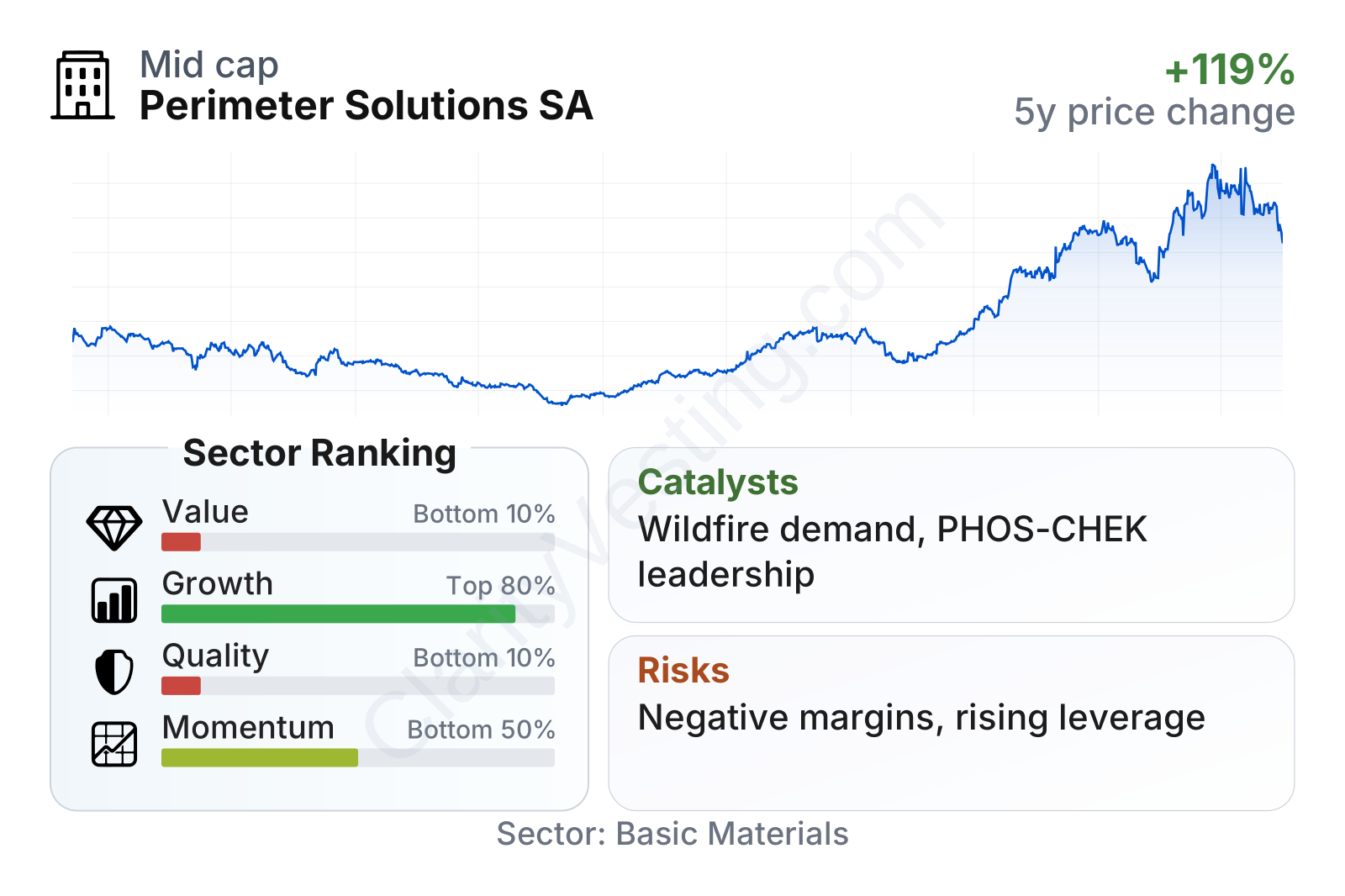
Perimeter is now a mid-sized company with a stock that has been very volatile. Over roughly three years, the share price moved from deep weakness to a very strong rebound, far outperforming the sector over the full period, although recent momentum has cooled somewhat with the stock trading below its 200-day average. In the factor breakdown, growth stands out as the strongest area, while value and quality rank poorly versus the broader materials sector. That combination usually points to a business the market is rewarding for expansion, but still discounting for uneven profitability and leverage.
Growth
Perimeter operates in a sector with a credible long-term tailwind. Wildfire suppression has become more important as fire seasons have grown longer and more destructive in many regions, especially in North America. That does not create perfectly predictable annual demand, but it does support the need for retardant capacity, distribution networks, and qualified suppliers. In the industrial chemicals segment, the growth case is less dramatic, but it adds diversification and exposure to infrastructure and resource-related demand.
The company’s strategy broadly makes sense for future expansion because it is centered on areas where reliability matters more than low pricing alone. Fire retardants are highly specialized products tied to regulatory approvals, testing standards, and operational readiness. Those are not markets where a new entrant can scale overnight. Perimeter has also highlighted manufacturing, base infrastructure, and service readiness as part of its offering, which can strengthen customer relationships beyond simply selling chemicals.
Revenue growth has been strong but uneven. After weakness in 2022 and 2023, growth accelerated sharply through 2024 and remained positive into 2025 and the first half of 2026. The latest year-over-year increase is still well above the sector median, showing that demand has not faded after the earlier surge. The pattern also confirms the business can be lumpy from quarter to quarter, which is normal for a company tied to wildfire activity and project timing.
Cash generation has improved meaningfully from the negative readings seen earlier in the cycle. Free cash flow turned strongly positive in 2024 and 2025, and although it came down from its peak in the latest period, it remained solidly positive. That matters because it suggests the underlying business can produce cash even when reported earnings are noisy. Over five years, free cash flow growth has been far stronger than the sector median, which is one of the clearest positive signals in the financial profile.
A meaningful catalyst is the ongoing need for wildfire preparedness. Fire agencies cannot improvise supply chains during peak season, so established vendors can benefit when governments increase readiness budgets or restock after severe fire years. Another potential opportunity comes from international adoption and broader use of aerial firefighting resources. If wildfire management remains a policy priority, Perimeter’s Fire Safety segment has a clear pathway to remain the company’s engine of growth.
Risks
This article is for informational purposes only and does not constitute financial advice. Some content is AI-generated. See Disclaimer