Stock Analysis · Parkway Life Real Estate Investment Trust (PRKWF)
Overview
Parkway Life Real Estate Investment Trust is a healthcare-focused real estate investment trust that owns income-producing properties used for medical and eldercare services. Its portfolio is centered on hospitals, nursing homes, and healthcare-related assets in Asia, with the largest exposure in Singapore and Japan. In simple terms, the trust collects rent from healthcare operators that use these buildings, then distributes a large share of its cash flow to unitholders, as is typical for REITs.
The business model is relatively straightforward: acquire healthcare properties, sign long leases with operators, and aim for stable rental income. That makes Parkway Life different from more cyclical property owners such as office or retail landlords, because demand for hospitals and eldercare facilities tends to be tied more closely to demographics and healthcare needs than to consumer spending or corporate leasing cycles.
Based on the latest annual disclosures, revenue is mainly generated from rental and related income tied to healthcare real estate. The portfolio mix by asset value is a useful guide to where the economics come from.
- Japan nursing homes: approximately 57% of portfolio value. These assets mainly generate lease income from eldercare facilities operated by third parties.
- Singapore hospitals and medical properties: approximately 39% of portfolio value. This includes the Mount Elizabeth, Gleneagles, and Parkway East hospital properties, plus selected medical-use assets.
- Malaysia and France healthcare assets: approximately 4% combined. These are smaller contributors and provide some diversification outside the two core markets.
This revenue base is attractive for long-term analysis because it is backed by essential-use properties. The 2025 income flow also points to a business with high gross profitability and limited operating costs relative to revenue, which is typical for a landlord model where tenants operate the facilities and the REIT mainly owns the real estate.
The income profile shows a landlord structure with strong gross margins and comparatively light overhead. Revenue has generally expanded over the last five years, while interest expense has also moved higher, which matters because debt costs can influence future distributable income.
Key Figures
| Metric | Value | Sector ⓘ |
|---|---|---|
| Date | Oct 17, 2026 | |
| Context | ||
| Sector | Real Estate | |
| Industry | REIT - Healthcare Facilities | |
| Market Cap ⓘ | $1.89B | |
| Beta ⓘ | 0.34 | |
Value (Cheapness) | ||
| P/E Ratio ⓘ | 14.50 | 17.38 |
| P/B Ratio ⓘ | 1.21 | 0.85 |
| FCF Yield ⓘ | 4.13% | 7.38% |
| Dividend Yield ⓘ | 5.66% | 4.85% |
| EBIT / EV ⓘ | N/A | 3.78% |
| PEG ⓘ | 4.41 | |
Growth (Business expansion) | ||
| Revenue Growth ⓘ | -1.00% | 5.30% |
| RPS Growth (5Y CAGR) ⓘ | 12.98% | 6.02% |
| EPS Growth (5Y CAGR) ⓘ | 53.65% | -11.37% |
| BVPS Growth (5Y CAGR) ⓘ | 8.53% | 0.45% |
| Margin Growth (5Y Trend) ⓘ | -173.98% | -0.22% |
| FCF Growth (5Y CAGR) ⓘ | -17.55% | 5.40% |
| DPS Growth (5Y CAGR) ⓘ | -2.18% | 5.02% |
Quality (Business durability) | ||
| ROIC (Latest) ⓘ | N/A | 5.69% |
| ROE (Latest) ⓘ | 10.10% | 7.56% |
| ROA (Latest) ⓘ | N/A | 2.85% |
| ROIC (5Y Median) ⓘ | 6.61% | 4.22% |
| ROE (5Y Median) ⓘ | 7.11% | 6.03% |
| ROA (5Y Median) ⓘ | 4.30% | 2.44% |
| Net Debt / EBIT (Latest) ⓘ | N/A | 7.59 |
| Net Debt / EBIT (5Y Median) ⓘ | 4.89 | 8.40 |
| Net Debt / EBITDA (Latest) ⓘ | N/A | 5.27 |
| Net Debt / Assets ⓘ | 31.77% | 37.76% |
| EBITDA / Interest ⓘ | N/A | 4.10 |
| Operating Margin (Latest) ⓘ | N/A | 35.29% |
| Operating Margin (5Y Median) ⓘ | 82.19% | 37.31% |
| Debt to Equity (Latest) ⓘ | 53.81% | 88.87% |
| Profit Margin (Latest) ⓘ | 106.54% | 19.61% |
| Free Cash Flow (Latest) ⓘ | $78.17M | |
Momentum (Price trend) | ||
| 3Y Return ⓘ | +36.94% | +30.75% |
| 12M Return (excl. last month) ⓘ | -7.47% | +4.36% |
| 6M Return ⓘ | -1.23% | -2.52% |
| Price vs. 200-Day MA ⓘ | +14.93% | -2.34% |
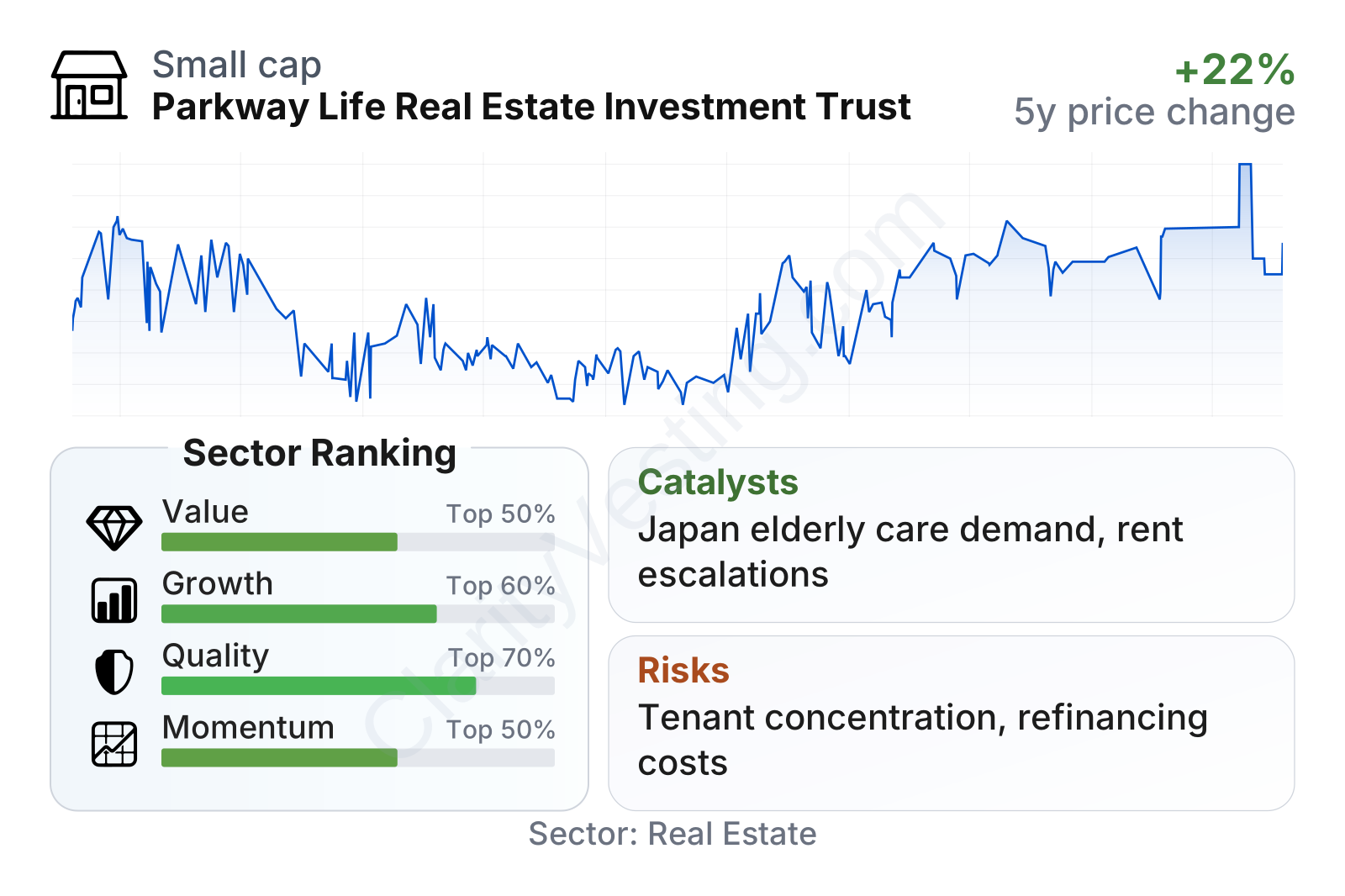
Parkway Life is a mid-sized healthcare REIT with a relatively low share-price volatility profile, as shown by a beta well below 1. On valuation, earnings-based pricing looks somewhat cheaper than the sector median, while the price-to-book ratio sits slightly above the sector median. Income remains one of the clearest features: the trailing dividend yield is above the sector median. Quality metrics are generally strong, with profitability and balance-sheet efficiency standing out versus many real estate peers. Growth metrics are more mixed, with solid multi-year expansion in revenue per share and book value per share, but weaker recent revenue growth and softer free cash flow progression.
Growth
Parkway Life operates in a part of real estate that benefits from long-term structural demand. Aging populations in Japan and Singapore, rising healthcare utilization, and the need for specialized care facilities all support demand for hospitals, nursing homes, and related medical infrastructure. That does not guarantee fast growth every year, but it does create a favorable backdrop for stable occupancy and rent collection over long periods.
The trust’s strategy also makes sense for future expansion because it is focused on essential healthcare assets rather than broad commercial property categories. Japan is especially important here: the country has one of the oldest populations in the world, and nursing home demand is tied to demographic needs rather than office hiring or discretionary shopping patterns. Singapore adds another layer of stability through hospital assets linked to a mature private healthcare ecosystem.
Revenue per share has trended upward over the last five years, with a particularly strong step-up in 2025 after a flatter 2024. That pattern suggests the business has still been able to grow on a per-unit basis despite a more challenging financing environment for real estate.
Distributions have been less smooth than revenue. The dividend per share record shows recovery after earlier weakness, but not a straight-line upward trend. For a REIT, this matters because long-term appeal often depends not only on asset growth but also on how consistently rental income converts into distributable cash.
A meaningful recent catalyst is the trust’s continued use of long lease structures with built-in rental escalation features on many assets, especially in Japan, where annual step-ups can help offset inflation over time. Another supportive factor is that healthcare real estate has remained a strategic area for capital allocation across Asia, which can create acquisition opportunities if pricing is disciplined. The portfolio’s concentration in assets with essential social use also gives management a clearer runway than more economically sensitive property sectors.
Risks
This article is for informational purposes only and does not constitute financial advice. Some content is AI-generated. See Disclaimer


