Stock Analysis · Perrigo Company PLC (PRGO)
Overview
Perrigo Company PLC is a consumer self-care and over-the-counter health products company. Instead of focusing mainly on prescription drugs, Perrigo sells products that people can buy without a prescription or through store brands. Its portfolio includes pain relief, cough and cold remedies, allergy products, digestive health, vitamins and supplements, skin care, infant formula, and personal care items. The company operates across North America and Europe and supplies both branded products and retailer-owned brands.
Perrigo’s business mix has become more focused on consumer health after several portfolio changes over recent years. Based on the company’s recent reporting structure, revenue is mainly generated from the following sources:
- Consumer Self-Care Americas – approximately 55% to 60% of revenue. This segment includes U.S. store-brand over-the-counter medicines, nutrition products, and personal care items sold through large retailers.
- Consumer Self-Care International – approximately 30% to 35% of revenue. This business includes branded and store-brand self-care products in Europe, Australia, and other international markets.
- Specialty Sciences – approximately 10% to 15% of revenue. This smaller segment includes products such as dermatology-related and other specialized self-care categories.
The company’s appeal is easy to understand: it operates in everyday healthcare categories with recurring consumer demand, and many of its products are lower-cost alternatives to well-known branded items. That gives Perrigo exposure to defensive end markets, but it also means heavy competition, retailer bargaining power, and ongoing pressure to protect margins.
The financial flow over recent years shows a business that still produces substantial gross profit, but operating earnings and net income have been uneven. Revenue climbed from a little above $4.1 billion in 2021 to roughly $4.7 billion in 2023, then moved back down toward about $4.3 billion by 2025. At the same time, interest costs stayed meaningful and a sharp deterioration in operating income appeared in 2025, which helps explain why the market has become cautious.
Key Figures
| Metric | Value | Sector ⓘ |
|---|---|---|
| Date | Oct 17, 2026 | |
| Context | ||
| Sector | Healthcare | |
| Industry | Drug Manufacturers - Specialty & Generic | |
| Market Cap ⓘ | $2.21B | |
| Beta ⓘ | 0.69 | |
Value (Cheapness) | ||
| P/E Ratio ⓘ | N/A | 24.79 |
| P/B Ratio ⓘ | 0.91 | 3.08 |
| FCF Yield ⓘ | 7.93% | 3.15% |
| Dividend Yield ⓘ | 7.55% | 1.94% |
| EBIT / EV ⓘ | -30.10% | 0.57% |
| PEG ⓘ | 1.14 | |
Growth (Business expansion) | ||
| Revenue Growth ⓘ | -3.20% | 7.45% |
| RPS Growth (5Y CAGR) ⓘ | -0.22% | 8.61% |
| EPS Growth (5Y CAGR) ⓘ | -19.22% | -17.81% |
| BVPS Growth (5Y CAGR) ⓘ | -13.90% | 3.72% |
| Margin Growth (5Y Trend) ⓘ | -35.97% | -0.62% |
| FCF Growth (5Y CAGR) ⓘ | 142.44% | 1.04% |
| DPS Growth (5Y CAGR) ⓘ | 4.35% | 6.77% |
Quality (Business durability) | ||
| ROIC (Latest) ⓘ | -17.11% | 3.24% |
| ROA (Latest) ⓘ | -19.61% | 3.01% |
| ROIC (5Y Median) ⓘ | 0.15% | 4.60% |
| ROA (5Y Median) ⓘ | -1.31% | 1.89% |
| Net Debt / EBIT (Latest) ⓘ | N/A | 1.34 |
| Net Debt / EBIT (5Y Median) ⓘ | 24.32 | 1.84 |
| Net Debt / EBITDA (Latest) ⓘ | N/A | 1.00 |
| Net Debt / Assets ⓘ | 38.05% | 5.45% |
| EBITDA / Interest ⓘ | N/A | 9.64 |
| Operating Margin (Latest) ⓘ | -34.97% | 9.27% |
| Operating Margin (5Y Median) ⓘ | 2.45% | 7.38% |
| Debt to Equity (Latest) ⓘ | 130.96% | 28.58% |
| Profit Margin (Latest) ⓘ | -41.85% | 3.59% |
| Free Cash Flow (Latest) ⓘ | $175.00M | |
Momentum (Price trend) | ||
| 3Y Return ⓘ | -35.48% | +42.80% |
| 12M Return (excl. last month) ⓘ | -31.78% | +18.50% |
| 6M Return ⓘ | +51.24% | +7.57% |
| Price vs. 200-Day MA ⓘ | +38.01% | +5.12% |
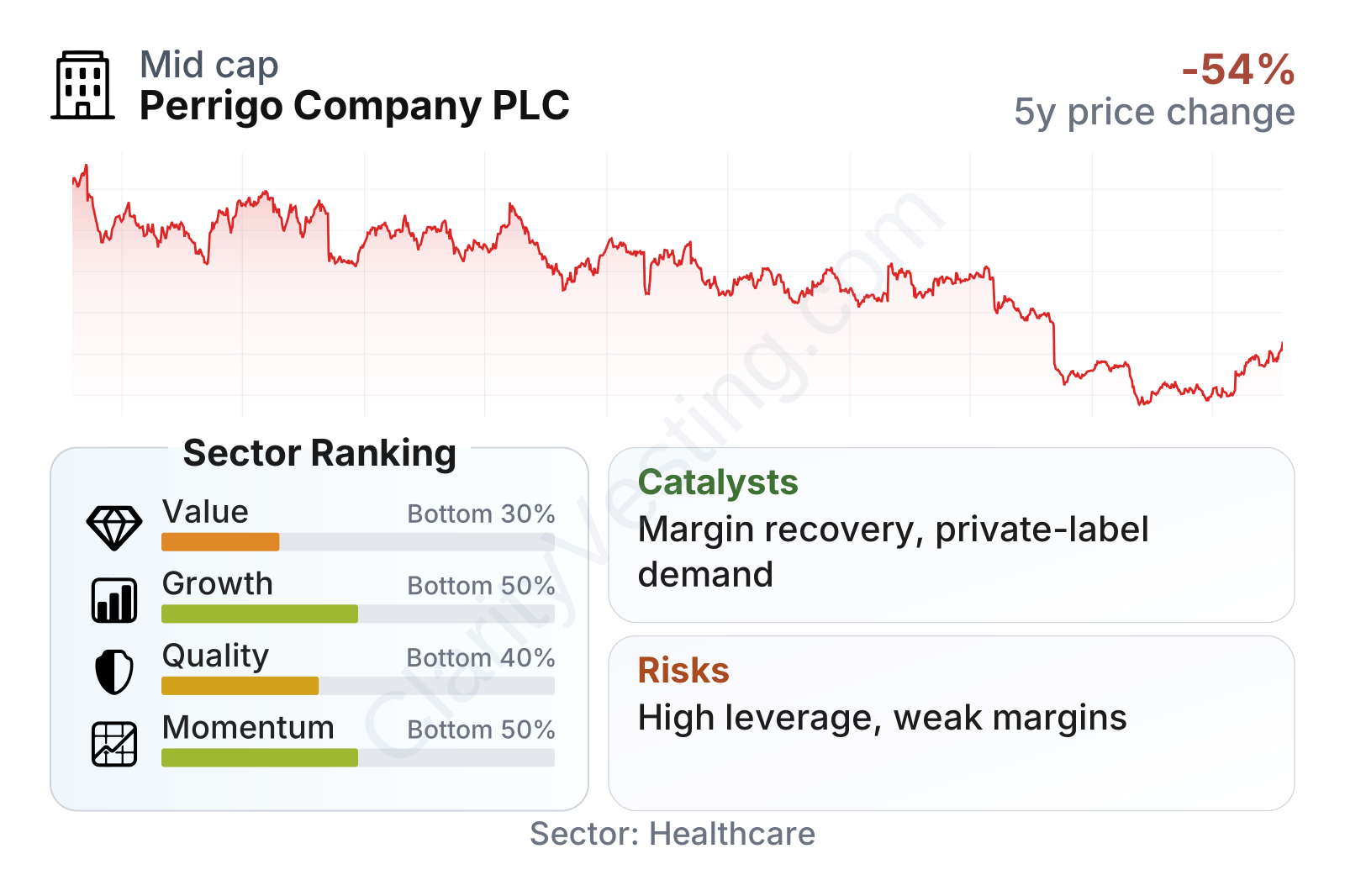
Perrigo is a mid-sized healthcare company with a stock that has been under strong long-term pressure, even though there has been a rebound over the last six months. Relative to the healthcare sector, the company screens weak on growth, profitability, and balance-sheet quality, while looking optically cheap on some valuation measures such as price-to-book and free-cash-flow yield. That mix usually signals that the market is discounting business stress rather than simply overlooking the company.
The latest profile also shows unusually high income yield and a below-market volatility level, but those figures need to be read carefully. A high dividend yield can reflect a falling share price as much as generous cash returns, and Perrigo’s negative earnings and weak returns on capital reduce the comfort that would normally come with an income-focused profile.
Growth
Perrigo operates in the consumer health and self-care market, which is a structurally attractive area over the long run. Aging populations, healthcare cost pressure, and consumer preference for treating minor conditions without a doctor visit all support demand for over-the-counter products. Store brands can also gain share when households become more price-conscious, because retailer-owned products are typically cheaper than leading brands.
That broader sector backdrop is constructive, but Perrigo’s own recent growth record has been much less convincing. Revenue growth turned negative in 2024 and remained negative through the more recent periods shown, placing the company below the sector median. This does not necessarily mean demand has disappeared, but it suggests that portfolio changes, category weakness, pricing pressure, mix effects, or execution challenges have outweighed the underlying benefits of the market.
The company’s strategy still has a clear industrial logic. Perrigo is centered on everyday self-care categories where consumers repeatedly purchase familiar products and retailers value dependable supply. The business also has room to benefit from innovation in adjacent categories, international expansion, and a larger role for retailer brands in household healthcare baskets. If management can stabilize volumes and improve category mix, even modest sales growth could matter because the company already has scale in sourcing, manufacturing, and distribution.
Cash generation is one of the more encouraging elements. Free cash flow has remained positive, although it has come down from stronger levels reached earlier. That matters because cash flow gives Perrigo more flexibility to manage debt, support dividends, invest in product launches, and absorb operational disruptions better than an income statement alone might suggest.
A practical near-term catalyst is the possibility of margin recovery if cost discipline, pricing, and product mix improve after a difficult period. Another is retailer demand for affordable health products during periods of consumer budget pressure, which can support private-label penetration. Recent corporate communications have also emphasized portfolio focus and operational execution, which indicates management is trying to simplify the business around categories where Perrigo has stronger positions.
Risks
This article is for informational purposes only and does not constitute financial advice. Some content is AI-generated. See Disclaimer


