Stock Analysis · PROG Holdings Inc (PRG)
Overview
PROG Holdings Inc is a consumer finance and lease-to-own company best known for helping customers acquire household goods, electronics, furniture, appliances, jewelry, and mobile devices when they may not qualify for traditional credit. Its main operating brands include Progressive Leasing, which offers lease-to-own solutions through retail partners and e-commerce channels, and Vive Financial, which provides second-look revolving credit products. In simple terms, the company sits between retailers and shoppers: retailers gain access to customers who might otherwise leave without making a purchase, while consumers gain another way to pay over time.
The business is heavily tied to merchants that sell durable consumer products, especially in categories where many purchases are discretionary but still important for households. PROG earns money from lease and finance charges, merchant relationships, and servicing activities tied to these payment solutions. The company’s model depends on underwriting risk well, keeping losses under control, and maintaining strong retailer partnerships.
Based on recent company disclosures, revenue is primarily concentrated in one segment.
- Progressive Leasing: approximately 85% to 90% of total revenue. This is the core business and includes lease-to-own transactions offered through large retail partner networks, stores, and online checkouts.
- Vive Financial: approximately 10% to 15% of total revenue. This business offers revolving credit products, mainly to consumers who may fall outside prime credit categories.
- Other and corporate activities: a very small share of revenue, if any, depending on the reporting period.
The multi-year income flow shows a business that remained sizeable even through a difficult 2022-2023 period. Revenue moved from roughly $2.7 billion in 2021 to about $2.4 billion to $2.5 billion more recently, while profitability weakened and then partially recovered. That pattern suggests the company has meaningful operating resilience, but also that earnings can swing when consumer conditions or underwriting outcomes change.
Key Figures
| Metric | Value | Sector ⓘ |
|---|---|---|
| Date | Oct 17, 2026 | |
| Context | ||
| Sector | Industrials | |
| Industry | Rental & Leasing Services | |
| Market Cap ⓘ | $1.22B | |
| Beta ⓘ | 1.78 | |
Value (Cheapness) | ||
| P/E Ratio ⓘ | 9.80 | 22.10 |
| P/B Ratio ⓘ | 1.51 | 1.97 |
| FCF Yield ⓘ | 14.16% | 6.38% |
| Dividend Yield ⓘ | 1.77% | 1.94% |
| EBIT / EV ⓘ | 11.14% | 4.79% |
| PEG ⓘ | 0.93 | |
Growth (Business expansion) | ||
| Revenue Growth ⓘ | 22.30% | 9.30% |
| RPS Growth (5Y CAGR) ⓘ | 9.80% | 7.81% |
| EPS Growth (5Y CAGR) ⓘ | -1.89% | -13.06% |
| BVPS Growth (5Y CAGR) ⓘ | 15.43% | 6.14% |
| Margin Growth (5Y Trend) ⓘ | -8.34% | 0.88% |
| FCF Growth (5Y CAGR) ⓘ | 8.28% | 11.01% |
| DPS Growth (5Y CAGR) ⓘ | 64.41% | 9.48% |
Quality (Business durability) | ||
| ROIC (Latest) ⓘ | 11.14% | 10.84% |
| ROA (Latest) ⓘ | 8.16% | 5.41% |
| ROIC (5Y Median) ⓘ | 13.62% | 9.38% |
| ROA (5Y Median) ⓘ | 9.40% | 4.95% |
| Net Debt / EBIT (Latest) ⓘ | 3.45 | 2.08 |
| Net Debt / EBIT (5Y Median) ⓘ | 2.01 | 2.27 |
| Net Debt / EBITDA (Latest) ⓘ | 0.45 | 1.39 |
| Net Debt / Assets ⓘ | 39.15% | 19.28% |
| EBITDA / Interest ⓘ | 37.81 | 9.58 |
| Operating Margin (Latest) ⓘ | 9.21% | 10.50% |
| Operating Margin (5Y Median) ⓘ | 8.88% | 10.29% |
| Debt to Equity (Latest) ⓘ | 110.15% | 65.48% |
| Profit Margin (Latest) ⓘ | 5.61% | 6.67% |
| Free Cash Flow (Latest) ⓘ | $172.42M | |
Momentum (Price trend) | ||
| 3Y Return ⓘ | +3.29% | +61.68% |
| 12M Return (excl. last month) ⓘ | +6.93% | +12.58% |
| 6M Return ⓘ | -1.72% | 0.00% |
| Price vs. 200-Day MA ⓘ | -15.84% | +0.02% |
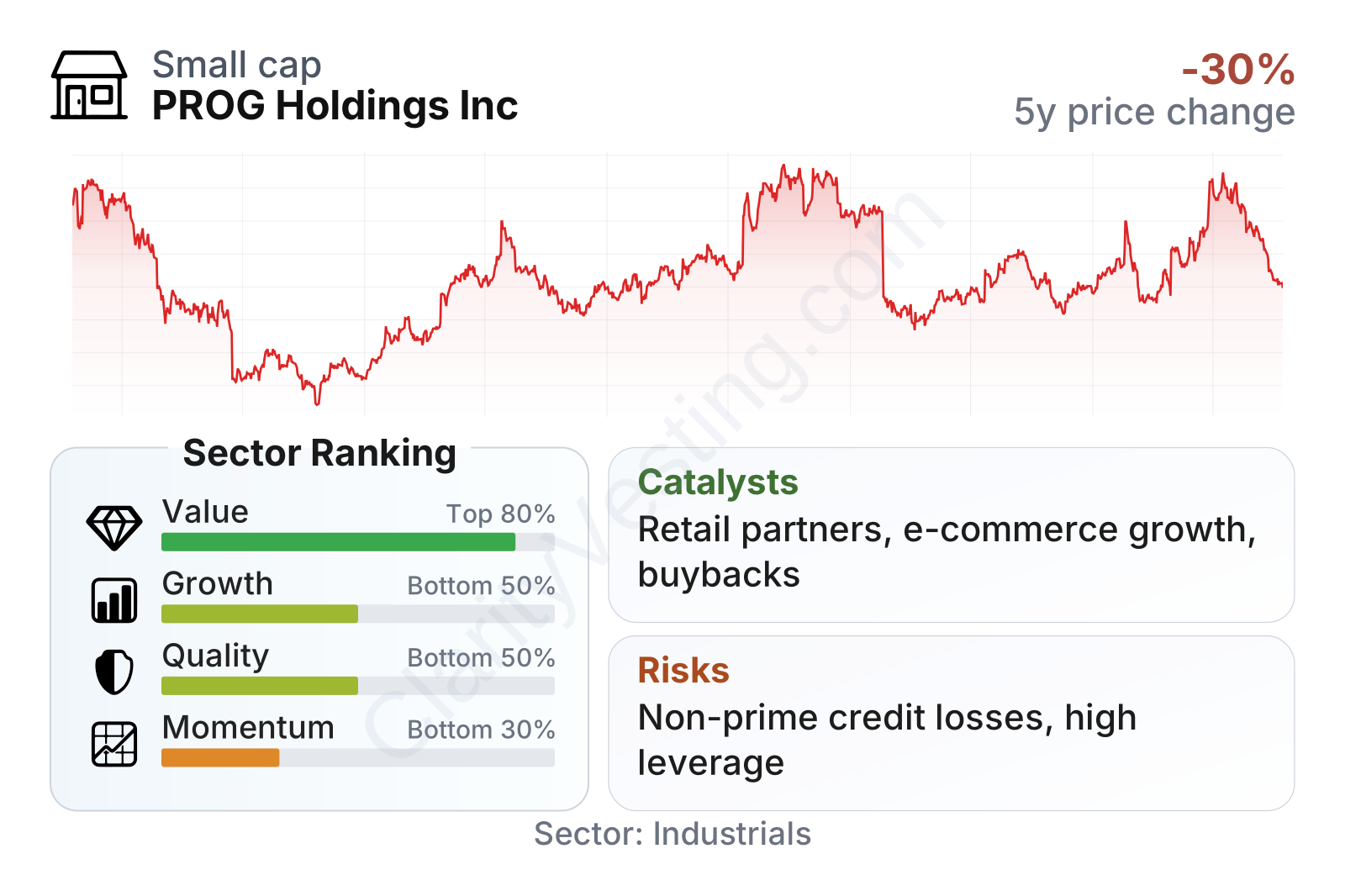
At a high level, PROG is a mid-sized company with a stock that has been volatile over the past several years. The latest factor summary points to a business that screens well on valuation, less well on market momentum, and more mixed on growth and quality. Compared with the broader sector, the shares trade on a clearly lower earnings multiple while also showing a notably stronger free cash flow yield. That usually means the market is demanding a discount because it sees meaningful uncertainty around future performance.
The quality picture is not weak across the board, but it is uneven. Returns on assets and long-term returns on invested capital compare reasonably well with sector medians, yet leverage is higher than many peers and profit margins are below sector norms. That combination is important: PROG generates real cash, but it does so in a business where credit performance and funding discipline matter a lot.
Growth
PROG operates in a part of consumer finance that can keep growing because a large group of U.S. households remains underserved by traditional lenders. Lease-to-own and second-look credit products can expand when retailers want higher approval rates and shoppers need payment flexibility. This is not a high-tech hypergrowth niche, but it is a structurally relevant one, especially in periods when tighter bank lending leaves more consumers outside standard credit boxes.
The company’s strategy also makes practical sense for future growth. Its main advantage is distribution: embedding financing offers into retailer and e-commerce checkouts can create repeat usage without requiring PROG to build a large direct-to-consumer storefront. Growth therefore depends less on opening branches and more on adding merchants, improving digital decisioning, increasing application approvals without taking excessive losses, and cross-selling additional products through existing relationships.
Revenue trends have been choppy rather than smooth. After several quarters of contraction through 2022 and 2023, growth improved during 2024, softened again late in 2025, and turned positive again in early 2026. The latest year-over-year increase is ahead of the sector median, which suggests the top line has regained some traction, but the path has not been linear. For a long-term view, that matters because it shows demand is real, yet sensitive to the consumer cycle.
Cash generation is one of the more constructive elements in the picture. Free cash flow has stayed solid over time and recently moved back toward the upper end of its recent range. With trailing free cash flow in the high hundreds of millions over the last twelve months depending on period measurement, the company appears capable of funding operations, supporting capital returns, and managing debt without relying on constant external financing. That is especially valuable in a lending-related business where headline earnings can move around more than cash generation.
Potential catalysts for future expansion include additional retailer partnerships, broader e-commerce penetration, normalization in consumer credit trends, and continued scaling of Vive Financial. Recent company updates have also highlighted ongoing share repurchases and capital return activity, which can amplify per-share results if operating performance stabilizes. More broadly, if merchants continue prioritizing conversion rates and alternative approval paths, PROG’s embedded payment offerings could remain relevant.
Risks
This article is for informational purposes only and does not constitute financial advice. Some content is AI-generated. See Disclaimer


