Stock Analysis · Procept Biorobotics Corp (PRCT)
Overview
PROCEPT BioRobotics is a medical device company focused on robot-assisted treatment for benign prostatic hyperplasia, or BPH, a common enlargement of the prostate that can cause urinary problems in older men. Its core product is the AQUABEAM robotic platform, used with the Aquablation therapy procedure. In simple terms, the company sells a system that helps surgeons remove prostate tissue with a high level of precision while aiming to reduce some of the trade-offs seen in more traditional treatments.
The business model is typical of many medical technology companies: first place the robotic system in hospitals, then generate recurring revenue from each procedure and related services. That means growth depends not only on selling more systems, but also on increasing procedure volume at hospitals that already use the platform.
Based on company filings, revenue is mainly generated from the following sources:
- Recurring handpiece and consumables revenue: approximately 55% to 65% of total revenue in recent periods. This includes the single-use or procedure-linked items used each time Aquablation therapy is performed.
- Robotic system sales: approximately 25% to 35% of revenue. This reflects sales of the AQUABEAM platform to hospitals and other care centers.
- Service and other revenue: approximately 5% to 10% of revenue. This generally includes service contracts, support, and related items tied to installed systems.
Over the last several years, the business mix appears to be improving in a useful way: recurring revenue has become more important as the installed base has grown. At the same time, total revenue has expanded sharply, and gross profit has risen faster than revenue in dollar terms. The main pressure point is operating expense, especially selling and administrative spending, which remains very high because the company is still investing heavily in commercial expansion.
Key Figures
| Metric | Value | Sector ⓘ |
|---|---|---|
| Date | Oct 17, 2026 | |
| Context | ||
| Sector | Healthcare | |
| Industry | Medical Devices | |
| Market Cap ⓘ | $1.02B | |
| Beta ⓘ | 0.92 | |
Value (Cheapness) | ||
| P/E Ratio ⓘ | N/A | 24.79 |
| P/B Ratio ⓘ | 2.97 | 3.08 |
| FCF Yield ⓘ | -12.36% | 3.15% |
| Dividend Yield ⓘ | N/A | 1.94% |
| EBIT / EV ⓘ | -11.96% | 0.57% |
| PEG ⓘ | N/A | |
Growth (Business expansion) | ||
| Revenue Growth ⓘ | 19.30% | 7.45% |
| RPS Growth (5Y CAGR) ⓘ | 62.83% | 8.61% |
| EPS Growth (5Y CAGR) ⓘ | -14.95% | -17.81% |
| BVPS Growth (5Y CAGR) ⓘ | 1.89% | 3.72% |
| Margin Growth (5Y Trend) ⓘ | N/A | -0.62% |
| FCF Growth (5Y CAGR) ⓘ | N/A | 1.04% |
| DPS Growth (5Y CAGR) ⓘ | N/A | 6.77% |
Quality (Business durability) | ||
| ROIC (Latest) ⓘ | -20.16% | 3.24% |
| ROA (Latest) ⓘ | -22.15% | 3.01% |
| ROIC (5Y Median) ⓘ | -22.62% | 4.60% |
| ROA (5Y Median) ⓘ | -25.85% | 1.89% |
| Net Debt / EBIT (Latest) ⓘ | N/A | 1.34 |
| Net Debt / EBIT (5Y Median) ⓘ | N/A | 1.84 |
| Net Debt / EBITDA (Latest) ⓘ | N/A | 1.00 |
| Net Debt / Assets ⓘ | -31.38% | 5.45% |
| EBITDA / Interest ⓘ | N/A | 9.64 |
| Operating Margin (Latest) ⓘ | -31.42% | 9.27% |
| Operating Margin (5Y Median) ⓘ | -74.82% | 7.38% |
| Debt to Equity (Latest) ⓘ | 22.79% | 28.58% |
| Profit Margin (Latest) ⓘ | -32.54% | 3.59% |
| Free Cash Flow (Latest) ⓘ | -$125.97M | |
Momentum (Price trend) | ||
| 3Y Return ⓘ | -41.71% | +42.80% |
| 12M Return (excl. last month) ⓘ | -45.14% | +18.50% |
| 6M Return ⓘ | -25.01% | +7.57% |
| Price vs. 200-Day MA ⓘ | -26.64% | +5.12% |
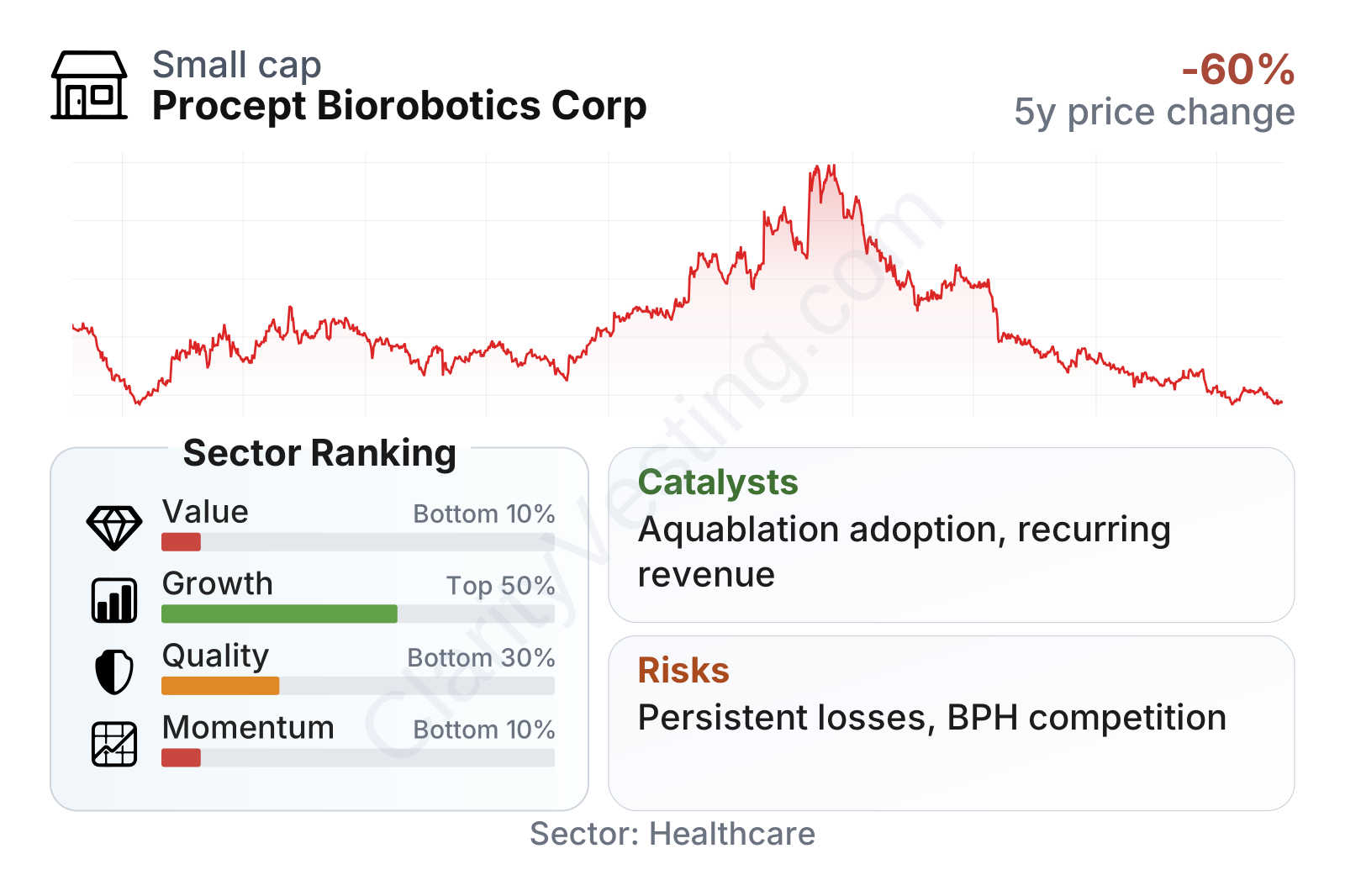
PROCEPT remains a relatively small public healthcare company by market value, and the stock has been very volatile. After a strong run into early 2025, the share price fell sharply through 2025 and into 2026. That weak market performance contrasts with the company’s revenue growth, which has remained well above the sector median. In the factor summary, growth looks solid, but value, quality, and momentum all rank poorly versus the broader healthcare group. In practical terms, the market is still treating PROCEPT as a high-expectation growth company that has not yet converted scale into durable profitability.
Growth
PROCEPT operates in a part of healthcare with attractive long-term demand drivers. BPH is common, prevalence rises with age, and the patient pool should benefit from aging demographics over time. That gives the company exposure to a large and recurring clinical need rather than a one-time medical trend. The broader robotic surgery and minimally invasive treatment markets are also expanding, which supports long-term interest in technologies that can improve precision, recovery time, and physician workflow.
The company’s strategy for growth is straightforward and logical. It is building an installed base of robotic systems, increasing surgeon adoption, and then benefiting from repeat procedures that drive recurring consumables revenue. This model can become more powerful over time because each new system creates future procedure opportunities. The company has also emphasized clinical data, urologist training, and hospital adoption, which are important in medical devices where physician confidence and reimbursement support can strongly influence usage.
Revenue growth has slowed from the extraordinary rates seen in earlier years, but it still remains strong in absolute terms and well above the sector median. Recent year-over-year growth has been around the high teens to low twenties, after much faster expansion during the company’s earlier scaling phase. That deceleration is normal for a business moving from a smaller base to a larger one. The more important question is whether procedure growth, system placements, and recurring revenue continue to expand together, and so far the overall direction still points upward.
Cash generation is another area to watch closely. Free cash flow is still negative, but the losses have improved from deeper outflows in prior periods. That suggests the business is moving in the right direction financially even though it has not yet crossed into self-funded growth. For a medical device company still building commercial reach, that is a meaningful but incomplete sign of progress.
Recent company updates have highlighted continued expansion of the installed base, higher procedure volumes, and ongoing efforts to broaden the physician and hospital footprint. Another important growth catalyst is the company’s work to expand awareness of Aquablation therapy through clinical results and guideline support. In medtech, strong evidence can matter as much as sales effort because hospitals and surgeons often adopt more confidently when long-term outcomes are documented.
Risks
This article is for informational purposes only and does not constitute financial advice. Some content is AI-generated. See Disclaimer


