Stock Analysis · Porch Group Inc (PRCH)
Overview
Porch Group Inc is a technology-driven company built around the homeownership journey. It started by offering software and services to companies involved in moving and setting up homes, then expanded into homeowners insurance and related protection products. Today, Porch combines insurance underwriting, policy distribution, and home-services data to reach customers at the moment they move, buy, finance, inspect, or maintain a home.
The business has become increasingly centered on insurance. Based on the company’s recent annual reporting and segment disclosures, revenue is primarily generated from premiums and insurance-related activities, with a smaller contribution from software, data, and service fees tied to home professionals and moving-related partners.
The main revenue sources appear to be:
- Insurance premiums and insurance services: approximately 70% to 80% of revenue. This includes homeowners insurance and related carrier activities, commissions, policy services, and other insurance-linked income.
- Vertical software and data services: approximately 15% to 25% of revenue. These products serve home inspectors, mortgage companies, title firms, utilities, and other housing ecosystem participants.
- Consumer home services and other fees: approximately 5% to 10% of revenue. This includes moving-related services, warranties, and additional homeowner support offerings.
What makes Porch different is the way these pieces connect. The company tries to acquire customers through home-related transaction points, then cross-sell higher-value insurance products. That model is meant to lower customer acquisition cost compared with insurers that rely more heavily on broad advertising.
Over the last several years, the income profile has shifted meaningfully. Revenue has expanded from under $200 million in 2021 to roughly $480 million in 2025, while operating results moved from large losses to positive operating income and positive net income in 2025. Gross profit also improved sharply, suggesting a more favorable business mix and better execution after earlier restructuring.
The financial flow over time shows a business that was once spending far ahead of revenue but has recently become more disciplined. Operating expenses are still substantial, especially selling, administrative, and product development costs, yet the gap between gross profit and bottom-line earnings narrowed significantly by 2024 and 2025.
Key Figures
| Metric | Value | Sector ⓘ |
|---|---|---|
| Date | Oct 17, 2026 | |
| Context | ||
| Sector | Financial Services | |
| Industry | Insurance - Property & Casualty | |
| Market Cap ⓘ | $1.87B | |
| Beta ⓘ | 3.16 | |
Value (Cheapness) | ||
| P/E Ratio ⓘ | N/A | 12.26 |
| P/B Ratio ⓘ | N/A | 1.23 |
| FCF Yield ⓘ | 4.48% | 10.40% |
| Dividend Yield ⓘ | N/A | 3.02% |
| EBIT / EV ⓘ | 3.03% | 8.14% |
| PEG ⓘ | N/A | |
Growth (Business expansion) | ||
| Revenue Growth ⓘ | 11.70% | 9.35% |
| RPS Growth (5Y CAGR) ⓘ | 22.74% | 12.19% |
| EPS Growth (5Y CAGR) ⓘ | N/A | -9.53% |
| BVPS Growth (5Y CAGR) ⓘ | N/A | 4.99% |
| Margin Growth (5Y Trend) ⓘ | N/A | -3.86% |
| FCF Growth (5Y CAGR) ⓘ | N/A | 4.81% |
| DPS Growth (5Y CAGR) ⓘ | -70.70% | 8.79% |
Quality (Business durability) | ||
| ROIC (Latest) ⓘ | 4.01% | 9.49% |
| ROE (Latest) ⓘ | N/A | 13.90% |
| ROA (Latest) ⓘ | -0.70% | 1.55% |
| ROIC (5Y Median) ⓘ | -17.19% | 7.86% |
| ROE (5Y Median) ⓘ | -105.64% | 12.17% |
| ROA (5Y Median) ⓘ | -13.75% | 1.30% |
| Net Debt / EBIT (Latest) ⓘ | 3.46 | 0.96 |
| Net Debt / EBIT (5Y Median) ⓘ | N/A | 0.73 |
| Net Debt / EBITDA (Latest) ⓘ | 2.38 | 0.92 |
| Operating Margin (Latest) ⓘ | 12.44% | 22.30% |
| Operating Margin (5Y Median) ⓘ | -23.58% | 24.63% |
| Debt to Equity (Latest) ⓘ | -3424.44% | 58.56% |
| Profit Margin (Latest) ⓘ | -2.62% | 26.57% |
| Free Cash Flow (Latest) ⓘ | $83.67M | |
Momentum (Price trend) | ||
| 3Y Return ⓘ | +2578.35% | +88.33% |
| 12M Return (excl. last month) ⓘ | -9.12% | +19.38% |
| 6M Return ⓘ | +136.16% | +4.75% |
| Price vs. 200-Day MA ⓘ | +52.21% | +3.50% |
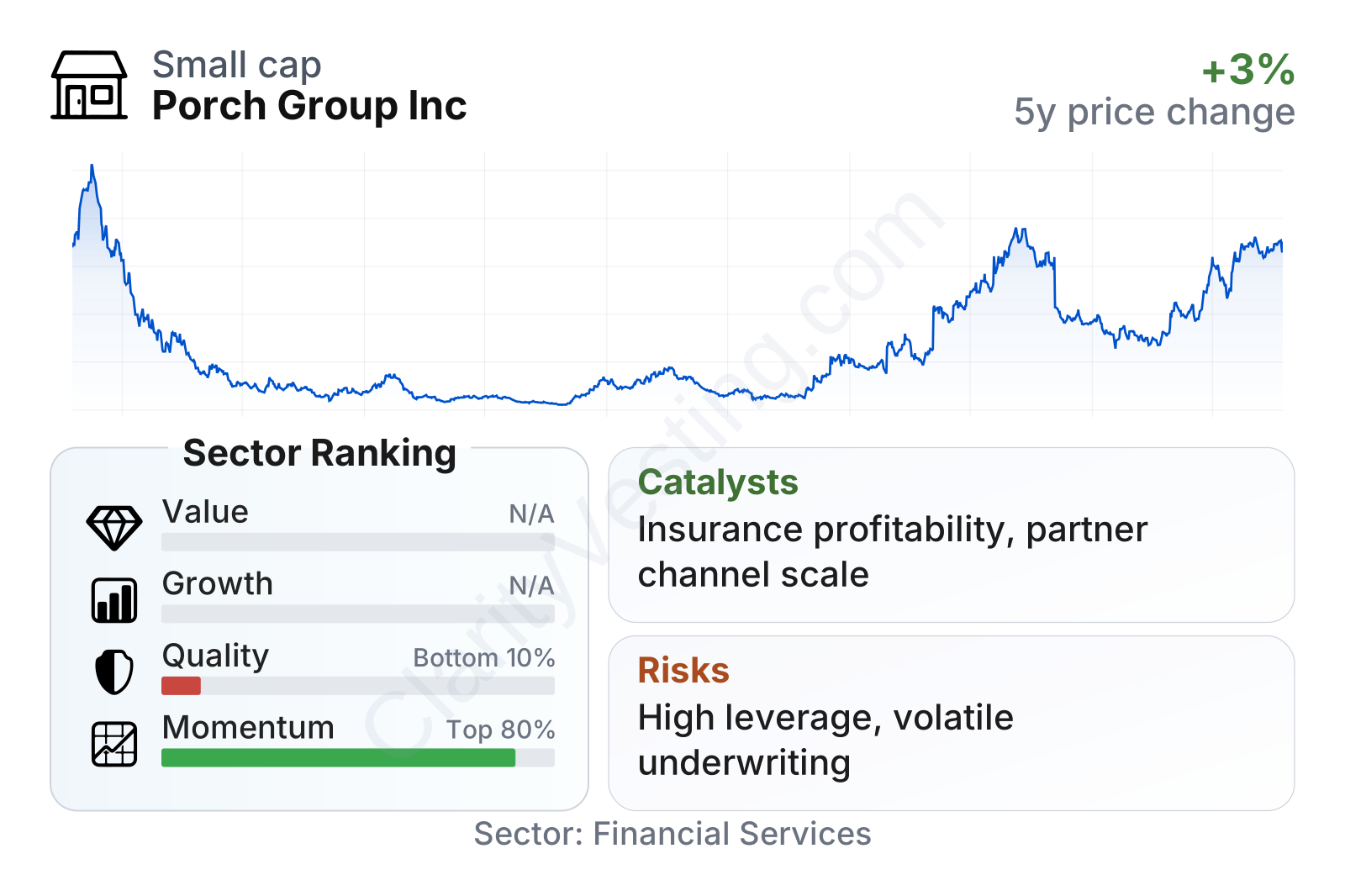
Porch is now a mid-sized public company with a market value around the low single-digit billions of dollars, but its share price behavior remains unusually volatile. The stock collapsed from the high teens in 2021 to below $1 in 2023, then rebounded sharply through 2025 and into 2026. That pattern reflects both improving fundamentals and a market that still assigns a high level of uncertainty to the business.
The latest metrics present a mixed picture. Growth indicators are generally better than many sector peers, with revenue growth above the sector median and a strong multi-year rise in revenue per share. Momentum has also improved considerably after the company’s turnaround. By contrast, quality measures still lag badly, largely because profitability and returns on capital were weak for several years and leverage remains heavier than the sector norm. Free cash flow has turned positive, which is important, but valuation measures do not look obviously cheap relative to the company’s remaining risk profile.
Growth
Porch operates in a part of the market that has room for long-term expansion. Housing transactions, mortgage activity, home maintenance, and property insurance are all large categories, and Porch’s strategy is built on connecting them. The broad idea is straightforward: if a company can identify customers at the exact moment they are making major home decisions, it has a better chance of selling insurance and related products efficiently.
That strategy makes industrial sense because homeownership creates recurring needs rather than one-time transactions. A customer may first appear through a move, inspection, or mortgage event, but insurance renewal, maintenance, protection plans, and related services can continue for years. If Porch can keep customer acquisition efficient and underwriting disciplined, the model has more durability than a simple lead-generation business.
A major positive development is the company’s improving earnings path.
Earnings per share have moved from deep losses in 2021 through 2024 toward roughly break-even and slightly positive territory in 2026. That does not prove that profitability is secure, but it does show that Porch is much closer to a sustainable earnings model than it was during its earlier high-loss phase.
Book value is more complicated.
Book value per share remains negative in the recent history shown, which limits the usefulness of traditional balance-sheet valuation methods. For a company in transition, that means the investment debate depends more on future earnings power, cash generation, and underwriting quality than on accounting net worth.
Recent company communications have highlighted continued focus on profitable insurance growth, adjusted EBITDA generation, and monetizing the company’s distribution advantage inside the home-buying and moving ecosystem. If execution remains steady, the strongest catalyst is simple: Porch no longer needs to prove only that revenue can grow; it now needs to prove that growth can convert into durable profit and cash flow.
Another meaningful opportunity comes from the embedded-distribution model. Traditional insurers often spend heavily on advertising to attract policyholders. Porch instead works through housing-related partners and events, which could become a structural advantage if the company keeps conversion rates high and loss ratios under control. In a sector where customer acquisition cost matters enormously, this can be a significant differentiator.
Risks
This article is for informational purposes only and does not constitute financial advice. Some content is AI-generated. See Disclaimer


