Stock Analysis · Praxis Precision Medicines Inc (PRAX)
Overview
Praxis Precision Medicines is a clinical-stage biotechnology company focused on disorders of the central nervous system. In simple terms, it develops medicines for brain-related conditions where abnormal electrical signaling plays a major role. Its pipeline is centered on epilepsy, movement disorders, and certain neuropsychiatric conditions, with programs designed to target specific biological mechanisms rather than offering broad, one-size-fits-all treatments.
The company’s business is still in the development stage, so it does not yet have recurring product sales from approved medicines. That matters because the investment case depends much more on clinical trial progress, regulatory milestones, and future commercial potential than on current operating profits.
Recent filings show that revenue has been very limited and uneven, which is typical for a biotech company before commercialization. Revenue has mainly come from collaboration-related or other non-product sources rather than from selling medicines to patients.
- Collaboration and license-related revenue: approximately the vast majority of revenue when present. This can include upfront payments, research support, milestone recognition, or accounting related to partnerships.
- Product revenue: approximately 0% at this stage, as Praxis does not yet have a broadly commercialized drug generating meaningful ongoing sales.
- Other revenue: typically minimal, with no major recurring contribution disclosed as a core operating driver.
The broader financial pattern is also clear: spending is dominated by research and development. Over the last several years, most cash outflow has gone into advancing the drug pipeline, while administrative costs have been much smaller by comparison. That is a normal structure for a biotech company, but it also means valuation is tied heavily to future scientific execution.
The financial flow highlights a business that remains driven by R&D spending rather than sales. Revenue has stayed small and inconsistent, while research expense has expanded sharply as the company moved more programs forward.
Key Figures
| Metric | Value | Sector ⓘ |
|---|---|---|
| Date | Oct 24, 2026 | |
| Context | ||
| Sector | Healthcare | |
| Industry | Biotechnology | |
| Market Cap ⓘ | $7.16B | |
| Beta ⓘ | 2.81 | |
Value (Cheapness) | ||
| P/E Ratio ⓘ | N/A | 25.42 |
| P/B Ratio ⓘ | 5.62 | 3.08 |
| FCF Yield ⓘ | -4.27% | 3.12% |
| Dividend Yield ⓘ | N/A | 1.85% |
| EBIT / EV ⓘ | -4.76% | 0.56% |
| PEG ⓘ | N/A | |
Growth (Business expansion) | ||
| Revenue Growth ⓘ | 1349.10% | 7.50% |
| RPS Growth (5Y CAGR) ⓘ | N/A | 8.60% |
| EPS Growth (5Y CAGR) ⓘ | -42.64% | -17.73% |
| BVPS Growth (5Y CAGR) ⓘ | -18.54% | 3.72% |
| Margin Growth (5Y Trend) ⓘ | N/A | -0.57% |
| FCF Growth (5Y CAGR) ⓘ | N/A | 0.96% |
| DPS Growth (5Y CAGR) ⓘ | N/A | 6.69% |
Quality (Business durability) | ||
| ROIC (Latest) ⓘ | -26.63% | 3.17% |
| ROA (Latest) ⓘ | -37.97% | 2.98% |
| ROIC (5Y Median) ⓘ | -55.37% | 4.56% |
| ROA (5Y Median) ⓘ | -64.03% | 1.87% |
| Net Debt / EBIT (Latest) ⓘ | N/A | 1.34 |
| Net Debt / EBIT (5Y Median) ⓘ | N/A | 1.86 |
| Net Debt / EBITDA (Latest) ⓘ | N/A | 1.00 |
| Net Debt / Assets ⓘ | -34.07% | 5.06% |
| EBITDA / Interest ⓘ | N/A | 9.55 |
| Operating Margin (Latest) ⓘ | N/A | 9.25% |
| Operating Margin (5Y Median) ⓘ | -5037.88% | 7.33% |
| Debt to Equity (Latest) ⓘ | 0.08% | 26.68% |
| Profit Margin (Latest) ⓘ | N/A | 3.34% |
| Free Cash Flow (Latest) ⓘ | -$306.00M | |
Momentum (Price trend) | ||
| 3Y Return ⓘ | +1441.19% | +51.61% |
| 12M Return (excl. last month) ⓘ | +522.08% | +19.90% |
| 6M Return ⓘ | -23.24% | +10.10% |
| Price vs. 200-Day MA ⓘ | -17.87% | +6.44% |
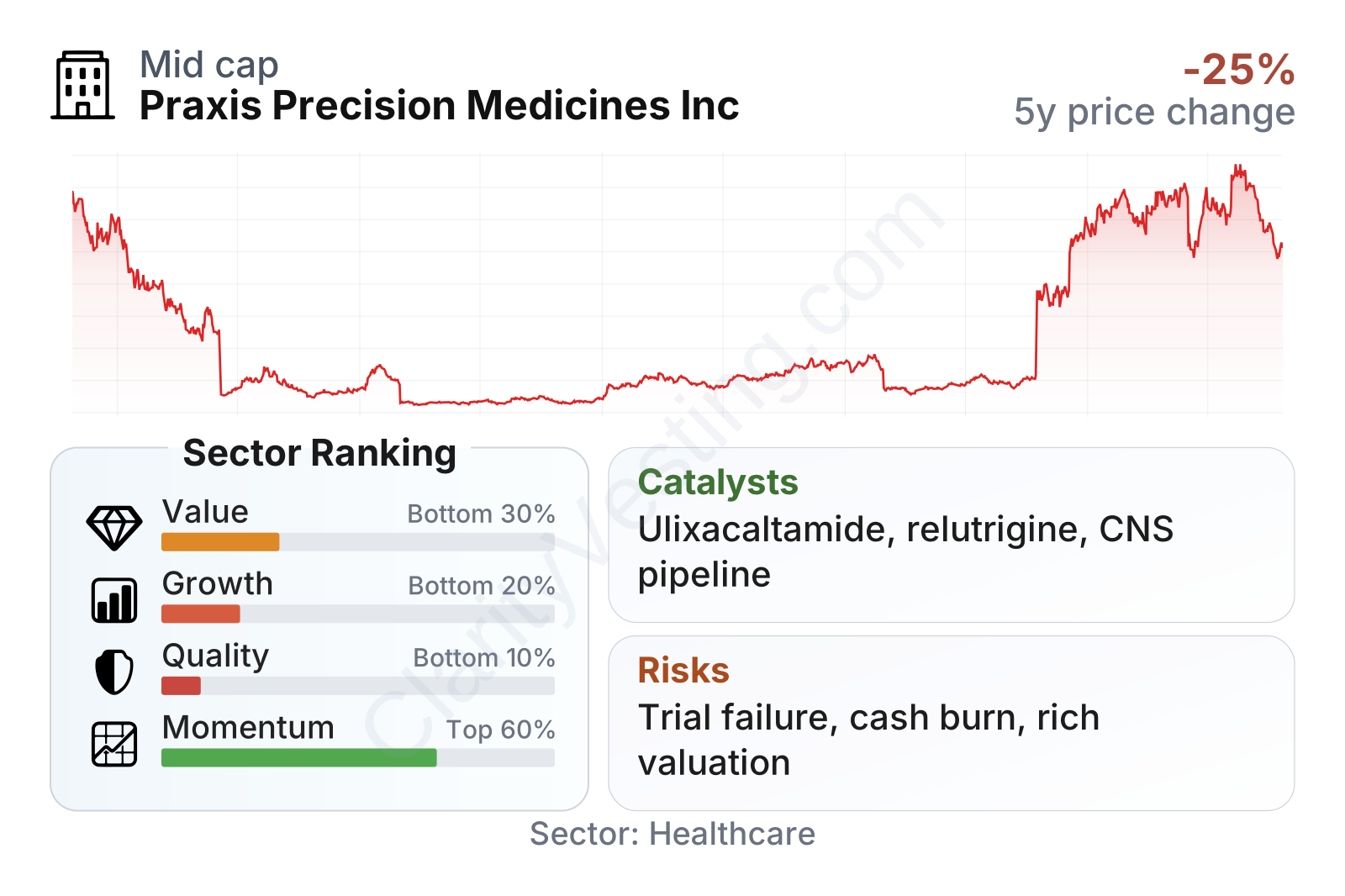
Praxis is now a mid-sized biotech by market value, but its operating profile still looks like an early-stage developer rather than a mature pharmaceutical company. The stock has shown unusually strong long-term price appreciation and very high volatility, while value, growth, and quality measures remain weak versus much of the healthcare sector because profits and cash generation are still negative.
The table also points to an important contrast. Balance-sheet leverage is extremely low, which is a strength, but profitability metrics remain deeply negative. In other words, the company has avoided loading up on debt, yet it has not reached the stage where its science translates into durable earnings power.
Growth
Praxis operates in a sector with meaningful long-term demand. Neurological and neuropsychiatric disorders remain areas of major unmet medical need, and successful treatments can become important assets because many of these conditions are chronic, serious, and underserved. Drug development in the brain has historically been difficult, but that is also why a company that produces strong clinical data can create significant value.
The company’s strategy makes sense on paper. Instead of spreading itself across many unrelated areas, Praxis has concentrated on central nervous system disorders where ion channels and neural circuit dysfunction are central to disease. That focus gives the pipeline a more coherent scientific identity than many smaller biotech companies.
A major growth catalyst is the company’s lead asset, ulixacaltamide, being developed for essential tremor. Essential tremor is common, current treatment options are often inadequate, and a successful late-stage program could give Praxis access to a large commercial opportunity. The company has also advanced relutrigine in epilepsy and continues to build a broader neuroscience pipeline, which creates multiple shots on goal rather than reliance on a single program.
Another positive point is that recent market enthusiasm appears tied to clinical and pipeline progress rather than to financial engineering. The stock’s dramatic rerating over the past year suggests investors have attached much higher probability to future commercial value after important development updates.
The recent revenue growth percentages look dramatic, but they should be interpreted carefully. Because the starting revenue base was very small, even modest collaboration-related changes can produce very large growth rates. For Praxis, pipeline advancement matters much more than top-line growth at this stage.
Cash flow remains decisively negative and has become more negative as development activity increased. That is not unusual for a clinical-stage biotech, but it does mean future growth will likely require continued access to capital unless a partnership, milestone payment, or eventual product launch changes the picture.
Recent company updates have continued to emphasize clinical execution, regulatory planning, and progress across key programs. For a business like Praxis, those are the developments that can most meaningfully change long-term prospects because they affect both the probability of approval and the potential size of future revenue.
Risks
This article is for informational purposes only and does not constitute financial advice. Some content is AI-generated. See Disclaimer


