Stock Analysis · Permian Resources Corporation (PR)
Overview
Permian Resources Corporation is an independent oil and gas producer focused on the Permian Basin, the most important shale-producing region in the United States. The company drills wells, produces crude oil, natural gas, and natural gas liquids, and then sells those commodities into the market. Its asset base is concentrated in West Texas and New Mexico, which matters because scale in one basin can lower operating costs, simplify infrastructure, and make drilling programs more efficient.
Like most exploration and production companies, Permian Resources does not rely on many different business lines. Revenue mainly comes from selling what it produces from its wells. Based on recent annual reporting, the mix is heavily weighted toward oil, with gas and natural gas liquids providing additional cash flow.
- Oil sales: approximately 60% to 70% of total revenue. This is the largest earnings driver because oil generally carries a much higher realized price than gas on an energy-equivalent basis.
- Natural gas liquids sales: approximately 15% to 25% of total revenue. This category includes products such as propane, butane, and related liquids separated during processing.
- Natural gas sales: approximately 10% to 20% of total revenue. This is the most price-sensitive segment because U.S. gas prices can be volatile and regionally constrained.
The business model is straightforward: acquire acreage, drill and complete wells, keep production growing where returns justify it, and convert operating cash flow into reinvestment, debt reduction, and shareholder distributions. Over the last several years, the company has also expanded through mergers and acquisitions, using consolidation to build a larger and more connected position in the Permian.
The long-term pattern in its financial structure shows strong revenue expansion from 2021 through 2025, with profitability scaling up as the company grew. Even so, earnings remain tied to commodity prices, so annual results can move sharply even when production volumes are stable.
One notable takeaway is that revenue increased materially over the past few years while operating expenses did not rise at the same pace, which points to improving scale. Net income also stayed solid through the more recent period despite fluctuations in gross profit, highlighting the benefit of a larger production base and operating discipline.
Key Figures
| Metric | Value | Sector ⓘ |
|---|---|---|
| Date | Oct 24, 2026 | |
| Context | ||
| Sector | Energy | |
| Industry | Oil & Gas E&P | |
| Market Cap ⓘ | $20.80B | |
| Beta ⓘ | 0.65 | |
Value (Cheapness) | ||
| P/E Ratio ⓘ | 16.34 | 15.40 |
| P/B Ratio ⓘ | 1.77 | 1.71 |
| FCF Yield ⓘ | 7.76% | 8.24% |
| Dividend Yield ⓘ | 2.50% | 3.52% |
| EBIT / EV ⓘ | 7.71% | 7.45% |
| PEG ⓘ | 1.25 | |
Growth (Business expansion) | ||
| Revenue Growth ⓘ | 55.10% | 26.85% |
| RPS Growth (5Y CAGR) ⓘ | 19.23% | 6.78% |
| EPS Growth (5Y CAGR) ⓘ | -4.83% | -14.41% |
| BVPS Growth (5Y CAGR) ⓘ | 7.75% | 6.08% |
| Margin Growth (5Y Trend) ⓘ | 13.47% | 0.55% |
| FCF Growth (5Y CAGR) ⓘ | 29.44% | 2.75% |
| DPS Growth (5Y CAGR) ⓘ | 511.01% | 16.79% |
Quality (Business durability) | ||
| ROIC (Latest) ⓘ | 8.87% | 11.30% |
| ROA (Latest) ⓘ | 6.89% | 6.00% |
| ROIC (5Y Median) ⓘ | 12.97% | 10.35% |
| ROA (5Y Median) ⓘ | 5.32% | 5.46% |
| Net Debt / EBIT (Latest) ⓘ | 1.84 | 1.64 |
| Net Debt / EBIT (5Y Median) ⓘ | 2.23 | 1.82 |
| Net Debt / EBITDA (Latest) ⓘ | 0.81 | 1.08 |
| Net Debt / Assets ⓘ | 16.23% | 17.29% |
| EBITDA / Interest ⓘ | 14.19 | 9.53 |
| Operating Margin (Latest) ⓘ | 28.43% | 16.21% |
| Operating Margin (5Y Median) ⓘ | 36.80% | 20.55% |
| Debt to Equity (Latest) ⓘ | 26.11% | 52.27% |
| Profit Margin (Latest) ⓘ | 21.52% | 8.79% |
| Free Cash Flow (Latest) ⓘ | $1.61B | |
Momentum (Price trend) | ||
| 3Y Return ⓘ | +86.46% | +68.93% |
| 12M Return (excl. last month) ⓘ | +71.58% | +42.90% |
| 6M Return ⓘ | +26.65% | +9.18% |
| Price vs. 200-Day MA ⓘ | +25.64% | +9.87% |
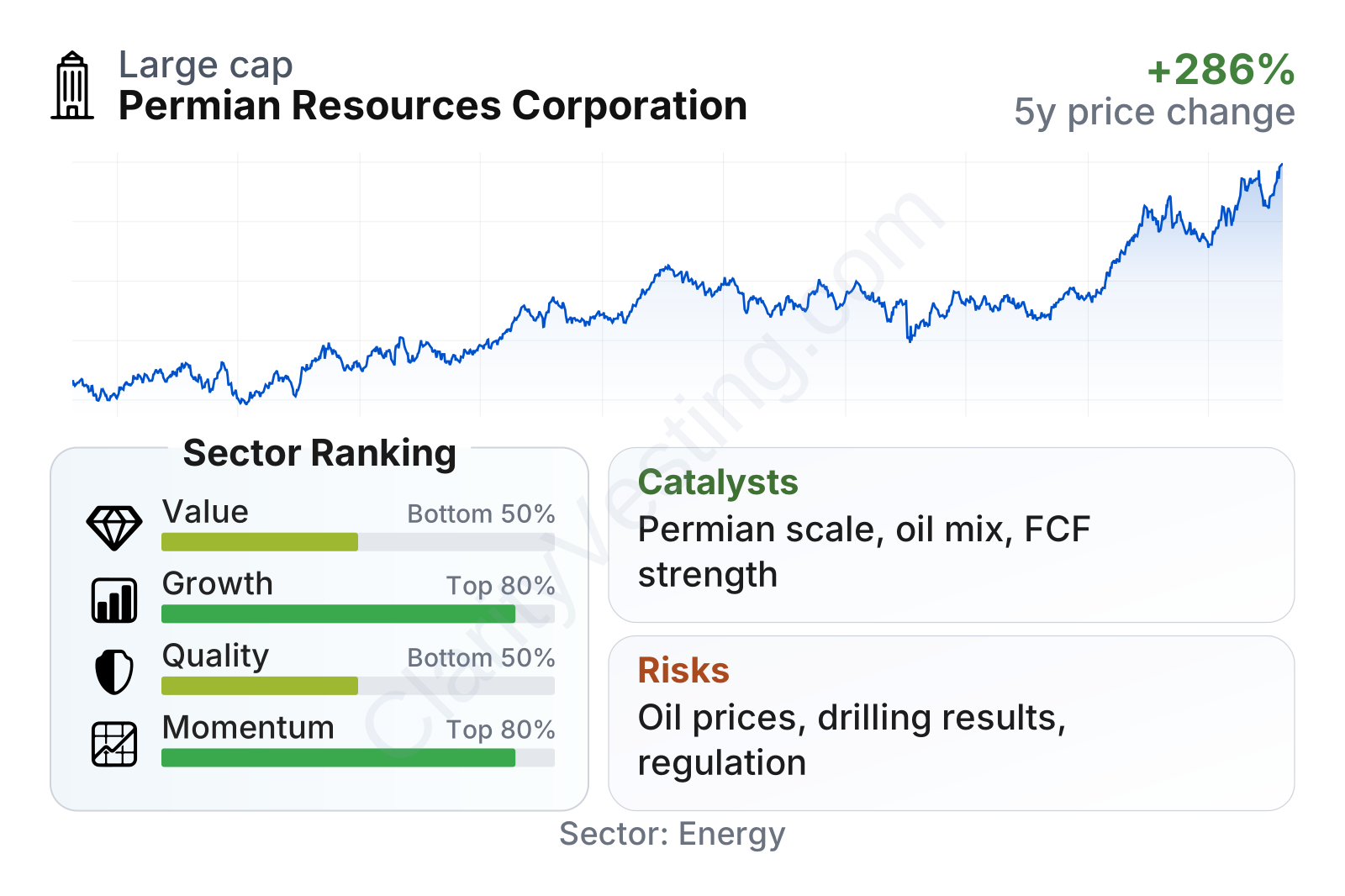
Permian Resources sits in the large independent producer category rather than the supermajor group. The stock has shown a strong multiyear advance, although with the volatility that is normal for upstream energy names. On current metrics, the company’s growth profile looks stronger than much of the sector, while profitability is also better than many peers. Valuation is not deeply discounted relative to the group, but it is not stretched either. Financial leverage appears moderate, with debt measures generally better than the sector median.
Growth
Permian Resources operates in a sector that is mature globally but still capable of selective growth in the U.S. shale market, especially in the Permian Basin. That basin remains one of the lowest-cost and most productive oil regions in North America, which gives well-positioned operators room to keep generating attractive returns even when commodity prices are not at peak levels. For a company like Permian Resources, growth is less about entering a new industry and more about drilling high-return inventory, improving recovery per well, and expanding scale through disciplined acquisitions.
The company’s strategy is coherent for this environment. It has concentrated acreage, a meaningful oil mix, and enough size to spread fixed costs across a broader production base. That supports efficient development and gives management flexibility to shift capital toward the best-return zones. Public company materials in 2026 also continued to emphasize operating efficiency, capital discipline, and returning cash while maintaining development activity.
Revenue growth has been uneven, which is common in this industry, but the broader trend remains strong. The latest year-over-year reading rebounded sharply, and the company’s recent growth rate is well above the sector median. Over a five-year period, revenue per share growth has also outpaced many peers, suggesting that expansion has not been driven only by dilution or temporary pricing effects.
Free cash flow has been positive and meaningful, although not perfectly linear from period to period. That is an important point for long-term analysis: the business is producing real cash after capital spending, not just accounting profits. The latest trailing cash generation is sizable, and the multiyear trend remains favorable even after a softer patch. This gives the company room to fund drilling, support dividends, and keep leverage under control.
A practical catalyst is continued consolidation in the Permian. Permian Resources has already used acquisitions to increase scale, and in a fragmented basin that can still create opportunities. Another catalyst is better well productivity or lower development costs through improved completion designs and infrastructure integration. In addition, if U.S. oil prices remain supportive, the company’s oil-heavy mix can translate into disproportionately strong cash flow. Recent company communications in 2026 have also pointed to ongoing execution on development plans and portfolio optimization, which could further improve returns if sustained.
Risks
This article is for informational purposes only and does not constitute financial advice. Some content is AI-generated. See Disclaimer


