Stock Analysis · Perpetua Resources Corp (PPTA)
Overview
Perpetua Resources Corp is a U.S. mining development company focused on the Stibnite Gold Project in Idaho. The company is not yet a producing miner. Its main objective is to permit, finance, build, and eventually operate a mine that is expected to produce both gold and antimony, while also carrying out a large environmental restoration effort at the historic Stibnite site. That makes Perpetua unusual: it is being valued not on current operating profits, but on the future potential of one major asset.
Because the project is still in development, Perpetua currently has no meaningful recurring commercial revenue from mining operations. Recent filings show revenue has been effectively 0%, which is typical for a pre-production resource company. The business today is centered on project advancement rather than sales.
The future economic profile of the company is expected to come primarily from the Stibnite project. Based on company technical disclosures, the future revenue mix would be driven by metals produced from that single mine.
- Gold — expected to be the largest future source of revenue, likely representing the clear majority of project economics. This would come from mined and processed gold-bearing ore.
- Antimony — expected to be the second-largest source of revenue. Antimony is used in defense, flame retardants, and certain industrial applications, and is strategically important because the U.S. has limited domestic supply.
- Silver — a smaller by-product contribution if recovered with the main ore stream.
In practical terms, Perpetua is currently an asset-development company with a strategic mineral angle rather than a conventional operating miner with diversified cash flow.
The long-term pattern is straightforward: no operating revenue yet, while expenses have risen as permitting, studies, staffing, and project preparation have intensified. Losses have widened as the company moves closer to a construction decision, which is common at this stage but means the investment case depends heavily on future execution.
Key Figures
| Metric | Value | Sector ⓘ |
|---|---|---|
| Date | Oct 17, 2026 | |
| Context | ||
| Sector | Basic Materials | |
| Industry | Other Precious Metals & Mining | |
| Market Cap ⓘ | $2.42B | |
| Beta ⓘ | 0.81 | |
Value (Cheapness) | ||
| P/E Ratio ⓘ | N/A | 16.90 |
| P/B Ratio ⓘ | 3.02 | 1.65 |
| FCF Yield ⓘ | -9.83% | 5.76% |
| Dividend Yield ⓘ | N/A | 2.13% |
| EBIT / EV ⓘ | -10.16% | 6.30% |
| PEG ⓘ | N/A | |
Growth (Business expansion) | ||
| Revenue Growth ⓘ | N/A | 11.10% |
| RPS Growth (5Y CAGR) ⓘ | N/A | 4.49% |
| EPS Growth (5Y CAGR) ⓘ | N/A | -13.47% |
| BVPS Growth (5Y CAGR) ⓘ | 45.76% | 5.51% |
| Margin Growth (5Y Trend) ⓘ | N/A | -1.54% |
| FCF Growth (5Y CAGR) ⓘ | N/A | 0.37% |
| DPS Growth (5Y CAGR) ⓘ | N/A | 6.08% |
Quality (Business durability) | ||
| ROIC (Latest) ⓘ | -25.47% | 9.26% |
| ROA (Latest) ⓘ | -35.24% | 4.91% |
| ROIC (5Y Median) ⓘ | -18.52% | 7.70% |
| ROA (5Y Median) ⓘ | -20.57% | 3.86% |
| Net Debt / EBIT (Latest) ⓘ | N/A | 1.40 |
| Net Debt / EBIT (5Y Median) ⓘ | N/A | 1.70 |
| Net Debt / EBITDA (Latest) ⓘ | N/A | 0.95 |
| Net Debt / Assets ⓘ | -73.77% | 13.69% |
| EBITDA / Interest ⓘ | N/A | 12.34 |
| Operating Margin (Latest) ⓘ | N/A | 13.20% |
| Operating Margin (5Y Median) ⓘ | N/A | 11.80% |
| Debt to Equity (Latest) ⓘ | 0.51% | 40.56% |
| Profit Margin (Latest) ⓘ | N/A | 6.43% |
| Free Cash Flow (Latest) ⓘ | -$237.95M | |
Momentum (Price trend) | ||
| 3Y Return ⓘ | +363.47% | +68.89% |
| 12M Return (excl. last month) ⓘ | +30.20% | +30.21% |
| 6M Return ⓘ | -45.87% | -4.16% |
| Price vs. 200-Day MA ⓘ | -33.41% | -1.27% |
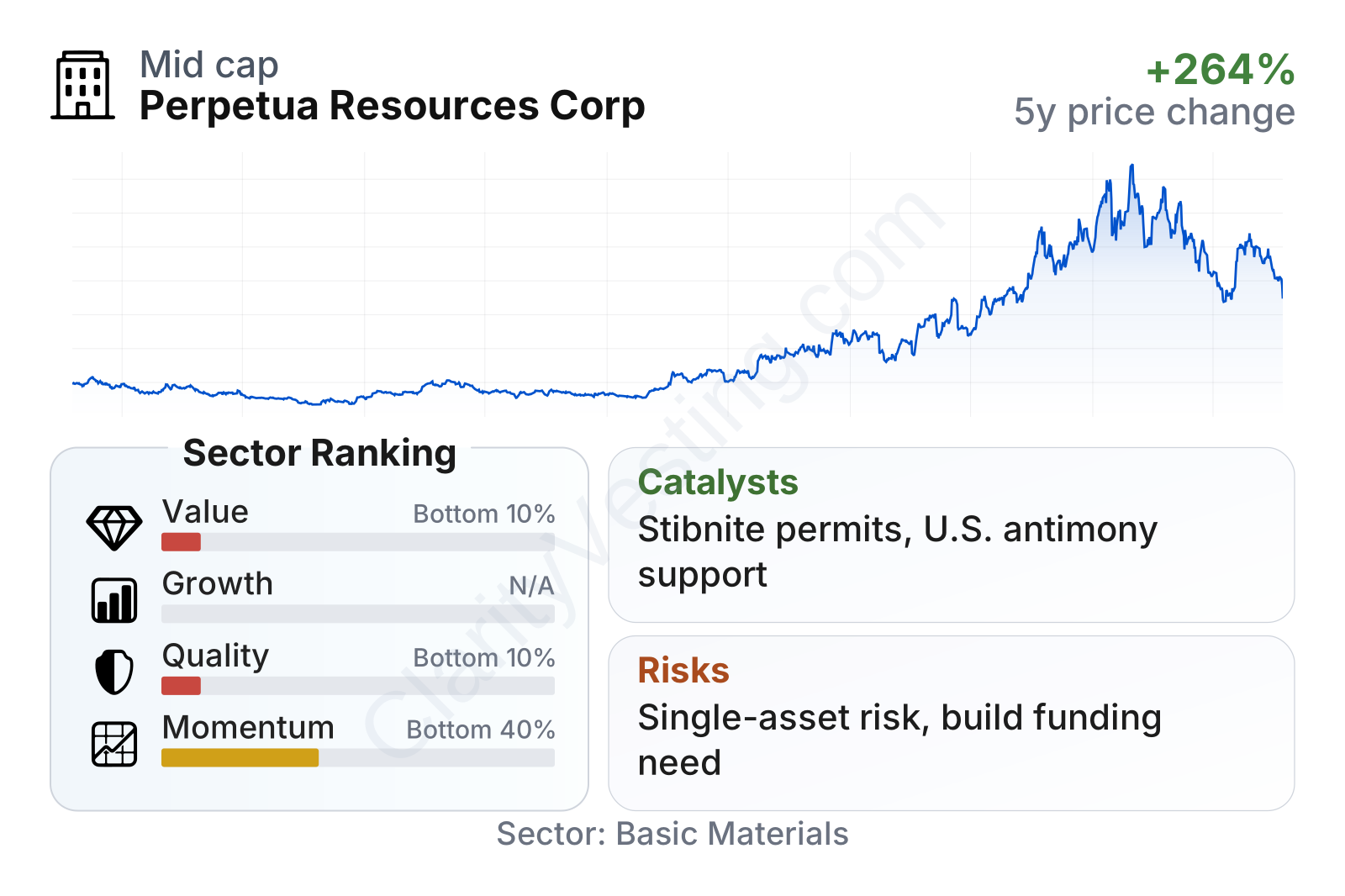
The broad picture is mixed. Perpetua is now a mid-sized development-stage mining company by market value, and its stock has delivered a very strong multi-year rise despite a notable pullback in recent months. On traditional valuation measures, it screens poorly because it has no earnings, no free cash flow, and no dividend. Quality metrics are also weak for the same reason: the company is still consuming capital rather than generating returns. One notable positive is the balance sheet structure, with very little debt compared with most mining peers.
Growth
Perpetua is exposed to two themes that could support long-term growth: gold and critical minerals. Gold remains a long-standing store-of-value commodity, while antimony has gained strategic importance because it is used in defense and industrial supply chains and the U.S. has very limited domestic production. That combination gives the company a potential growth angle that is broader than a standard single-metal mining project.
The company’s strategy is coherent for its stage of development. Rather than trying to operate multiple small assets, it is concentrating capital and management attention on one large U.S. project with permitting momentum and national strategic relevance. If that project reaches construction and then production, the shift in financial profile could be dramatic because Perpetua would move from no revenue to a meaningful production base from one asset.
A major catalyst has been U.S. government support tied to critical minerals and defense supply chains. The company has highlighted backing from federal agencies, including Department of Defense-related support for antimony supply development. That matters because antimony is one of the project’s distinguishing features and could improve access to funding, political support, and strategic interest.
Another important catalyst is permitting progress. In recent periods, the company has continued advancing the final federal and state approval process for the Stibnite Gold Project. For a development miner, permits are often the event that most changes the market’s view because they reduce uncertainty and open the door to financing and construction planning.
There is also a commodity-price lever. Higher gold prices can materially improve the economics of a future mine, while stronger attention to critical mineral security can increase the perceived value of domestic antimony exposure. Perpetua effectively sits at the intersection of both trends.
That said, growth is still conceptual rather than financial today. Free cash flow has become substantially more negative as the company spends more heavily to move the project forward. This does not invalidate the long-term opportunity, but it shows that the business is still in the capital-consuming phase and has not yet crossed into self-funding growth.
Risks
This article is for informational purposes only and does not constitute financial advice. Some content is AI-generated. See Disclaimer


