Stock Analysis · PPG Industries Inc (PPG)
Overview
PPG Industries is a global coatings and specialty materials company. In simple terms, it makes paints, coatings, sealants, and related products that protect and improve surfaces. Its products are used on houses, cars, airplanes, industrial equipment, packaging, roads, and many other everyday items. The company operates across North America, Europe, Asia-Pacific, and Latin America, and its business is tied to both new production and ongoing maintenance demand.
PPG’s revenue is primarily generated from coatings rather than commodity chemicals. Based on the company’s recent business structure, the main sources of revenue are approximately the following:
- Performance Coatings: about 60% of revenue. This includes architectural coatings sold through company-owned stores and independent dealers, protective and marine coatings for infrastructure and industrial assets, traffic solutions, and specialty coatings for repair and maintenance markets.
- Industrial Coatings: about 40% of revenue. This includes automotive original equipment manufacturer coatings, coatings for auto parts, packaging coatings, general industrial finishes, and aerospace coatings.
That mix matters because coatings tend to offer better margins and more product differentiation than many basic chemical categories. The business also benefits from recurring repainting, repair, and maintenance activity, which can make demand more resilient than one-time construction or manufacturing cycles alone.
The financial flow in recent years shows a business with fairly steady revenue, improving operating income, and tighter cost control after a weaker 2022. Gross profit has remained substantial even when sales were not growing quickly, which suggests pricing discipline and a product mix tilted toward higher-value applications.
Key Figures
| Metric | Value | Sector ⓘ |
|---|---|---|
| Date | Oct 03, 2026 | |
| Context | ||
| Sector | Basic Materials | |
| Industry | Specialty Chemicals | |
| Market Cap ⓘ | $23.57B | |
| Beta ⓘ | 1.06 | |
Value (Cheapness) | ||
| P/E Ratio ⓘ | 15.37 | 17.61 |
| P/B Ratio ⓘ | 2.82 | 1.77 |
| FCF Yield ⓘ | 5.97% | 5.87% |
| Dividend Yield ⓘ | 2.65% | 2.06% |
| EBIT / EV ⓘ | 7.56% | 6.43% |
| PEG ⓘ | 1.53 | |
Growth (Business expansion) | ||
| Revenue Growth ⓘ | 7.20% | 11.30% |
| RPS Growth (5Y CAGR) ⓘ | -0.10% | 4.46% |
| EPS Growth (5Y CAGR) ⓘ | -10.13% | -13.11% |
| BVPS Growth (5Y CAGR) ⓘ | 6.89% | 5.51% |
| Margin Growth (5Y Trend) ⓘ | 2.88% | -1.57% |
| FCF Growth (5Y CAGR) ⓘ | -0.59% | 0.55% |
| DPS Growth (5Y CAGR) ⓘ | 5.42% | 6.02% |
Quality (Business durability) | ||
| ROIC (Latest) ⓘ | 11.43% | 9.31% |
| ROA (Latest) ⓘ | 7.04% | 4.94% |
| ROIC (5Y Median) ⓘ | 11.75% | 7.91% |
| ROA (5Y Median) ⓘ | 5.99% | 3.93% |
| Net Debt / EBIT (Latest) ⓘ | 2.65 | 1.40 |
| Net Debt / EBIT (5Y Median) ⓘ | 2.51 | 1.70 |
| Net Debt / EBITDA (Latest) ⓘ | 2.13 | 0.91 |
| Net Debt / Assets ⓘ | 26.36% | 13.69% |
| EBITDA / Interest ⓘ | 10.91 | 11.93 |
| Operating Margin (Latest) ⓘ | 13.67% | 13.07% |
| Operating Margin (5Y Median) ⓘ | 11.93% | 11.86% |
| Debt to Equity (Latest) ⓘ | 88.35% | 40.43% |
| Profit Margin (Latest) ⓘ | 9.57% | 6.57% |
| Free Cash Flow (Latest) ⓘ | $1.41B | |
Momentum (Price trend) | ||
| 3Y Return ⓘ | -13.77% | +65.06% |
| 12M Return (excl. last month) ⓘ | +3.48% | +36.05% |
| 6M Return ⓘ | -1.14% | +1.89% |
| Price vs. 200-Day MA ⓘ | -5.92% | +1.03% |
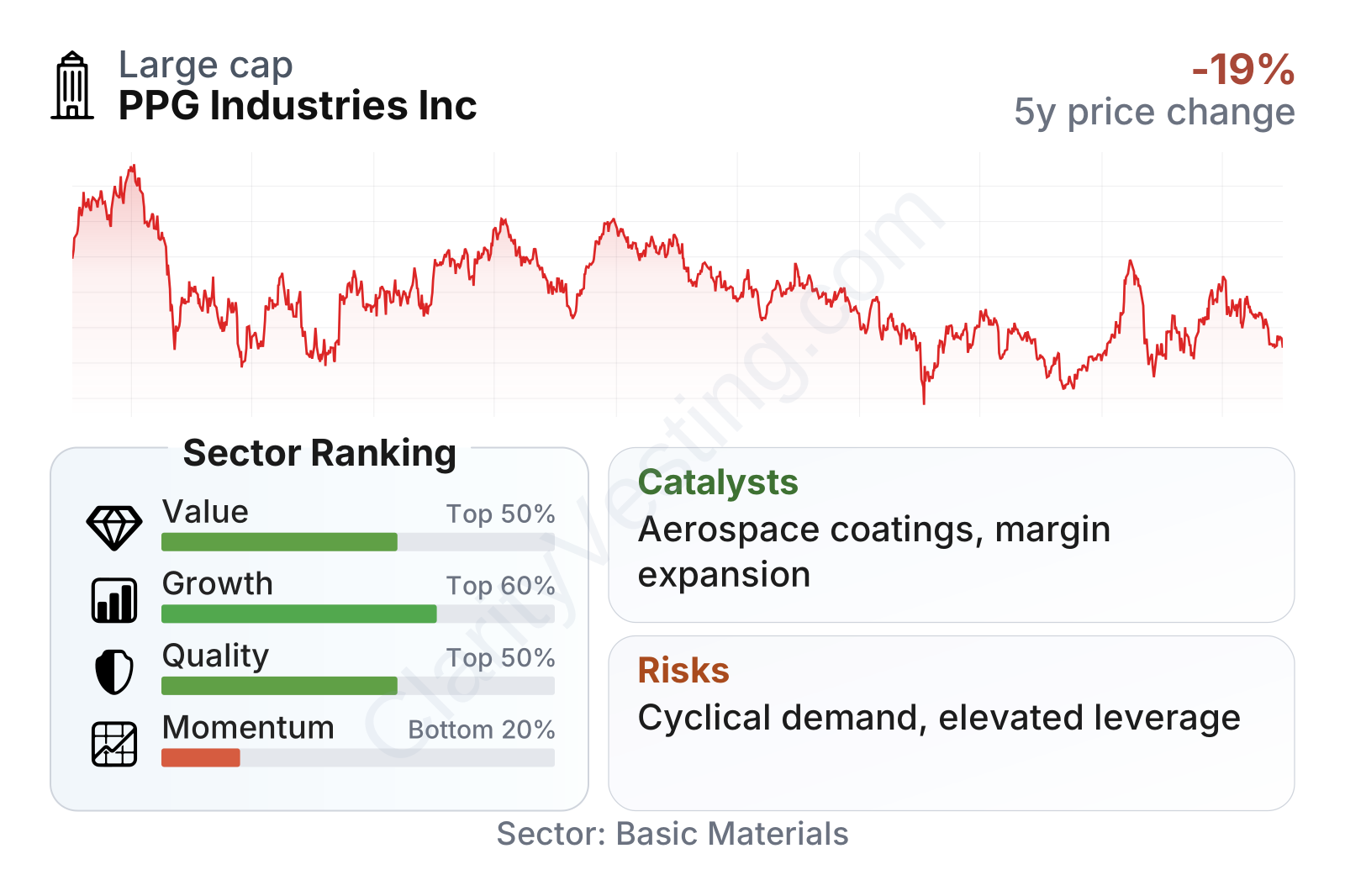
PPG is a large specialty chemicals company with a market value in the tens of billions of dollars and a share price profile that has been uneven over the last several years. The stock has recovered from earlier lows, but its momentum remains weaker than much of its sector. In the latest factor snapshot, valuation looks broadly moderate, quality is solid, growth is mixed, and recent market performance is relatively soft.
Several underlying signals stand out. Profitability metrics are above sector medians, with returns on capital and assets showing that PPG still converts its industrial footprint into respectable earnings. Free cash flow yield and dividend yield also compare reasonably well. At the same time, leverage is higher than many peers, and long-term revenue growth has not been especially strong, which helps explain why the market has not awarded the shares a premium multiple.
Growth
PPG operates in a sector with durable long-term demand rather than explosive expansion. Coatings are essential in construction, transportation, aerospace, packaging, and industrial production. Over time, these end markets tend to grow with economic activity, infrastructure spending, vehicle production, urbanization, and maintenance needs. That does not make the company a fast grower, but it does place it in categories where products are necessary and often repeatedly purchased.
Its current strategy is sensible for that kind of market. PPG has focused on productivity, margin improvement, portfolio discipline, and targeted growth in higher-value applications such as aerospace, protective coatings, and premium architectural products. This approach is more about improving the quality of revenue than simply pushing for volume. For a mature industrial company, that is often a more reliable path to compounding earnings over time.
Revenue growth has been inconsistent quarter to quarter, which reflects cyclical demand, portfolio changes, and a difficult comparison period in some parts of the business. More recently, year-over-year growth has returned to positive territory at a mid-single-digit to high-single-digit pace. That is not exceptional for the sector, but it does indicate that the company is not in structural decline.
Cash generation is another important part of the growth picture. Free cash flow has bounced around, but it remains meaningful in absolute dollars and supports dividends, debt service, restructuring, and selective capital allocation. For a coatings company, the ability to keep producing solid cash even in a mixed demand environment is a useful sign of business durability.
A relevant catalyst is aerospace and other specialized coatings markets, where qualification requirements, technical know-how, and long customer relationships can support pricing and market position. Infrastructure-related maintenance demand and repair-and-remodel activity are also helpful because they are less dependent on brand-new construction starts than many materials businesses. If industrial activity and transportation demand remain stable, these niches can continue supporting margin and earnings improvement.
Risks
This article is for informational purposes only and does not constitute financial advice. Some content is AI-generated. See Disclaimer