Stock Analysis · Perusahaan Gas Negara Persero (PPAAY)
Overview
Perusahaan Gas Negara Persero, usually known as PGN, is Indonesia’s main state-controlled natural gas infrastructure company. Through its operating subsidiaries, it transports, distributes, trades, and processes natural gas, and it also operates in supporting areas such as oil and gas transportation and regasification. In simple terms, PGN sits in the middle of the gas value chain: it buys or sources gas, moves it through pipelines and related infrastructure, and delivers it to industrial users, commercial customers, power generation, and other end markets.
Its business is important because natural gas remains a key transition fuel in Indonesia. It is cleaner than coal and fuel oil in many applications, but it still depends on regulation, domestic supply, and infrastructure buildout. PGN’s role is therefore not just selling gas volumes; it is also about owning strategic networks that are difficult to replicate.
The latest annual reporting shows that revenue is still heavily centered on gas-related activities. Based on the company’s reporting structure and business description, the main sources of revenue can be summarized as follows:
- Natural gas trading and distribution: approximately 70% to 85% of revenue. This includes gas purchased and resold to industrial, commercial, household, and power customers, as well as distribution through pipeline networks.
- Upstream oil and gas and related services: approximately 10% to 20% of revenue. This typically includes contributions from exploration, production interests, and supporting energy services within the group.
- Transmission, transportation, regasification, and other gas infrastructure services: approximately 5% to 10% of revenue. This includes pipeline transportation fees, LNG-related services, and other infrastructure-based activities.
What stands out is that PGN is not a high-margin software-like business; it is an infrastructure-heavy utility. Revenue can rise even when profitability is under pressure, especially if the company is selling more gas but at tighter spreads. That pattern has recently been visible: revenue has continued to edge higher over time, while earnings have been less stable.
The business mix shows a company with fairly steady top-line expansion over the past several years, but also a cost structure where most revenue is absorbed by gas procurement and operating costs. Interest expense has improved meaningfully, which supports earnings resilience, yet the final profit captured from each dollar of revenue remains modest.
Key Figures
| Metric | Value | Sector ⓘ |
|---|---|---|
| Date | Oct 17, 2026 | |
| Context | ||
| Sector | Utilities | |
| Industry | Utilities - Regulated Gas | |
| Market Cap ⓘ | $2.33B | |
| Beta ⓘ | 0.14 | |
Value (Cheapness) | ||
| P/E Ratio ⓘ | 8.12 | 17.28 |
| P/B Ratio ⓘ | 1.04 | 1.51 |
| FCF Yield ⓘ | 14.16% | 0.65% |
| Dividend Yield ⓘ | N/A | 3.77% |
| EBIT / EV ⓘ | 34.79% | 5.01% |
| PEG ⓘ | 0.39 | |
Growth (Business expansion) | ||
| Revenue Growth ⓘ | -3.80% | 6.10% |
| RPS Growth (5Y CAGR) ⓘ | 6.91% | 3.87% |
| EPS Growth (5Y CAGR) ⓘ | -32.60% | -11.30% |
| BVPS Growth (5Y CAGR) ⓘ | -7.18% | 4.23% |
| Margin Growth (5Y Trend) ⓘ | -7.84% | 3.57% |
| FCF Growth (5Y CAGR) ⓘ | N/A | -8.84% |
| DPS Growth (5Y CAGR) ⓘ | 100.50% | 4.84% |
Quality (Business durability) | ||
| ROIC (Latest) ⓘ | N/A | 6.53% |
| ROA (Latest) ⓘ | 3.85% | 3.20% |
| ROIC (5Y Median) ⓘ | 10.72% | 5.95% |
| ROA (5Y Median) ⓘ | 4.04% | 2.75% |
| Net Debt / EBIT (Latest) ⓘ | -0.50 | 7.13 |
| Net Debt / EBIT (5Y Median) ⓘ | 0.49 | 7.23 |
| Net Debt / EBITDA (Latest) ⓘ | -0.31 | 4.31 |
| Net Debt / Assets ⓘ | -4.79% | 38.42% |
| EBITDA / Interest ⓘ | 19.04 | 4.58 |
| Operating Margin (Latest) ⓘ | 15.00% | 20.83% |
| Operating Margin (5Y Median) ⓘ | 17.25% | 20.08% |
| Debt to Equity (Latest) ⓘ | 38.31% | 137.69% |
| Profit Margin (Latest) ⓘ | 6.19% | 11.37% |
| Free Cash Flow (Latest) ⓘ | $329.75M | |
Momentum (Price trend) | ||
| 3Y Return ⓘ | +43.50% | +52.37% |
| 12M Return (excl. last month) ⓘ | -20.99% | +8.84% |
| 6M Return ⓘ | -16.04% | -3.95% |
| Price vs. 200-Day MA ⓘ | +2.41% | -0.79% |
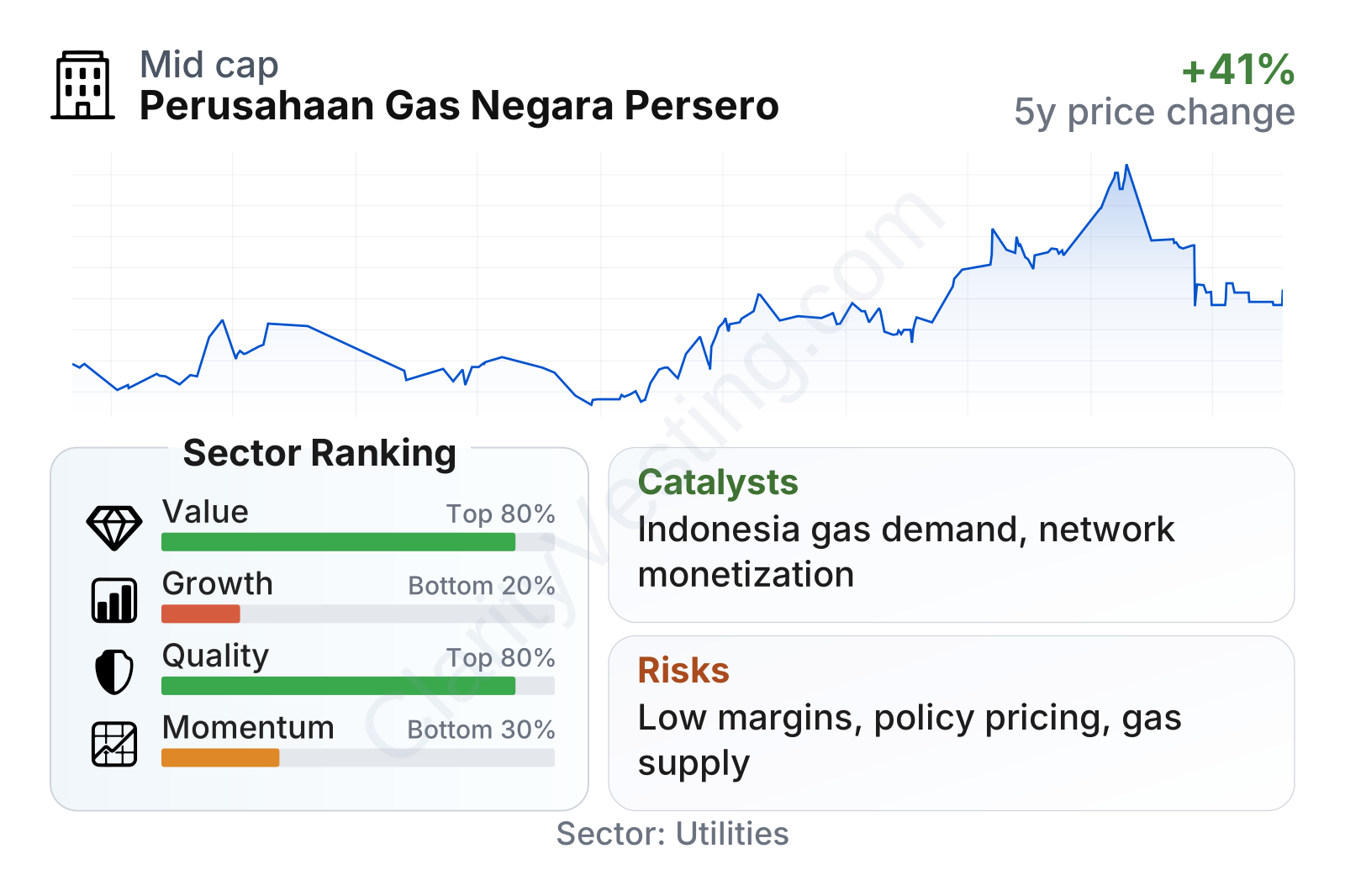
PGN currently looks inexpensive on common valuation measures compared with much of the regulated utility universe, while balance-sheet strength is clearly better than sector norms. The weaker area is growth and market momentum: recent revenue growth has slipped into negative territory, margins are below the sector median, and the stock’s recent performance has lagged peers despite a stronger longer-term operating base.
At a high level, PGN is a mid-sized utility with unusually low share-price volatility, shown by a beta close to zero. That often reflects the defensive nature of regulated gas infrastructure and the fact that the company operates in a strategic domestic market rather than in a highly cyclical export niche.
Growth
The sector backdrop is mixed but still relevant for long-term expansion. Natural gas is not a fast-growth industry in the same way as cloud computing or semiconductors, yet in Southeast Asia it still has a practical role in electricity, industrial fuel switching, urban distribution, and energy security. Indonesia continues to need domestic energy infrastructure, and PGN is one of the few platforms with national scale in gas networks, transportation, and downstream delivery.
The company’s strategy broadly makes industrial sense. It is built around expanding gas utilization, optimizing pipeline and midstream assets, and integrating supply, transport, and end-customer distribution. That is a logical path for a utility-like operator because owning the network can create recurring demand even when commodity conditions fluctuate. The strategic challenge is that growth depends not just on demand, but also on reliable domestic gas allocation, pricing frameworks, and project execution.
Revenue per share has trended upward over the last five years, which suggests the commercial footprint has expanded even if annual growth has not been smooth. That matters because it indicates PGN has been able to build business volume over time rather than simply relying on one-off pricing effects.
Cash generation has been more uneven. Free cash flow was very strong in parts of the last few years, then moved down materially in the latest trailing period. For a long-term assessment, this means PGN has demonstrated the ability to produce sizable cash, but that cash flow is not yet following a clean upward line. Investors looking at business durability would likely focus on whether lower recent cash generation reflects temporary working-capital movements, investment timing, or a more lasting squeeze on profitability.
Recent company updates and public policy direction continue to support the broad opportunity set: Indonesia has kept emphasizing domestic gas use, downstream industrial development, and energy infrastructure efficiency. For PGN, the most meaningful catalyst is not a single breakthrough technology but the gradual monetization of an entrenched gas network across a large economy. If more industrial users, commercial customers, and power-related demand are connected to that system, PGN has a built-in platform to capture the flow.
Risks
This article is for informational purposes only and does not constitute financial advice. Some content is AI-generated. See Disclaimer


