Stock Analysis · Powell Industries Inc (POWL)
Overview
Powell Industries is a U.S.-based electrical equipment company that designs, engineers, manufactures, and services systems used to distribute, control, and monitor electricity in complex industrial facilities. Its products are not consumer-facing. They are built for demanding environments such as oil and gas sites, petrochemical plants, electric utility infrastructure, data centers, mining operations, and transportation projects. In simple terms, Powell helps large industrial customers move power safely inside critical facilities and keep those systems operating reliably.
The company’s business is centered on custom-engineered electrical equipment rather than high-volume standardized products. Its offering includes integrated power control rooms, medium- and low-voltage switchgear, bus duct systems, motor control equipment, relays, automation and monitoring systems, and field services such as startup, testing, maintenance, and modernization. This makes Powell more of a project and solutions provider than a pure component manufacturer.
Based on recent annual disclosures, revenue is mainly tied to end markets rather than a few named products. Approximate revenue exposure is best understood through the markets the company serves:
- Oil and gas, petrochemical, and related process industries: likely the largest share, estimated at roughly 45% to 60% of revenue in recent years. This includes electrical systems for upstream, midstream, downstream, refining, LNG, and chemical facilities.
- Utilities and other electric infrastructure: estimated at roughly 20% to 30%. This covers equipment for power generation, substations, grid-related projects, and broader electrification work.
- Commercial and other industrial markets, including data centers, mining, transportation, and general industrial projects: estimated at roughly 15% to 30%. This part has become more important as power-intensive infrastructure demand has broadened beyond energy markets.
- Services, aftermarket, and modernization: a smaller portion of total sales, likely in the single- to low-double-digit percentage range within the mix, depending on project timing. This includes repairs, replacements, commissioning, and lifecycle support.
One notable feature of Powell’s revenue model is that project timing can create uneven quarterly results. Orders are often large, customized, and recognized over time, so backlog and execution matter as much as near-term sales.
The flow of the business over the last few years shows more than just rising revenue. Profitability has improved sharply as sales scaled up faster than operating costs. Revenue moved from a little over $500 million in fiscal 2022 to above $1.1 billion in fiscal 2025, while operating income and net income rose much faster, pointing to stronger project mix, better factory absorption, and firmer pricing.
Key Figures
| Metric | Value | Sector ⓘ |
|---|---|---|
| Date | Oct 24, 2026 | |
| Context | ||
| Sector | Industrials | |
| Industry | Electrical Equipment & Parts | |
| Market Cap ⓘ | $6.01B | |
| Beta ⓘ | 1.17 | |
Value (Cheapness) | ||
| P/E Ratio ⓘ | 31.60 | 22.29 |
| P/B Ratio ⓘ | 8.24 | 1.98 |
| FCF Yield ⓘ | 4.06% | 6.26% |
| Dividend Yield ⓘ | 0.22% | 1.92% |
| EBIT / EV ⓘ | 3.78% | 4.83% |
| PEG ⓘ | 2.10 | |
Growth (Business expansion) | ||
| Revenue Growth ⓘ | 8.90% | 9.30% |
| RPS Growth (5Y CAGR) ⓘ | 22.80% | 7.76% |
| EPS Growth (5Y CAGR) ⓘ | 54.90% | -13.17% |
| BVPS Growth (5Y CAGR) ⓘ | 19.82% | 6.13% |
| Margin Growth (5Y Trend) ⓘ | 20.87% | 0.74% |
| FCF Growth (5Y CAGR) ⓘ | N/A | 10.79% |
| DPS Growth (5Y CAGR) ⓘ | 0.67% | 9.41% |
Quality (Business durability) | ||
| ROIC (Latest) ⓘ | 26.96% | 10.75% |
| ROA (Latest) ⓘ | 15.17% | 5.41% |
| ROIC (5Y Median) ⓘ | 15.40% | 9.37% |
| ROA (5Y Median) ⓘ | 8.75% | 4.95% |
| Net Debt / EBIT (Latest) ⓘ | -2.62 | 2.04 |
| Net Debt / EBIT (5Y Median) ⓘ | -3.91 | 2.27 |
| Net Debt / EBITDA (Latest) ⓘ | -2.53 | 1.39 |
| Net Debt / Assets ⓘ | -44.86% | 19.27% |
| EBITDA / Interest ⓘ | N/A | 9.58 |
| Operating Margin (Latest) ⓘ | 20.77% | 10.49% |
| Operating Margin (5Y Median) ⓘ | 8.94% | 10.30% |
| Debt to Equity (Latest) ⓘ | 0.33% | 64.82% |
| Profit Margin (Latest) ⓘ | 16.49% | 6.67% |
| Free Cash Flow (Latest) ⓘ | $243.96M | |
Momentum (Price trend) | ||
| 3Y Return ⓘ | +600.15% | +67.77% |
| 12M Return (excl. last month) ⓘ | +89.65% | +12.05% |
| 6M Return ⓘ | -29.26% | 0.00% |
| Price vs. 200-Day MA ⓘ | -19.68% | +0.67% |
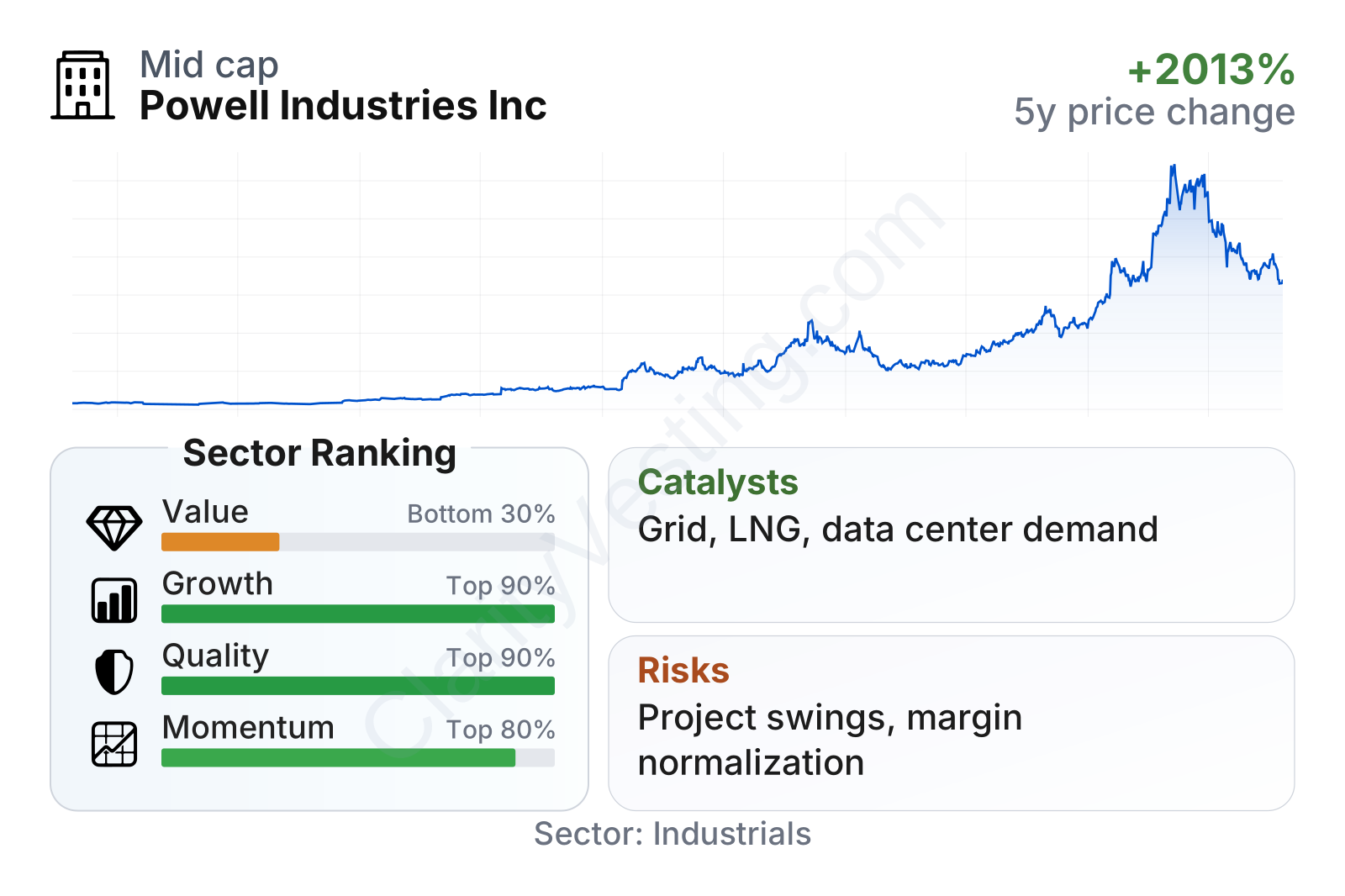
Powell stands out for quality and growth, both ranked near the top of its sector, while valuation looks much less favorable. Returns on capital and assets are well above sector norms, margins are strong, and the balance sheet is unusually clean with net cash rather than meaningful leverage. Growth over the last five years has also been exceptional, especially in earnings and revenue per share. The trade-off is that the market already recognizes these strengths: valuation multiples are above typical industrial peers, and the dividend yield is minimal. In other words, the operating profile looks elite, but the stock is no longer priced like an overlooked cyclical manufacturer.
The share-price history also highlights how dramatically market expectations have changed. After trading at modest levels only a few years ago, the stock has re-rated sharply as earnings accelerated. That kind of move often reflects real business improvement, but it can also make future returns more dependent on continued execution.
Growth
Powell operates in several parts of the economy that currently have favorable long-term demand drivers. Electrification of industry, grid upgrades, LNG and petrochemical investment, data center power needs, and modernization of aging electrical infrastructure all support demand for the kind of engineered power distribution systems the company builds. These are not short-lived themes. Many of them are tied to multi-year capital spending cycles.
The company’s strategy also fits this environment. Powell focuses on technically demanding projects where reliability, engineering capability, certifications, and delivery execution matter more than simply offering the lowest price. That positioning is important because it can protect margins better than commodity manufacturing. It also gives the company access to industries where project failure is very costly for customers.
Recent revenue growth has cooled from the extraordinary surge seen in 2023 and 2024, but it has remained positive in 2026, running around high-single digits year over year. That moderation is not surprising after a period of exceptional expansion. More important is that Powell’s five-year growth record remains far ahead of most sector peers, showing that the business has not only benefited from a temporary rebound but has also expanded its earnings power materially.
Cash generation has been more volatile than accounting profit, which is common for project-driven industrial businesses because working capital can swing with milestone payments, inventory needs, and project schedules. Even so, free cash flow has turned clearly positive over time and remains substantial in absolute dollars. That supports the view that recent profit gains are not purely paper earnings.
A meaningful catalyst has been the expansion of demand from large power-intensive facilities, especially where customers need custom electrical houses, switchgear, and integrated systems on tight schedules. Powell has also discussed strong backlog and sustained demand in its recent company communications, which suggests that current activity is supported by committed projects rather than only early-stage inquiry levels. The growing importance of U.S. industrial investment and domestic infrastructure buildout may further widen the addressable market for specialized electrical equipment suppliers.
Another positive element is the company’s balance sheet. Because Powell carries very little debt, it has room to invest in capacity, working capital, and execution without the financial strain that often limits smaller industrial peers during upcycles.
Risks
This article is for informational purposes only and does not constitute financial advice. Some content is AI-generated. See Disclaimer


