Stock Analysis · Post Holdings Inc (POST)
Overview
Post Holdings is a packaged food company focused on everyday staple categories rather than fast-changing discretionary products. Its portfolio spans ready-to-eat cereal, refrigerated and frozen foods, foodservice ingredients, and active nutrition products. The business is built around brands and private-label offerings that are sold through grocery stores, club channels, e-commerce, foodservice distributors, and ingredient customers.
Based on the company’s latest fiscal year reporting, revenue is spread across four main operating segments. Ranked from largest to smallest, the mix is approximately:
- Foodservice: about 34% of revenue. This includes egg and potato products, refrigerated items, cheese, sausage, and other value-added products sold largely to restaurants and institutional customers through the Michael Foods platform.
- Refrigerated Retail: about 25% of revenue. This segment includes branded and private-label side dishes, eggs, cheese, sausage, and refrigerated or frozen consumer foods, mainly through Bob Evans, Simply Potatoes, and related lines.
- Post Consumer Brands: about 24% of revenue. This is the traditional grocery shelf business, centered on ready-to-eat cereal, pet food, peanut butter, and other pantry products.
- Weetabix: about 17% of revenue. This segment is led by cereals and breakfast products sold primarily in the U.K. and international markets.
That mix matters because it makes Post less dependent on any single aisle in the grocery store. It also gives the company exposure to both branded and private-label demand, plus a meaningful foodservice business that behaves differently from retail categories. Over the last several years, total revenue has climbed materially, while operating income has been more uneven because input costs, mix, and financing costs have all had an impact.
The business has expanded from roughly $5.9 billion of annual revenue in fiscal 2022 to a little above $8.1 billion in fiscal 2025. Gross profit improved over that period as well, but net income did not keep pace, showing that gains at the top of the income statement have been partly absorbed by overhead, interest expense, and other costs. That is a useful snapshot of Post: a larger company than it was a few years ago, but one still working to convert scale into cleaner bottom-line performance.
Key Figures
| Metric | Value | Sector ⓘ |
|---|---|---|
| Date | Oct 17, 2026 | |
| Context | ||
| Sector | Consumer Defensive | |
| Industry | Packaged Foods | |
| Market Cap ⓘ | $3.38B | |
| Beta ⓘ | 0.32 | |
Value (Cheapness) | ||
| P/E Ratio ⓘ | 13.97 | 17.88 |
| P/B Ratio ⓘ | 1.29 | 1.29 |
| FCF Yield ⓘ | 16.38% | 12.39% |
| Dividend Yield ⓘ | N/A | 2.85% |
| EBIT / EV ⓘ | 7.53% | 6.43% |
| PEG ⓘ | 1.17 | |
Growth (Business expansion) | ||
| Revenue Growth ⓘ | -1.80% | 4.10% |
| RPS Growth (5Y CAGR) ⓘ | 14.19% | 6.18% |
| EPS Growth (5Y CAGR) ⓘ | 29.66% | -13.59% |
| BVPS Growth (5Y CAGR) ⓘ | 9.22% | 3.20% |
| Margin Growth (5Y Trend) ⓘ | -1.10% | -0.15% |
| FCF Growth (5Y CAGR) ⓘ | 5.39% | 4.10% |
| DPS Growth (5Y CAGR) ⓘ | N/A | 6.79% |
Quality (Business durability) | ||
| ROIC (Latest) ⓘ | 5.53% | 12.34% |
| ROA (Latest) ⓘ | 2.22% | 6.30% |
| ROIC (5Y Median) ⓘ | 5.51% | 10.49% |
| ROA (5Y Median) ⓘ | 2.63% | 5.44% |
| Net Debt / EBIT (Latest) ⓘ | 9.06 | 1.96 |
| Net Debt / EBIT (5Y Median) ⓘ | 8.87 | 2.35 |
| Net Debt / EBITDA (Latest) ⓘ | 4.40 | 1.38 |
| Net Debt / Assets ⓘ | 57.32% | 21.51% |
| EBITDA / Interest ⓘ | 3.99 | 9.46 |
| Operating Margin (Latest) ⓘ | 9.66% | 8.87% |
| Operating Margin (5Y Median) ⓘ | 9.95% | 9.53% |
| Debt to Equity (Latest) ⓘ | 247.97% | 72.35% |
| Profit Margin (Latest) ⓘ | 3.48% | 5.40% |
| Free Cash Flow (Latest) ⓘ | $553.10M | |
Momentum (Price trend) | ||
| 3Y Return ⓘ | -5.77% | +20.92% |
| 12M Return (excl. last month) ⓘ | -23.61% | +2.13% |
| 6M Return ⓘ | -22.95% | +1.26% |
| Price vs. 200-Day MA ⓘ | -17.53% | +1.39% |
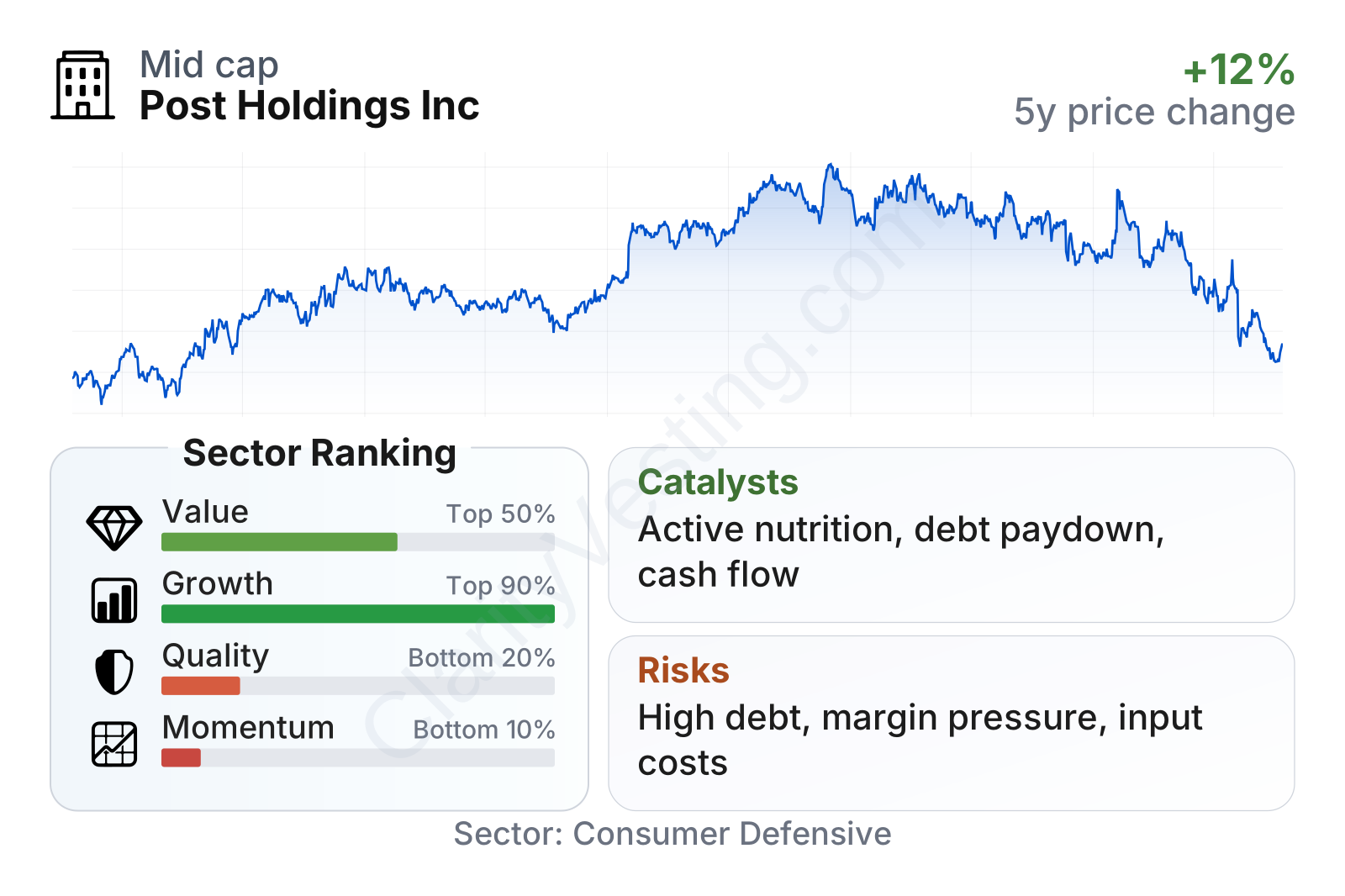
Post is a mid-sized consumer staples company with a relatively low stock volatility profile. On valuation, several measures look moderate versus the broader packaged foods group, while free cash flow generation stands out as comparatively strong. Growth measures are helped by a solid multi-year record in revenue per share, earnings per share, and cash flow expansion, even though the most recent year-over-year revenue reading has softened. The weakest area is balance-sheet quality: leverage is high, interest coverage is thinner than many peers, and profitability metrics such as return on assets and return on invested capital trail the sector.
Growth
Post operates in a mature but resilient sector. Packaged foods is not usually a high-growth industry, yet it can still offer steady expansion through pricing, acquisitions, portfolio shifts, innovation, and gains in higher-value niches. In Post’s case, the strategy has been to build a broader food platform rather than remain mostly a cereal company. That makes strategic sense because traditional ready-to-eat cereal is a slower category, while refrigerated foods, foodservice, convenience products, and active nutrition can offer better long-term demand drivers.
The recent sales trend shows that growth has cooled sharply from the stronger pace seen in 2022 through 2024. More recently, quarterly year-over-year comparisons have moved closer to flat, with even a slight decline in the latest reading. That does not automatically signal deterioration in the business, but it does suggest that the easy phase of inflation-driven pricing and acquisition-fueled growth is behind it. From here, progress likely depends more on volume stabilization, product mix, and execution inside each segment.
Cash generation remains an important positive. Free cash flow has been comfortably positive and, despite some swings, has recovered well from weaker periods. With trailing free cash flow above $500 million, Post has flexibility to reduce debt, repurchase shares, invest in capacity, or pursue bolt-on deals. For a food manufacturer, that matters because long-term value creation often comes less from explosive revenue growth and more from disciplined capital allocation over time.
One notable catalyst is the company’s active nutrition platform. Post has highlighted this area in recent years through brands and capabilities tied to protein shakes, powders, bars, and ready-to-drink products. This market benefits from consumer interest in high-protein diets, convenience, and wellness-oriented snacking. Another growth support is the private-label and value-focused side of the portfolio, which can remain relevant when consumers become more price-sensitive.
Recent company updates also show continued emphasis on portfolio optimization and operating discipline rather than dramatic transformation. That is consistent with the kind of growth profile typical in consumer staples: slower, but potentially durable if execution stays steady and category positions remain defensible.
Risks
This article is for informational purposes only and does not constitute financial advice. Some content is AI-generated. See Disclaimer


