Stock Analysis · Portland General Electric Co (POR)
Overview
Portland General Electric is a regulated electric utility serving customers in Oregon. In simple terms, it generates or buys electricity, delivers that power through its transmission and distribution network, and earns revenue mainly from customer bills that are overseen by state regulators. Because it operates in a regulated market, its business is generally steadier than many industrial or technology companies, but growth tends to be gradual and closely tied to infrastructure investment, electricity demand, and approved customer rates.
The company’s revenue is primarily tied to retail electricity sales and related regulated services inside its service territory. Based on recent annual reporting, the mix is broadly concentrated in electricity delivered to different customer groups, with a smaller contribution from wholesale power and other activities.
- Residential customers: approximately 35% to 40% of revenue, coming from electricity used in homes.
- Commercial customers: approximately 30% to 35% of revenue, including offices, retail, and service businesses.
- Industrial customers: approximately 15% to 20% of revenue, largely from larger power users such as manufacturing and processing facilities.
- Wholesale and other: approximately 10% to 15% of revenue, including wholesale electricity sales, transmission-related activities, and miscellaneous utility services.
That structure matters for long-term analysis because most of Portland General Electric’s income is tied to essential electricity demand in a growing region rather than discretionary consumer spending. Over the last several years, total revenue has trended upward overall, though not in a straight line, while interest costs have also risen as the company has continued to invest heavily in its system.
The broad financial flow shows a utility that has expanded revenue meaningfully since 2021, but with a noticeable rise in power supply costs and interest expense. Operating income improved over that period, yet the cost of financing growth has become a more important factor in how much ultimately reaches net income.
Key Figures
| Metric | Value | Sector ⓘ |
|---|---|---|
| Date | Nov 14, 2026 | |
| Context | ||
| Sector | Utilities | |
| Industry | Utilities - Regulated Electric | |
| Market Cap ⓘ | $5.47B | |
| Beta ⓘ | 0.50 | |
Value (Cheapness) | ||
| P/E Ratio ⓘ | 19.62 | 17.73 |
| P/B Ratio ⓘ | 1.26 | 1.95 |
| FCF Yield ⓘ | -7.61% | -0.52% |
| Dividend Yield ⓘ | 4.62% | 3.52% |
| EBIT / EV ⓘ | 5.01% | 5.78% |
| PEG ⓘ | 1.63 | |
Growth (Business expansion) | ||
| Revenue Growth ⓘ | 2.00% | 8.40% |
| RPS Growth (5Y CAGR) ⓘ | 3.32% | 3.61% |
| EPS Growth (5Y CAGR) ⓘ | -4.69% | -2.45% |
| BVPS Growth (5Y CAGR) ⓘ | 5.43% | 4.14% |
| Margin Growth (5Y Trend) ⓘ | 1.95% | 3.59% |
| FCF Growth (5Y CAGR) ⓘ | -9.10% | -8.59% |
| DPS Growth (5Y CAGR) ⓘ | 4.97% | 4.81% |
Quality (Business durability) | ||
| ROIC (Latest) ⓘ | 5.26% | 6.55% |
| ROA (Latest) ⓘ | 2.02% | 3.13% |
| ROIC (5Y Median) ⓘ | 5.78% | 5.92% |
| ROA (5Y Median) ⓘ | 2.37% | 2.74% |
| Net Debt / EBIT (Latest) ⓘ | 9.74 | 6.90 |
| Net Debt / EBIT (5Y Median) ⓘ | 9.52 | 7.25 |
| Net Debt / EBITDA (Latest) ⓘ | 4.66 | 4.25 |
| Net Debt / Assets ⓘ | 37.79% | 38.00% |
| EBITDA / Interest ⓘ | 4.63 | 4.58 |
| Operating Margin (Latest) ⓘ | 15.42% | 20.25% |
| Operating Margin (5Y Median) ⓘ | 15.53% | 19.99% |
| Debt to Equity (Latest) ⓘ | 122.11% | 137.35% |
| Profit Margin (Latest) ⓘ | 7.68% | 10.44% |
| Free Cash Flow (Latest) ⓘ | -$416.00M | |
Momentum (Price trend) | ||
| 3Y Return ⓘ | +34.29% | +54.85% |
| 12M Return (excl. last month) ⓘ | +6.95% | +6.56% |
| 6M Return ⓘ | -2.66% | +0.18% |
| Price vs. 200-Day MA ⓘ | -6.21% | +2.16% |
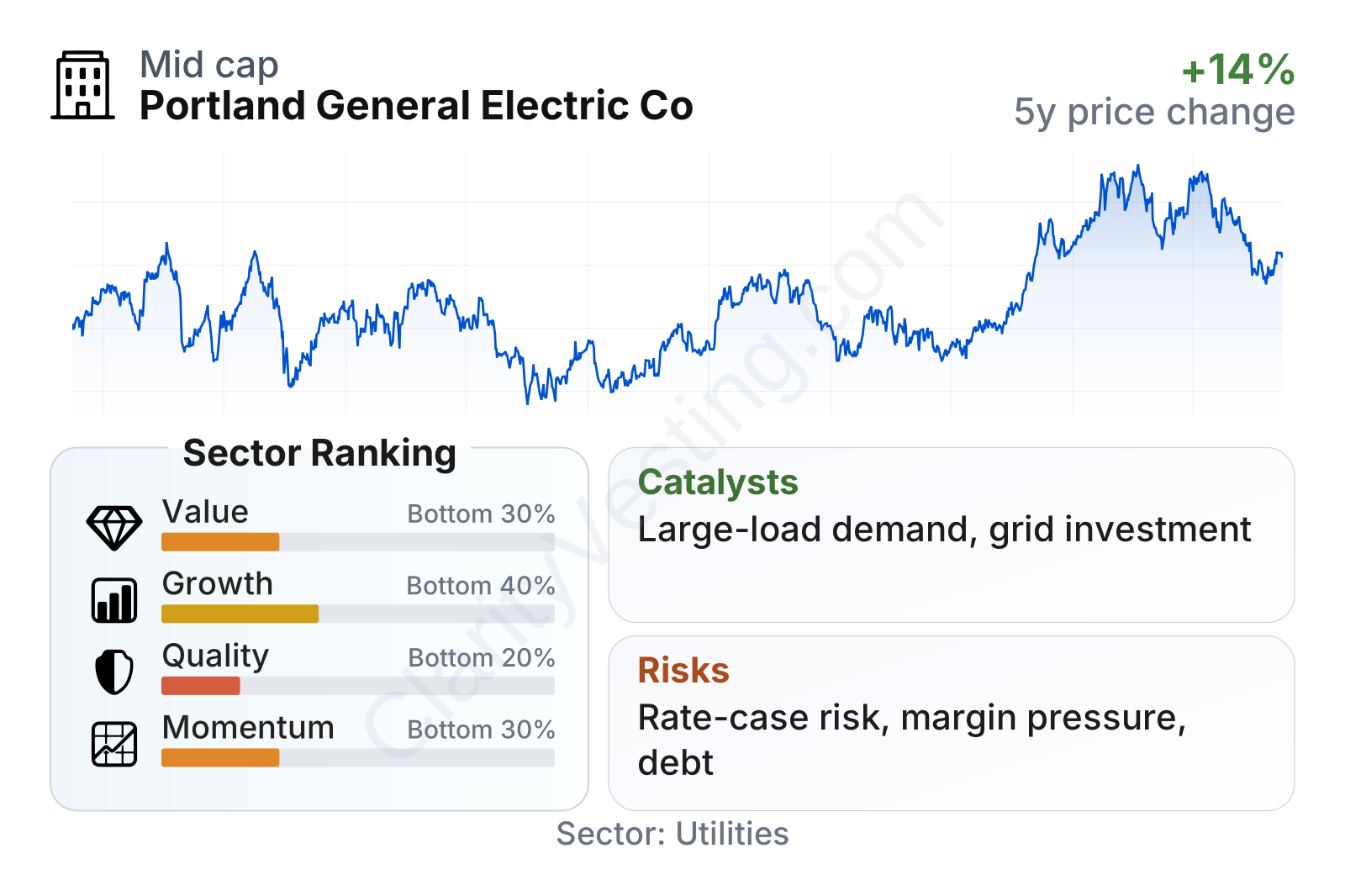
Portland General Electric is a mid-sized regulated utility with a relatively low beta of about 0.5, which means its share price has historically moved less than the broader market. The current factor profile is mixed. Valuation is not especially stretched versus the utility sector, but the company ranks weaker on quality, growth, and recent momentum. Its dividend yield is above the sector median, while free cash flow remains a pressure point because large capital spending programs consume cash faster than the business currently generates it.
The stock’s price path has been positive over the last several years, although recent trading has been less robust than the sector average. That weaker momentum seems tied more to concerns about profitability, capital intensity, and funding needs than to a collapse in the underlying business.
Growth
Electric utilities are not high-growth businesses in the usual sense, but they can still grow steadily when their service areas add people, businesses, and electricity demand. Portland General Electric operates in Oregon, where long-term drivers such as population growth, electrification, transportation charging, grid modernization, and data-center-related demand can support a larger regulated asset base over time. For a utility, that asset base is critical because approved investments in transmission, distribution, and generation can translate into future earnings if regulators allow recovery.
Management’s strategy appears aligned with those trends. The company has been investing in cleaner generation, grid reliability, and capacity additions to serve rising power needs. In a regulated utility, that often provides the clearest path to future expansion: build needed infrastructure, place it into service, and seek rate recovery over time. This is less dramatic than rapid-growth sectors, but it can be durable when execution and regulatory relations remain sound.
Revenue per share has moved upward over the past five years overall, although the pattern has not been perfectly smooth. That points to a business that is expanding its billing base, but still dealing with normal utility swings such as weather, purchased power costs, and timing effects from rate cases.
Free cash flow is an important point to interpret correctly. It has often been negative because utilities spend heavily on long-lived infrastructure before those investments are fully reflected in earnings and cash recovery. There was a visible improvement more recently, moving from deeply negative territory toward positive levels, which is encouraging, but one quarter or one period of improvement does not by itself remove the underlying capital intensity of the business.
A meaningful catalyst is rising regional electricity demand. Public company updates in 2026 have emphasized large-load opportunities, including demand linked to digital infrastructure and broader electrification. If that demand converts into sustained customer growth and approved system investment, Portland General Electric could have a clearer runway for earnings expansion than a typical slow-growing utility.
Risks
This article is for informational purposes only and does not constitute financial advice. Some content is AI-generated. See Disclaimer