Stock Analysis · Pool Corporation (POOL)
Overview
Pool Corporation is the largest wholesale distributor of swimming pool supplies, equipment, and related outdoor living products in North America, with additional operations in Europe and Australia. It does not primarily build pools itself. Instead, it acts as the middle layer between manufacturers and professional contractors, retailers, and commercial customers. That role matters because pool professionals need fast product availability, broad inventory, and local delivery during a highly seasonal business cycle.
The company’s revenue comes mainly from products tied to the construction, maintenance, and renovation of swimming pools, plus adjacent outdoor categories. Based on recent annual disclosures, the mix is approximately:
- Maintenance products, repair parts, and related supplies: about 60% of sales. This includes chemicals, cleaning and testing products, replacement components, and everyday items used to keep pools operating.
- Pool equipment: about 22% of sales. This covers pumps, filters, heaters, lights, automatic controls, and other installed systems.
- Construction materials and renovation products: about 16% of sales. This includes surfaces, tile, coping, decking, and products used in new pool builds or major remodels.
- Irrigation and landscape products plus other outdoor living items: about 2% of sales. This is a smaller category, but it broadens the offering to contractors serving backyards and outdoor spaces.
That revenue structure gives Pool Corporation a useful balance. New pool construction is cyclical, but maintenance and replacement demand tends to be steadier because existing pools still require chemicals, repairs, and periodic equipment upgrades. The business model therefore depends less on a single one-time purchase and more on recurring product flow across a large installed base of pools.
Over the last several years, revenue and profit surged during the post-pandemic pool boom, then normalized as demand cooled. Even after that reset, the company still produces solid gross profit and meaningful net income, although operating costs have taken a larger share of sales than at the peak cycle.
Key Figures
Metric Value Sector ⓘ Date Oct 24, 2026 Context Sector Industrials Industry Industrial Distribution Market Cap ⓘ $6.24B Beta ⓘ 1.04 P/E Ratio ⓘ 15.77 22.29 P/B Ratio ⓘ 4.97 1.98 FCF Yield ⓘ 9.79% 6.26% Dividend Yield ⓘ 3.00% 1.92% EBIT / EV ⓘ 4.32% 4.83% PEG ⓘ 1.60 Revenue Growth ⓘ 2.20% 9.30% RPS Growth (5Y CAGR) ⓘ 2.04% 7.76% EPS Growth (5Y CAGR) ⓘ -23.29% -13.17% BVPS Growth (5Y CAGR) ⓘ 4.68% 6.13% Margin Growth (5Y Trend) ⓘ -4.76% 0.74% FCF Growth (5Y CAGR) ⓘ 2.92% 10.79% DPS Growth (5Y CAGR) ⓘ 13.83% 9.41% ROIC (Latest) ⓘ 17.43% 10.75% ROA (Latest) ⓘ 11.02% 5.41% ROIC (5Y Median) ⓘ 30.24% 9.37% ROA (5Y Median) ⓘ 14.96% 4.95% Net Debt / EBIT (Latest) ⓘ 2.94 2.04 Net Debt / EBIT (5Y Median) ⓘ 1.74 2.27 Net Debt / EBITDA (Latest) ⓘ 2.69 1.39 Net Debt / Assets ⓘ 44.31% 19.27% EBITDA / Interest ⓘ 12.40 9.58 Operating Margin (Latest) ⓘ 10.49% 10.49% Operating Margin (5Y Median) ⓘ 13.47% 10.30% Debt to Equity (Latest) ⓘ 134.54% 64.82% Profit Margin (Latest) ⓘ 7.41% 6.67% Free Cash Flow (Latest) ⓘ $610.65M 3Y Return ⓘ -43.60% +67.77% 12M Return (excl. last month) ⓘ -45.85% +12.05% 6M Return ⓘ -24.99% 0.00% Price vs. 200-Day MA ⓘ -14.65% +0.67%
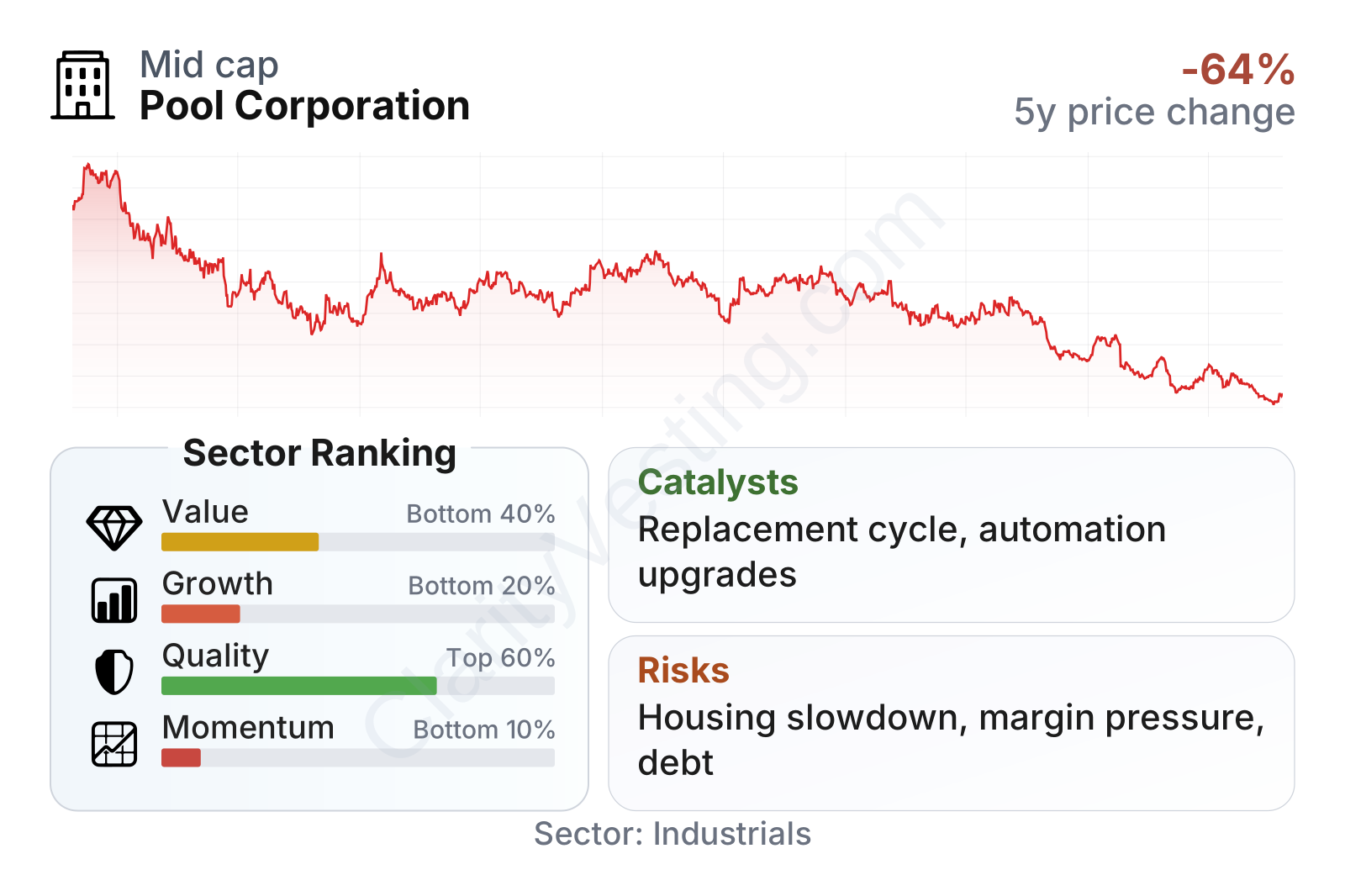
Pool Corporation is a mid-to-large-sized industrial distributor with market volatility close to the broader market. The overall profile is mixed: growth and recent share-price momentum rank weakly versus the sector, while business quality remains above average. Profitability on capital is still strong, free cash flow generation is healthy, and the dividend yield is above the sector median. Valuation metrics look less demanding than they did in earlier years, with the earnings multiple now below the sector median, although the price-to-book ratio remains elevated because this is a distribution business with strong returns on capital rather than heavy asset intensity.
Growth
Pool Corporation operates in a niche that benefits from a very large installed base of existing pools. Long-term growth does not depend only on building new pools. It also comes from recurring maintenance, equipment replacement, remodel activity, and the continued shift toward higher-value products such as automation, energy-efficient pumps, heaters, lighting, and water-treatment systems. In simple terms, once a pool exists, it creates years of follow-on demand.
Recent growth has been uneven. After exceptionally strong expansion in 2021 and 2022, sales turned negative through much of 2023 and 2024 as the industry worked through a post-boom slowdown. More recently, year-over-year revenue returned to positive territory, but only at a modest pace. That suggests the business may be moving from contraction toward stabilization rather than entering a new high-growth phase.
Cash generation remains an important strength. Free cash flow has stayed substantial despite softer earnings, which matters in a distribution business where inventory, working capital discipline, and branch economics drive results. Pool Corporation has also used acquisitions, new sales centers, and product category expansion to deepen its reach. That strategy is sensible because scale helps with purchasing, product availability, and customer service, all of which are difficult for smaller regional rivals to match consistently.
A notable catalyst for future growth is the replacement cycle. Many pools built or upgraded during the housing and backyard boom are now entering the period when owners and service companies spend more on parts, equipment, and renovations. Another growth lever is technology adoption: automated controls, variable-speed pumps, and energy-related upgrades can raise average revenue per pool even when new construction remains soft. If housing activity and discretionary backyard spending improve, the company would also be positioned to benefit because it already has a wide distribution footprint.
Recent company communications have emphasized continued network investment, digital tools for customers, and product mix opportunities rather than a dependence on aggressive new-pool construction. That is a practical direction for the current environment.
Risks
This article is for informational purposes only and does not constitute financial advice. Some content is AI-generated. See Disclaimer


