Stock Analysis · Insulet Corporation (PODD)
Overview
Insulet Corporation is a medical device company focused on diabetes care. Its main product is the Omnipod, a tubeless insulin delivery system used by people with insulin-dependent diabetes. Unlike traditional insulin pumps that use tubing, Omnipod is worn directly on the body and works with a separate controller or compatible smartphone software. The company also offers related software, support services, and accessories tied to the same ecosystem.
For long-term analysis, the business is relatively easy to understand: Insulet makes money by placing users on its insulin pump platform and then generating recurring sales as those users continue buying disposable pods. That creates a model with both hardware adoption and repeat-use consumables, which tends to be more predictable than one-time device sales.
Based on recent annual reporting, revenue is concentrated in a small number of areas:
- Omnipod product revenue: about 99% of total revenue. This includes disposable pods, starter kits, controllers, and related diabetes management products sold in the U.S. and internationally.
- Drug delivery and other revenue: about 1% of total revenue. This has historically included non-core delivery programs and smaller legacy activities, but it is not a meaningful driver compared with Omnipod.
Within Omnipod, the largest share comes from ongoing pod sales rather than the initial hardware setup, which is important because it means revenue can build as the installed user base expands. Geographically, the U.S. remains the largest market, while international sales have become increasingly important as Insulet expands reimbursement, distribution, and awareness outside the domestic market.
The financial flow over recent years also shows a company that has scaled meaningfully. Revenue has climbed strongly since 2021, gross profit has expanded faster than cost of revenue, and operating income has improved as fixed costs have been spread over a larger sales base. Selling and administrative spending remains large, which is normal for a company still investing heavily in market expansion, but the overall structure now looks much more profitable than it did a few years ago.
Key Figures
| Metric | Value | Sector ⓘ |
|---|---|---|
| Date | Oct 24, 2026 | |
| Context | ||
| Sector | Healthcare | |
| Industry | Medical Devices | |
| Market Cap ⓘ | $9.84B | |
| Beta ⓘ | 1.10 | |
Value (Cheapness) | ||
| P/E Ratio ⓘ | 26.72 | 25.42 |
| P/B Ratio ⓘ | 7.23 | 3.08 |
| FCF Yield ⓘ | 3.03% | 3.12% |
| Dividend Yield ⓘ | N/A | 1.85% |
| EBIT / EV ⓘ | 5.65% | 0.56% |
| PEG ⓘ | 3.31 | |
Growth (Business expansion) | ||
| Revenue Growth ⓘ | 23.50% | 7.50% |
| RPS Growth (5Y CAGR) ⓘ | 23.83% | 8.60% |
| EPS Growth (5Y CAGR) ⓘ | 36.11% | -17.73% |
| BVPS Growth (5Y CAGR) ⓘ | 26.96% | 3.72% |
| Margin Growth (5Y Trend) ⓘ | 8.00% | -0.57% |
| FCF Growth (5Y CAGR) ⓘ | N/A | 0.96% |
| DPS Growth (5Y CAGR) ⓘ | N/A | 6.69% |
Quality (Business durability) | ||
| ROIC (Latest) ⓘ | 17.86% | 3.17% |
| ROA (Latest) ⓘ | 12.12% | 2.98% |
| ROIC (5Y Median) ⓘ | 12.04% | 4.56% |
| ROA (5Y Median) ⓘ | 7.87% | 1.87% |
| Net Debt / EBIT (Latest) ⓘ | 0.74 | 1.34 |
| Net Debt / EBIT (5Y Median) ⓘ | 3.18 | 1.86 |
| Net Debt / EBITDA (Latest) ⓘ | 0.63 | 1.00 |
| Net Debt / Assets ⓘ | 13.06% | 5.06% |
| EBITDA / Interest ⓘ | 10.37 | 9.55 |
| Operating Margin (Latest) ⓘ | 18.28% | 9.25% |
| Operating Margin (5Y Median) ⓘ | 14.78% | 7.33% |
| Debt to Equity (Latest) ⓘ | 66.69% | 26.68% |
| Profit Margin (Latest) ⓘ | 12.29% | 3.34% |
| Free Cash Flow (Latest) ⓘ | $298.30M | |
Momentum (Price trend) | ||
| 3Y Return ⓘ | +0.76% | +51.61% |
| 12M Return (excl. last month) ⓘ | -58.41% | +19.90% |
| 6M Return ⓘ | -23.50% | +10.10% |
| Price vs. 200-Day MA ⓘ | -19.02% | +6.44% |
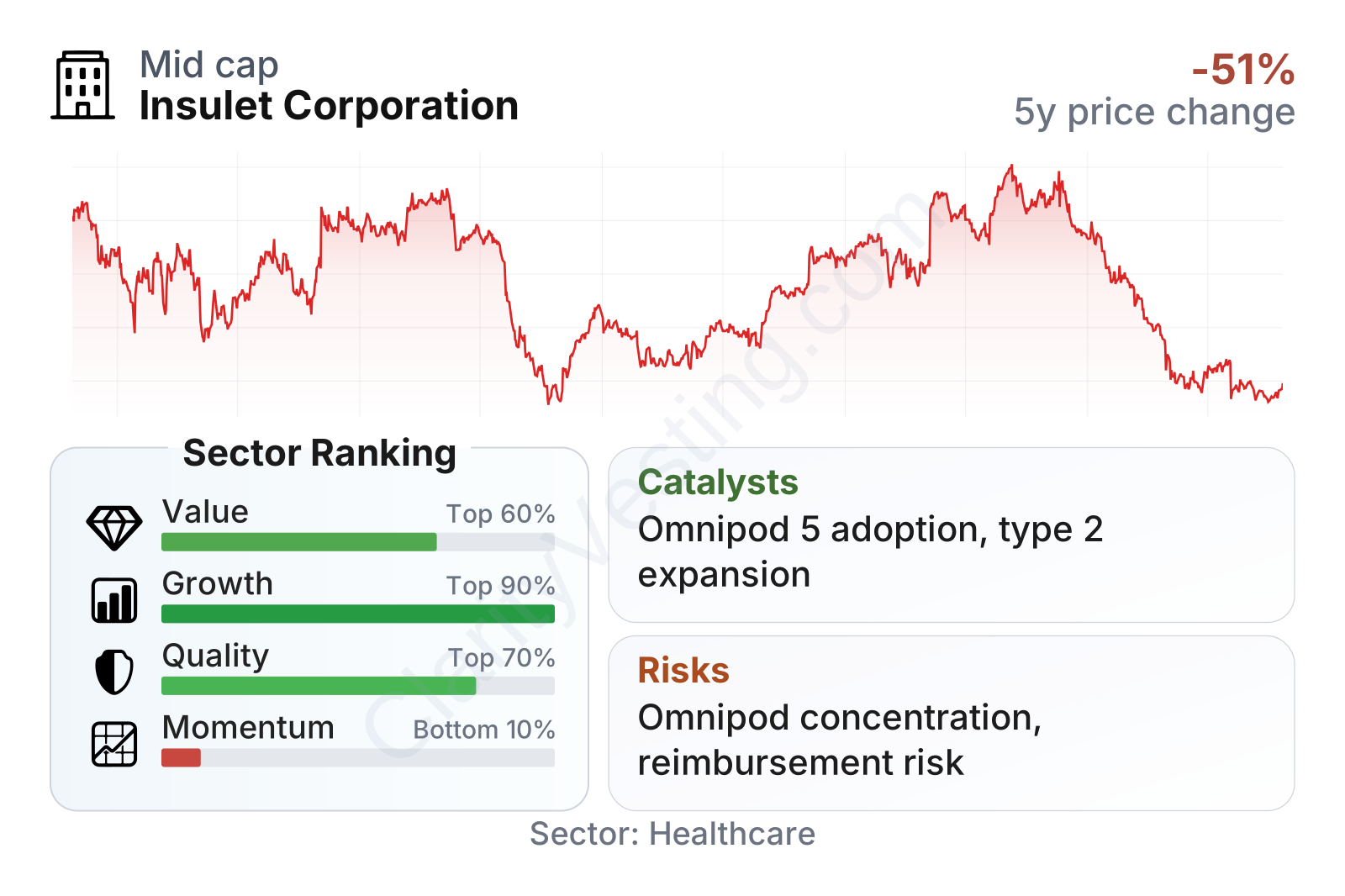
Insulet is now a mid-sized healthcare company with a stock that has been volatile despite strong business growth. The metric profile is unusual in a good way: growth ranks near the top of its sector, quality is also above average, and profitability is materially stronger than many healthcare peers. Value metrics are more mixed. The earnings multiple is close to the sector median, but the price-to-book ratio is clearly higher, reflecting expectations for future returns rather than asset value. Momentum is the weakest area by far, showing that market sentiment has recently been much worse than operating performance.
Growth
Insulet operates in a part of healthcare with favorable long-term demand. Diabetes remains a large and growing global health issue, and better insulin delivery tools can improve convenience and treatment adherence. That gives the company exposure to both structural healthcare demand and a product category that is still gaining adoption. Tubeless insulin delivery remains a differentiated niche inside the broader diabetes technology market.
The company’s strategy is coherent. Insulet is building around a recurring-use platform rather than a one-time equipment sale. Once a patient starts using Omnipod, the relationship can become durable because switching devices takes effort, clinical support, training, and reimbursement approval. This creates a combination of customer stickiness and repeat purchasing that is attractive when adoption keeps rising.
Revenue growth has been consistently strong for several years and has generally stayed well above the healthcare sector median. Annual growth has often remained in the 20% to 30% range, which is unusually robust for a medical device company of this size. Just as important, this has not been a one-quarter spike. The pattern shows repeated strong demand across multiple periods, suggesting that expansion is being driven by a widening user base rather than only temporary pricing or channel effects.
Cash generation has also improved materially. Free cash flow moved from negative territory to solidly positive over the last few years, which matters because it shows growth is increasingly translating into financial flexibility. That gives Insulet more room to fund manufacturing, product development, commercial expansion, and software capabilities without depending as heavily on external financing.
One of the clearest growth catalysts is the continued rollout and expansion of Omnipod 5, the company’s automated insulin delivery platform. This system integrates insulin delivery with glucose monitoring to automate part of the treatment process, making the product more competitive in the fast-growing smart diabetes device segment. The company has also been expanding compatibility, geographic reach, and access through broader reimbursement channels. These steps increase the addressable market and can improve retention once users are on the platform.
Another important support for future growth is manufacturing scale. Insulet has been investing in additional production capacity to support higher demand and international expansion. For a consumable-based business, reliable supply is critical: if production scales smoothly, growth can continue with fewer bottlenecks. If manufacturing efficiency keeps improving alongside volume, margins could also benefit over time.
Recent company updates have also pointed to continued adoption gains in both type 1 and type 2 diabetes markets. The type 2 opportunity is especially notable because it is much larger in patient count than type 1 diabetes. Even modest progress there could materially expand the company’s long-term runway.
Risks
This article is for informational purposes only and does not constitute financial advice. Some content is AI-generated. See Disclaimer


