Stock Analysis · Pennant Group Inc (PNTG)
Overview
Pennant Group is a healthcare services company focused on care for older adults and patients recovering from illness or injury. Its operations are centered on home health, hospice, and senior living. In simple terms, Pennant helps patients receive nursing and therapy services at home, provides end-of-life hospice support, and operates senior living communities for residents who need daily assistance or independent living options.
The company organizes its business in two main segments. Based on its latest annual results, revenue is weighted more heavily toward healthcare services delivered outside hospitals, especially in the home and hospice setting.
- Home Health and Hospice Services: about 74% of revenue. This includes skilled nursing, physical, occupational and speech therapy, medical social work, hospice care, and related services delivered primarily in patients’ homes.
- Senior Living Services: about 26% of revenue. This includes assisted living, independent living, and memory care communities, with revenue coming from resident fees and related services.
Pennant’s model is built around local operations with support from a centralized parent platform. That matters because healthcare is highly local: referral relationships, staffing, reimbursement management, and occupancy trends often determine whether a location performs well. Over the last several years, the business has expanded meaningfully through a mix of organic growth and acquisitions, with revenue rising from roughly $440 million in 2021 to nearly $948 million in 2025. At the same time, profitability also improved, which suggests the company has not been growing at any cost.
The business mix also helps explain why Pennant has attracted attention. Home-based care has become more important as payers and patients look for lower-cost alternatives to institutional care, while senior living adds another leg to the platform and creates local market presence across the aging-care spectrum.
The progression over recent years shows a clear expansion in scale, with revenue, gross profit, operating income, and net income all moving higher. Costs remain heavy, which is normal in labor-intensive healthcare services, but the company has still widened earnings as it has grown.
Key Figures
| Metric | Value | Sector ⓘ |
|---|---|---|
| Date | Oct 03, 2026 | |
| Context | ||
| Sector | Healthcare | |
| Industry | Medical Care Facilities | |
| Market Cap ⓘ | $1.36B | |
| Beta ⓘ | 1.27 | |
Value (Cheapness) | ||
| P/E Ratio ⓘ | 44.32 | 24.06 |
| P/B Ratio ⓘ | 4.44 | 3.08 |
| FCF Yield ⓘ | 1.91% | 3.07% |
| Dividend Yield ⓘ | N/A | 2.05% |
| EBIT / EV ⓘ | 2.96% | 0.63% |
| PEG ⓘ | 1.96 | |
Growth (Business expansion) | ||
| Revenue Growth ⓘ | 35.80% | 7.50% |
| RPS Growth (5Y CAGR) ⓘ | 16.94% | 8.70% |
| EPS Growth (5Y CAGR) ⓘ | 2.31% | -18.20% |
| BVPS Growth (5Y CAGR) ⓘ | 24.18% | 3.95% |
| Margin Growth (5Y Trend) ⓘ | 4.46% | -0.58% |
| FCF Growth (5Y CAGR) ⓘ | N/A | 0.88% |
| DPS Growth (5Y CAGR) ⓘ | N/A | 6.80% |
Quality (Business durability) | ||
| ROIC (Latest) ⓘ | 8.37% | 3.29% |
| ROA (Latest) ⓘ | 3.61% | 3.02% |
| ROIC (5Y Median) ⓘ | 9.34% | 4.75% |
| ROA (5Y Median) ⓘ | 2.54% | 1.93% |
| Net Debt / EBIT (Latest) ⓘ | 8.68 | 1.33 |
| Net Debt / EBIT (5Y Median) ⓘ | 12.69 | 1.83 |
| Net Debt / EBITDA (Latest) ⓘ | 7.33 | 0.99 |
| Net Debt / Assets ⓘ | 46.14% | 5.33% |
| EBITDA / Interest ⓘ | 6.11 | 9.63 |
| Operating Margin (Latest) ⓘ | 5.01% | 9.25% |
| Operating Margin (5Y Median) ⓘ | 4.68% | 7.80% |
| Debt to Equity (Latest) ⓘ | 137.50% | 28.99% |
| Profit Margin (Latest) ⓘ | 2.93% | 3.60% |
| Free Cash Flow (Latest) ⓘ | $25.99M | |
Momentum (Price trend) | ||
| 3Y Return ⓘ | +251.36% | +37.48% |
| 12M Return (excl. last month) ⓘ | +57.18% | +20.85% |
| 6M Return ⓘ | +27.81% | +9.73% |
| Price vs. 200-Day MA ⓘ | +13.53% | +4.69% |
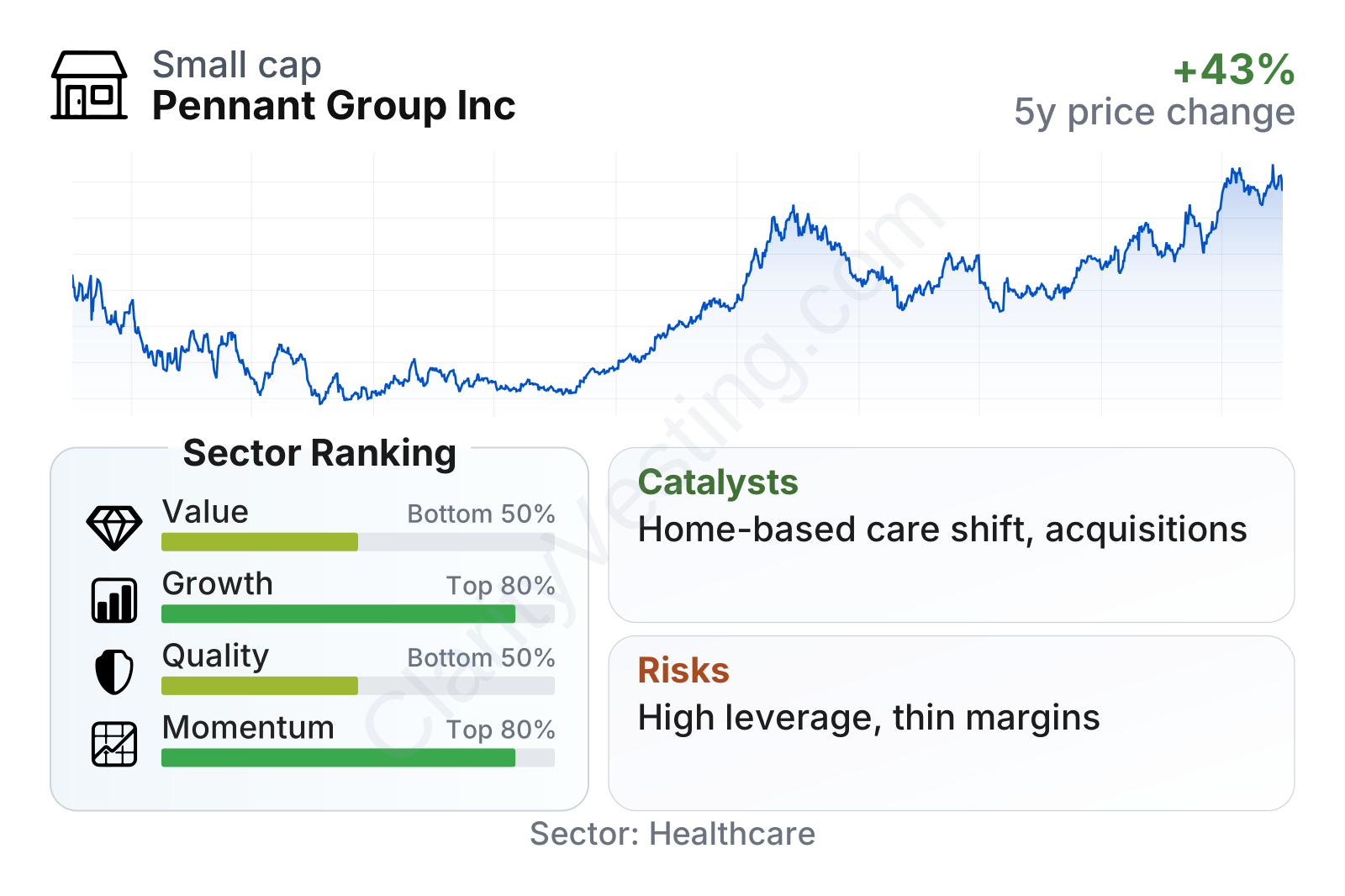
Pennant is now a mid-sized healthcare operator by market value, and the stock has shown strong momentum compared with much of the sector. The table points to a mixed profile: growth and market performance rank well above many peers, while valuation looks richer and balance-sheet leverage remains a weaker point. Quality measures are not uniformly strong, but returns on invested capital are better than many healthcare peers, which suggests Pennant has been able to turn expansion into acceptable economic returns.
The stock’s path has been volatile. After a steep decline in 2022, it recovered strongly through 2024 and 2026. That pattern fits a company whose earnings base improved materially, but it also shows that sentiment can shift quickly when markets reassess healthcare reimbursement, acquisition execution, or leverage.
Growth
Pennant operates in parts of healthcare that have long-term demand support. The U.S. population is aging, chronic disease remains widespread, and patients increasingly prefer to receive care at home when possible. Payers also have incentives to use lower-cost settings when outcomes are acceptable. Those broad trends support home health and hospice in particular, while senior living benefits from demographic demand over time, even if occupancy and labor conditions can fluctuate.
The company’s strategy also appears coherent. Pennant has been building density in local markets, adding agencies and communities, and using a decentralized operating model that gives local leaders responsibility while the parent company provides systems, compliance, finance, and strategic support. In healthcare services, that combination can work well if leadership quality is strong, because acquired assets often need local improvement rather than a one-size-fits-all corporate formula.
Recent growth has been unusually strong. Year-over-year revenue growth moved from low double digits in 2023 to roughly 24% to 53% during 2024 and 2025, and it remained around 36% in the first half of 2026. That is far above the sector median and indicates that Pennant is still in an expansion phase rather than a mature, slow-growth period.
Cash generation has also improved. Free cash flow was negative in 2022, then turned positive and climbed to nearly $40 million on a trailing basis by early 2026. That shift matters because it suggests growth is becoming more self-funded, at least compared with the earlier period when expansion placed more strain on the business.
A notable catalyst is continued consolidation in post-acute care and senior services. Many smaller operators face regulatory complexity, staffing challenges, and capital constraints, creating acquisition opportunities for scaled platforms. Pennant has already shown that acquisitions can accelerate growth. Another important tailwind is the broader healthcare system’s push toward home-based care, where Pennant has meaningful exposure through home health and hospice.
Recent company updates have also highlighted ongoing expansion through acquisitions and new operations, which reinforces the view that management still sees a long runway in fragmented local markets. For a long-term view, the key question is not whether Pennant can grow at all, but whether it can keep adding locations without weakening margins or overloading the balance sheet.
Risks
This article is for informational purposes only and does not constitute financial advice. Some content is AI-generated. See Disclaimer