Stock Analysis · Pandox AB (PNDXF)
Overview
Pandox AB is a Swedish hotel real estate company that owns hotel properties and, in some cases, also runs hotel operations. Its business model is easier to understand than it may first appear: Pandox mainly makes money from owning hotels in major cities and travel destinations, then collecting rent or operating income from those assets. The company is active across Northern Europe and several other European markets, and its portfolio is focused on hotels rather than broad commercial real estate.
This structure gives Pandox two earnings engines. One comes from the property side, where hotel operators pay rent under lease agreements. The other comes from hotel operations, where Pandox captures more of the upside when occupancy and room prices are strong, but also takes on more day-to-day business risk. That mix makes the company more exposed to the travel cycle than a traditional landlord, but it also creates more direct participation in hotel market recoveries.
Based on the company’s recent annual reporting, revenue is mainly generated from the following sources:
- Property Management: approximately 55% to 65% of revenue. This includes rental income from hotel properties, often under lease structures linked to hotel performance.
- Operator Activities: approximately 35% to 45% of revenue. This covers hotels operated directly or through operating arrangements, where Pandox is more exposed to occupancy, average room rates, and operating costs.
- Other income: a small residual share. This can include service-related and ancillary items, but it is not a major earnings driver.
The broader financial flow shows a business that has rebuilt revenue strongly since the travel disruption years. Sales and operating profit have climbed meaningfully from 2021 through 2025, while administrative costs have remained relatively modest compared with total revenue. That said, interest expense is still a major item, which matters because hotel property ownership is capital-intensive and debt-funded.
Key Figures
| Metric | Value | Sector ⓘ |
|---|---|---|
| Date | Nov 21, 2026 | |
| Context | ||
| Sector | Real Estate | |
| Industry | Real Estate Services | |
| Market Cap ⓘ | $3.74B | |
| Beta ⓘ | 1.20 | |
Value (Cheapness) | ||
| P/E Ratio ⓘ | 9.66 | 17.59 |
| P/B Ratio ⓘ | N/A | 1.58 |
| FCF Yield ⓘ | -27.02% | 5.76% |
| Dividend Yield ⓘ | N/A | 4.81% |
| EBIT / EV ⓘ | 7.85% | 4.97% |
| PEG ⓘ | N/A | |
Growth (Business expansion) | ||
| Revenue Growth ⓘ | 23.20% | 5.70% |
| RPS Growth (5Y CAGR) ⓘ | 21.17% | 5.96% |
| EPS Growth (5Y CAGR) ⓘ | -35.69% | -3.46% |
| BVPS Growth (5Y CAGR) ⓘ | 5.88% | 0.32% |
| Margin Growth (5Y Trend) ⓘ | 20.43% | -0.65% |
| FCF Growth (5Y CAGR) ⓘ | 127.18% | 5.08% |
| DPS Growth (5Y CAGR) ⓘ | -0.50% | 5.00% |
Quality (Business durability) | ||
| ROIC (Latest) ⓘ | 6.04% | 5.13% |
| ROE (Latest) ⓘ | 10.21% | 7.64% |
| ROA (Latest) ⓘ | 3.09% | 3.05% |
| ROIC (5Y Median) ⓘ | 6.14% | 4.20% |
| ROE (5Y Median) ⓘ | 5.37% | 6.03% |
| ROA (5Y Median) ⓘ | 2.19% | 2.41% |
| Net Debt / EBIT (Latest) ⓘ | 7.86 | 7.59 |
| Net Debt / EBIT (5Y Median) ⓘ | 14.00 | 8.34 |
| Net Debt / EBITDA (Latest) ⓘ | 7.51 | 5.43 |
| Net Debt / Assets ⓘ | 45.42% | 38.21% |
| EBITDA / Interest ⓘ | 3.12 | 4.20 |
| Operating Margin (Latest) ⓘ | 82.69% | 34.59% |
| Operating Margin (5Y Median) ⓘ | 57.01% | 37.64% |
| Debt to Equity (Latest) ⓘ | 152.94% | 90.32% |
| Profit Margin (Latest) ⓘ | 42.73% | 20.10% |
| Free Cash Flow (Latest) ⓘ | -$1.01B | |
Momentum (Price trend) | ||
| 3Y Return ⓘ | +123.66% | +27.88% |
| 12M Return (excl. last month) ⓘ | +4.15% | +1.16% |
| 6M Return ⓘ | 0.00% | -3.06% |
| Price vs. 200-Day MA ⓘ | +0.56% | -0.73% |
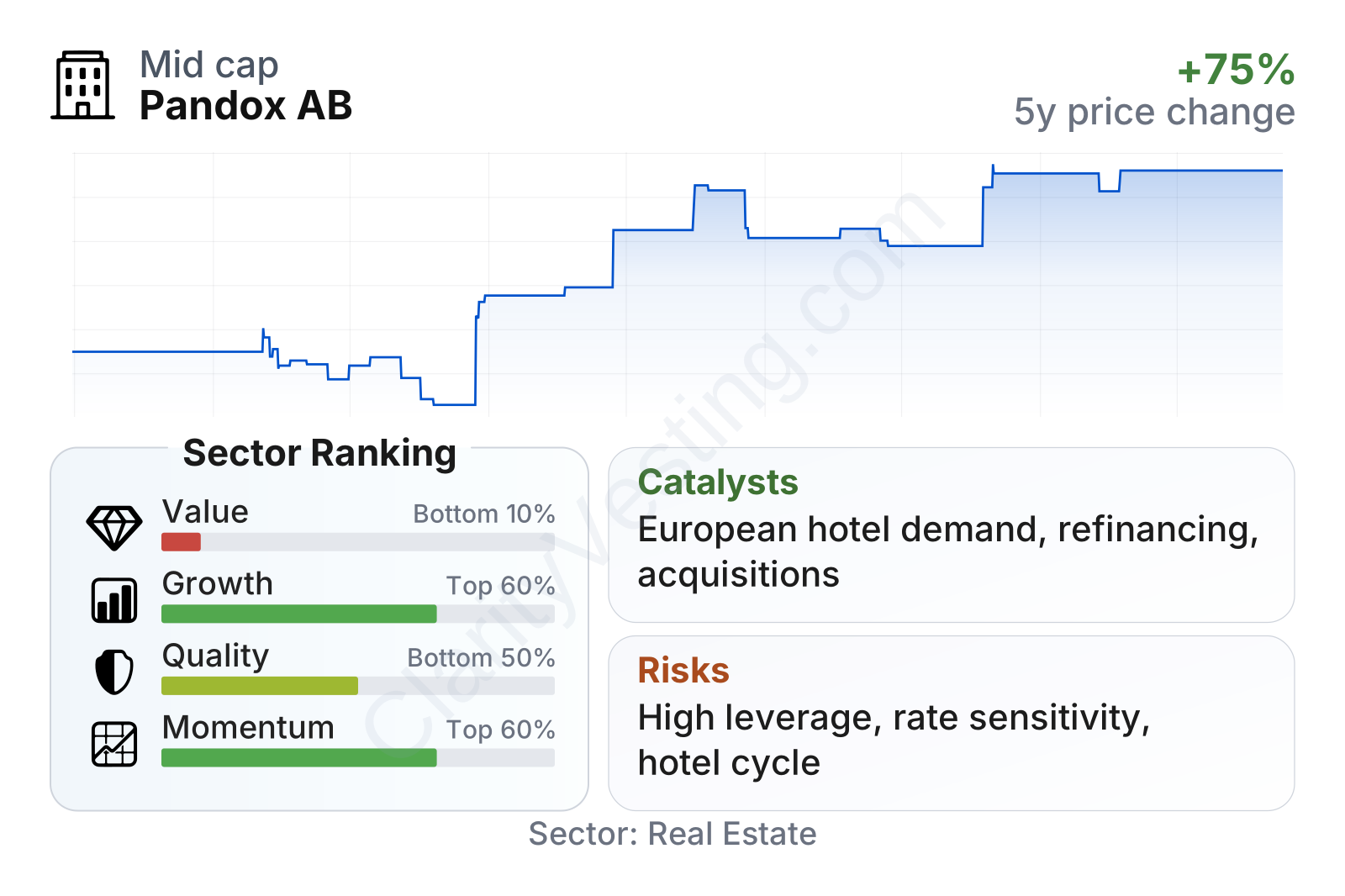
Pandox is a mid-sized listed real estate company with a stock that has been more volatile than many property peers, reflected in a beta a little above 1. Its valuation multiples look low on earnings, with a P/E below the sector median, but that does not automatically mean the shares are cheap in a simple sense. The company ranks weakly on traditional value measures because free cash flow is currently negative and the trailing dividend yield is absent in the latest twelve-month snapshot.
On the other hand, the operating business has shown better-than-sector growth in several areas. Revenue growth, revenue per share growth, and margin improvement have all been noticeably stronger than the median real estate peer. Profitability is mixed: operating margin is exceptionally high for the sector, while asset returns and leverage-adjusted quality measures are less impressive because the balance sheet remains heavy with debt.
Price performance has also been solid over the last three years and stronger than much of the sector, suggesting the market has already recognized a large part of the recovery in hotel fundamentals.
Growth
Pandox operates in a part of real estate that is tied directly to travel demand. Over the long run, urban tourism, business travel, events, and international mobility tend to support hotel demand, especially in gateway cities with limited room supply growth. That makes the sector structurally more cyclical than office or residential property, but it also offers stronger upside when travel markets are healthy.
The company’s strategy is coherent for that backdrop. Pandox focuses on hotel assets in locations where replacement costs are high and where demand can recover through both occupancy and room rate increases. Its combination of leased hotels and operated hotels adds flexibility: leases can provide more stable income, while operated properties can capture stronger gains when hotel trading conditions improve.
Revenue per share has increased sharply over the last five years, with the biggest rebound occurring after the pandemic-disrupted period. Growth has recently become more moderate, which is not surprising after a strong recovery phase, but the level remains well above 2021. That points to a business that has largely restored its earnings base and is now moving into a more normalized expansion stage.
The dividend trend also suggests improving underlying conditions. Distributions have resumed and increased over the last few years, although the broader historical growth rate is still modest because the pandemic period interrupted payouts. For a hotel property owner, the ability to rebuild distributions after a severe downturn says something positive about asset quality and earnings resilience after recovery.
Potential catalysts are fairly clear. Continued strength in European hotel demand, room-rate growth, selective acquisitions, and refinancing on better terms could all support future results. The company has also highlighted active asset management as part of its model, meaning renovation, repositioning, and contract optimization can create value without relying only on broad market growth. If travel demand remains firm and financing conditions become easier, that combination could be meaningful.
Risks
This article is for informational purposes only and does not constitute financial advice. Some content is AI-generated. See Disclaimer


