Stock Analysis · PennyMac Mortgage Investment Trust (PMT-PB)
Overview
PennyMac Mortgage Investment Trust is a mortgage real estate investment trust, or mortgage REIT. Instead of owning office buildings, apartments, or shopping centers, it mainly owns and finances mortgage-related assets. Its business is centered on the U.S. housing finance market, with a strong focus on mortgage servicing rights, credit risk transfer investments, and other mortgage-backed assets. In simple terms, it earns money from the cash flows tied to home loans and from managing the financial rights connected to those loans.
The company’s revenue can be volatile from year to year because accounting results are heavily influenced by interest rates, valuation changes, and gains or losses on mortgage-related investments. Based on recent company reporting, the largest economic drivers of earnings are approximately the following:
- Mortgage servicing rights and related hedging activity: roughly 40% to 50% of the business mix in recent periods. This includes the value and cash flow from servicing home loans, plus the related interest-rate protection strategy.
- Credit-sensitive mortgage investments: roughly 25% to 35%. This includes credit risk transfer arrangements and other investments tied to mortgage credit performance rather than direct home ownership.
- Interest income from investment portfolio assets: roughly 15% to 25%. This comes from mortgage-backed securities, loans, and other interest-earning holdings.
- Correspondent production and other activities: generally a smaller contribution, often below 15%. This can include mortgage acquisition-related income and other operating items.
That mix matters because PennyMac Mortgage Investment Trust is not a plain income vehicle. Its performance depends on mortgage servicing economics, financing costs, and the direction of interest rates. Over the last several years, revenue has moved sharply between weak and very strong periods, showing how sensitive the model is to market conditions. Operating expenses have stayed relatively contained compared with the swings in revenue, while interest expense remains a major cost because leverage is a core part of the business.
The long-term pattern shows a business with powerful earnings rebounds when mortgage market conditions improve, but one that can also post sharp reversals when rates or asset values move against it. That makes understanding the balance sheet and earnings mix especially important.
Key Figures
| Metric | Value | Sector ⓘ |
|---|---|---|
| Date | Oct 17, 2026 | |
| Context | ||
| Sector | Real Estate | |
| Industry | REIT - Mortgage | |
| Market Cap ⓘ | $1.51B | |
| Beta ⓘ | 1.17 | |
Value (Cheapness) | ||
| P/E Ratio ⓘ | N/A | 17.38 |
| P/B Ratio ⓘ | 0.96 | 0.85 |
| FCF Yield ⓘ | -666.22% | 7.38% |
| Dividend Yield ⓘ | 7.87% | 4.85% |
| EBIT / EV ⓘ | N/A | 3.78% |
| PEG ⓘ | N/A | |
Growth (Business expansion) | ||
| Revenue Growth ⓘ | 6.10% | 5.30% |
| RPS Growth (5Y CAGR) ⓘ | 120.38% | 6.02% |
| EPS Growth (5Y CAGR) ⓘ | N/A | -11.37% |
| BVPS Growth (5Y CAGR) ⓘ | -2.80% | 0.45% |
| Margin Growth (5Y Trend) ⓘ | 122.32% | -0.22% |
| FCF Growth (5Y CAGR) ⓘ | N/A | 5.40% |
| DPS Growth (5Y CAGR) ⓘ | -1.34% | 5.02% |
Quality (Business durability) | ||
| ROIC (Latest) ⓘ | N/A | 5.69% |
| ROE (Latest) ⓘ | 8.91% | 7.56% |
| ROA (Latest) ⓘ | 0.76% | 2.85% |
| ROIC (5Y Median) ⓘ | 1.07% | 4.22% |
| ROE (5Y Median) ⓘ | 6.68% | 6.03% |
| ROA (5Y Median) ⓘ | 0.72% | 2.44% |
| Net Debt / EBIT (Latest) ⓘ | N/A | 7.59 |
| Net Debt / EBIT (5Y Median) ⓘ | 248.70 | 8.40 |
| Net Debt / EBITDA (Latest) ⓘ | 23.34 | 5.27 |
| Net Debt / Assets ⓘ | 90.44% | 37.76% |
| EBITDA / Interest ⓘ | 0.91 | 4.10 |
| Operating Margin (Latest) ⓘ | N/A | 35.29% |
| Operating Margin (5Y Median) ⓘ | 53.91% | 37.31% |
| Debt to Equity (Latest) ⓘ | 1236.91% | 88.87% |
| Profit Margin (Latest) ⓘ | 24.28% | 19.61% |
| Free Cash Flow (Latest) ⓘ | -$10.07B | |
Momentum (Price trend) | ||
| 3Y Return ⓘ | +25.64% | +30.75% |
| 12M Return (excl. last month) ⓘ | -3.37% | +4.36% |
| 6M Return ⓘ | -9.86% | -2.52% |
| Price vs. 200-Day MA ⓘ | -7.93% | -2.34% |
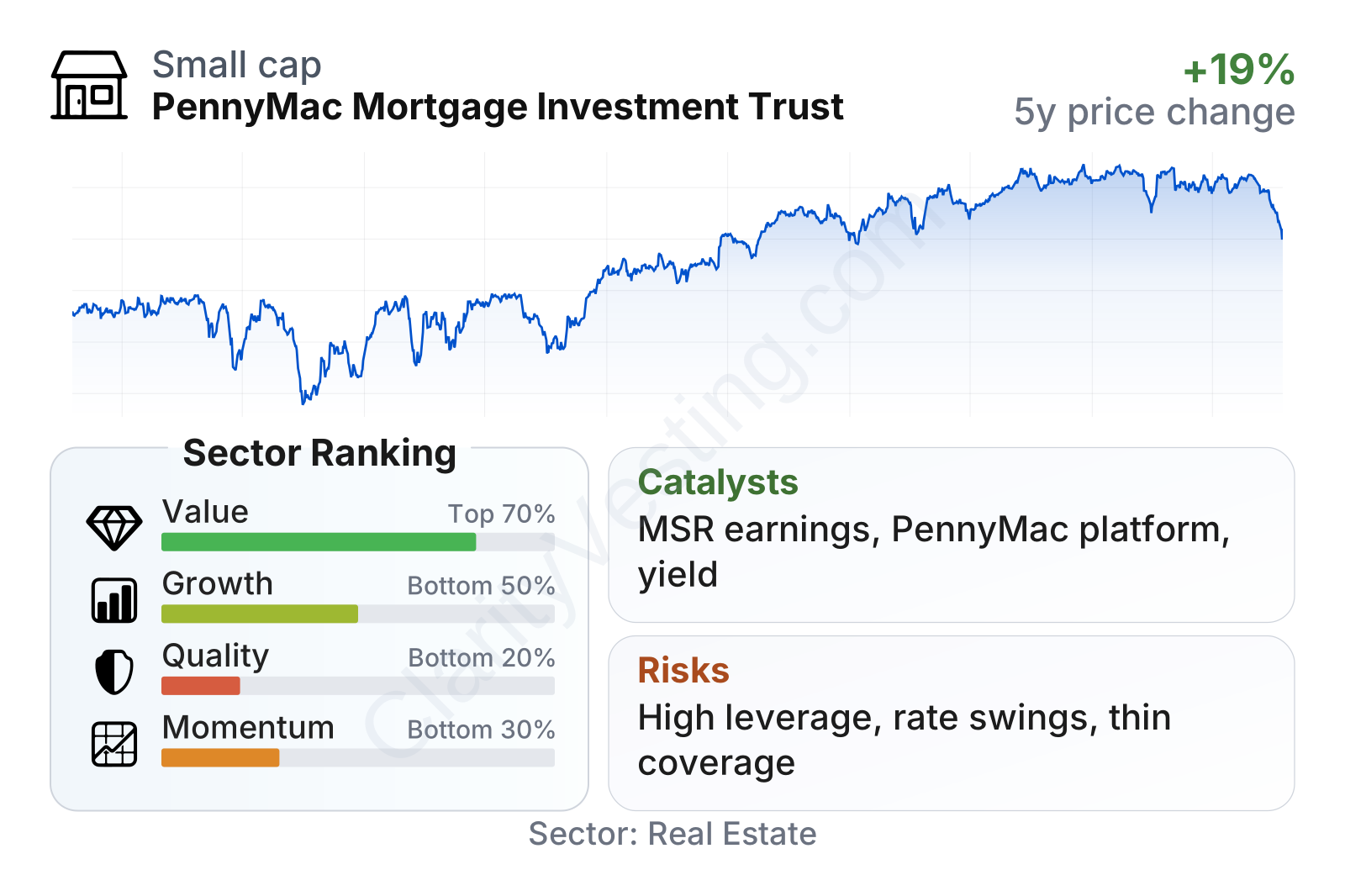
PennyMac Mortgage Investment Trust is a mid-sized mortgage REIT with a stock that has gradually recovered from its 2022 weakness and has traded in a relatively stable range more recently. The latest factor profile is mixed. Value metrics are around the middle of the real estate sector, helped by a dividend yield of about 7.5%, which is above the sector median. Growth signals are uneven: recent revenue growth is slightly ahead of the sector median, but the broader growth profile still ranks in the lower half because results have been inconsistent and book value per share has declined over the past five years. Quality is the weakest area. Profit margin and return on equity are respectable, but leverage is far above sector norms, interest coverage is thin, and free cash flow is deeply negative. Momentum is also softer than the sector median, suggesting the market is not assigning a strong premium to the current setup.
Growth
PennyMac Mortgage Investment Trust operates in a sector that remains important and structurally large: U.S. housing finance. Mortgage servicing, mortgage credit transfer, and related financing activities are not niche markets. They are tied to one of the largest consumer credit systems in the country. That gives the company a durable addressable market, even if near-term performance is cyclical.
The company’s strategy has a logical foundation for long-term growth because mortgage servicing rights can become more valuable when interest rates stay elevated and refinancing slows. In that environment, homeowners keep their loans longer, which can support servicing cash flows. At the same time, if the mortgage market becomes more active again, PennyMac’s ties to the broader PennyMac platform can help it source assets and capital opportunities efficiently.
Revenue per share has been highly uneven, which is normal for this type of business but still important to recognize. The broad direction since 2022 has been upward, with a particularly strong rebound in 2023 through 2025. That suggests the company has been able to benefit from a more favorable mix of servicing and investment economics after a difficult period.
The dividend pattern has also stabilized after a noticeable cut in 2023. Since then, the payout has recovered and held near the same level, which signals a more balanced approach between distributing income and preserving capital. For a mortgage REIT, that stability can matter as much as growth.
A meaningful catalyst is the company’s exposure to mortgage servicing rights. These assets can perform well when rates stay higher for longer, because prepayments tend to slow. Another catalyst is any improvement in housing finance activity that expands investment opportunities without sharply compressing servicing values. In addition, PennyMac Mortgage Investment Trust benefits from its relationship with PennyMac Financial Services, one of the better-known platforms in U.S. mortgage origination and servicing. That relationship can support sourcing, operating scale, and market access that smaller competitors may struggle to match.
Recent company communications have continued to emphasize disciplined capital allocation, servicing-related investments, and credit-focused strategies rather than aggressive expansion into riskier areas. For a long-term view, that is a relevant point: the company appears to be leaning into the areas where it already has experience and infrastructure.
Risks
This article is for informational purposes only and does not constitute financial advice. Some content is AI-generated. See Disclaimer


