Stock Analysis · Harbour Energy plc (PMOIF)
Overview
Harbour Energy plc is an upstream oil and gas company. In simple terms, it explores for hydrocarbons, develops fields, produces oil and natural gas, and sells those volumes into energy markets. The company was originally centered on the U.K. North Sea, but it has become more geographically diversified after expanding into countries such as Norway, Germany, Argentina, Mexico, North Africa, and Southeast Asia through the Wintershall Dea assets combination completed in 2024.
That matters for long-term analysis because Harbour is no longer just a mature North Sea producer. It now has a broader set of producing assets, development projects, and gas exposure, which can reduce dependence on any one basin while also increasing operational complexity.
Its revenue is still primarily tied to commodity production and realized prices rather than to a wide mix of business lines. Based on recent annual reporting, the main sources of revenue can be summarized as follows:
- Crude oil sales: approximately 50% to 60% of revenue. This is the largest contributor and includes production from legacy U.K. assets and the broader international portfolio.
- Natural gas sales: approximately 25% to 35% of revenue. This includes pipeline gas sold mainly into European markets, where pricing can be volatile but strategically important.
- Natural gas liquids and other hydrocarbon sales: approximately 5% to 15% of revenue. This includes condensates and other associated liquids produced alongside gas.
- Hedging and other operating income effects: variable and sometimes material. These do not represent a core product line, but they can influence reported revenue and earnings depending on market prices and the company’s risk-management program.
Over the last several years, the business has shown that strong operating income does not always translate into strong net income. The main reason is the heavy tax burden common in some of its jurisdictions, along with interest expense, commodity price swings, and non-cash items. Even so, the company has remained highly cash generative, especially after the portfolio expansion.
The profit flow highlights a business with much larger revenue and operating income than a few years ago, but also one where taxes absorb an unusually large share of earnings. In other words, Harbour’s underlying fields can produce substantial cash, yet reported profit can look weak or even negative after taxation and financing costs.
Key Figures
| Metric | Value | Sector ⓘ |
|---|---|---|
| Date | Oct 03, 2026 | |
| Context | ||
| Sector | Energy | |
| Industry | Oil & Gas E&P | |
| Market Cap ⓘ | $5.24B | |
| Beta ⓘ | -0.29 | |
Value (Cheapness) | ||
| P/E Ratio ⓘ | 15.22 | 14.47 |
| P/B Ratio ⓘ | 1.45 | 1.70 |
| FCF Yield ⓘ | 65.36% | 8.66% |
| Dividend Yield ⓘ | 4.68% | 3.77% |
| EBIT / EV ⓘ | 63.79% | 7.46% |
| PEG ⓘ | N/A | |
Growth (Business expansion) | ||
| Revenue Growth ⓘ | 21.60% | 27.35% |
| RPS Growth (5Y CAGR) ⓘ | 11.17% | 6.75% |
| EPS Growth (5Y CAGR) ⓘ | N/A | -15.45% |
| BVPS Growth (5Y CAGR) ⓘ | 46.46% | 5.85% |
| Margin Growth (5Y Trend) ⓘ | 20.10% | 0.75% |
| FCF Growth (5Y CAGR) ⓘ | 16.64% | 3.62% |
| DPS Growth (5Y CAGR) ⓘ | 198.52% | 16.85% |
Quality (Business durability) | ||
| ROIC (Latest) ⓘ | 1.20% | 11.33% |
| ROA (Latest) ⓘ | 0.22% | 6.03% |
| ROIC (5Y Median) ⓘ | -0.73% | 10.16% |
| ROA (5Y Median) ⓘ | 0.06% | 5.34% |
| Net Debt / EBIT (Latest) ⓘ | 0.81 | 1.62 |
| Net Debt / EBIT (5Y Median) ⓘ | 1.91 | 1.91 |
| Net Debt / EBITDA (Latest) ⓘ | 0.44 | 1.06 |
| Net Debt / Assets ⓘ | 18.72% | 17.29% |
| EBITDA / Interest ⓘ | 17.64 | 9.64 |
| Operating Margin (Latest) ⓘ | 35.61% | 16.32% |
| Operating Margin (5Y Median) ⓘ | 25.38% | 19.53% |
| Debt to Equity (Latest) ⓘ | 166.85% | 54.41% |
| Profit Margin (Latest) ⓘ | 2.91% | 8.79% |
| Free Cash Flow (Latest) ⓘ | $3.43B | |
Momentum (Price trend) | ||
| 3Y Return ⓘ | +37.59% | +62.93% |
| 12M Return (excl. last month) ⓘ | +17.72% | +44.83% |
| 6M Return ⓘ | -6.13% | -1.62% |
| Price vs. 200-Day MA ⓘ | +13.51% | +5.18% |
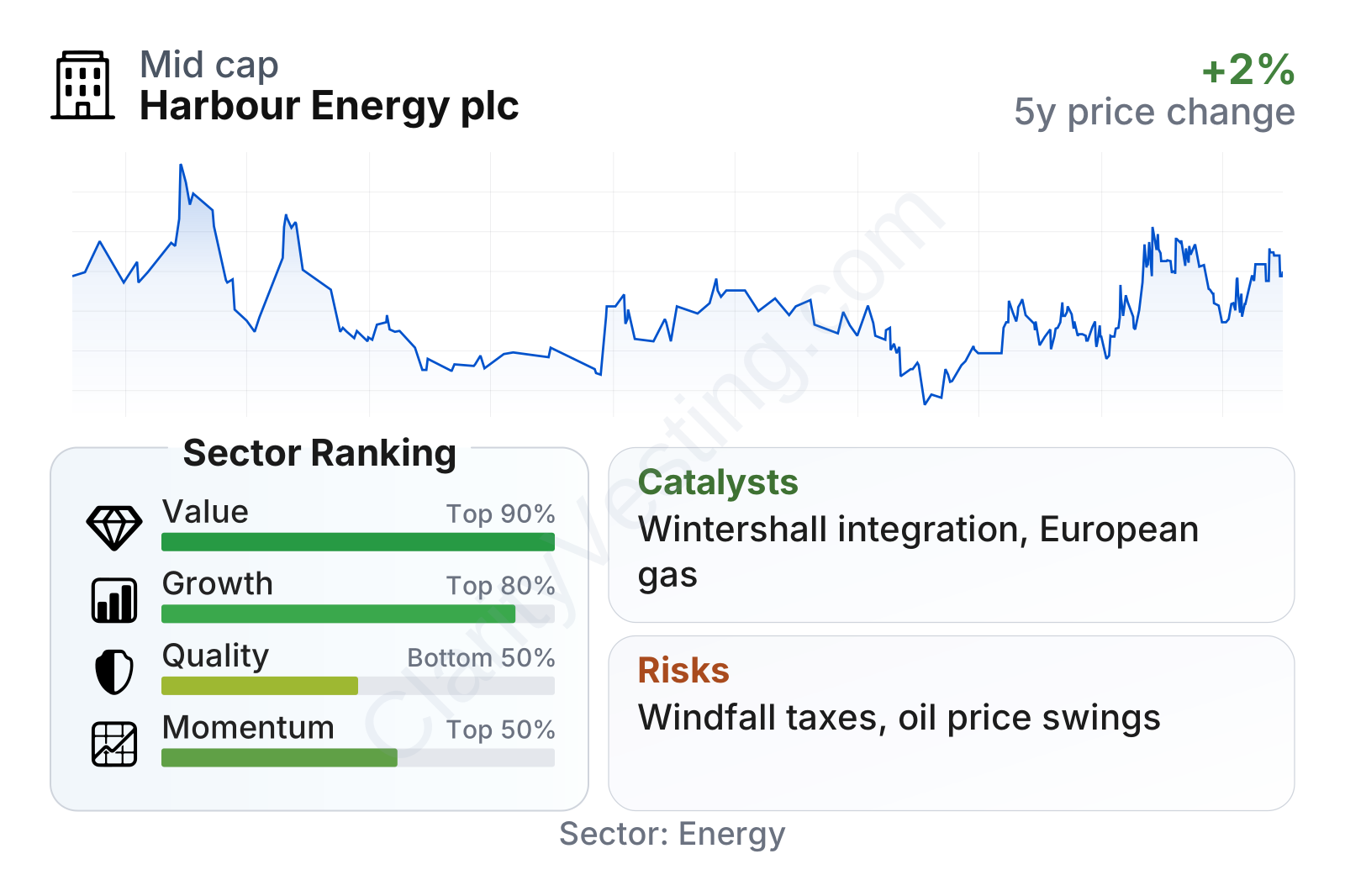
Harbour currently sits in the stronger part of its sector on valuation and growth indicators, while quality metrics are more mixed. The stock trades around the sector median on earnings and slightly below the sector median on book value, but cash-based measures stand out more favorably: free cash flow yield and EBIT relative to enterprise value are far above typical sector levels. Dividend yield is also above the sector median.
Growth metrics are generally solid over a multiyear period. Revenue per share, free cash flow, book value per share, and dividends have all expanded faster than the sector median, helped by portfolio changes and stronger operating scale. However, returns on capital and returns on assets remain weak versus peers, and net profit margin is modest despite strong operating margin. That mismatch points back to taxes, financing costs, and the uneven economics that can appear in upstream energy businesses.
The stock-price path has also been uneven. After a notable decline from 2021 into 2025, the shares recovered into 2026. Even after that rebound, the longer-term picture still looks more cyclical than consistently compounding, which fits the nature of the industry.
Growth
Harbour operates in a sector with a mixed long-term backdrop. Traditional oil and gas production is not a high-structural-growth industry in the same way as software or semiconductors, but it remains essential to the global energy system. Natural gas in particular still has a meaningful role in power generation, industrial use, and energy security, especially in Europe. That gives Harbour exposure to a market that may not be rapidly expanding in volume, but can still generate strong cash flows when supply is tight and prices are supportive.
The company’s strategy is centered on scale, diversification, and reserve replacement. The Wintershall Dea transaction significantly broadened Harbour’s asset base, lifting production and extending reserve life across multiple countries. For a long-term view, that is one of the most important changes in the company’s profile: it moved from being heavily concentrated in a mature basin to owning a wider portfolio with more development options.
Another constructive element is the company’s gas weighting. European energy security remains a strategic issue, and gas assets in stable or nearby supply regions can retain importance even during the energy transition. Harbour also has a pipeline of projects intended to support production and offset natural declines from mature fields. In upstream energy, replacing reserves and sustaining output are central to keeping a business relevant over time.
Recent company updates have also pointed to continued portfolio high-grading, cost discipline, and selective disposals or farm-down activity where appropriate. If executed well, that can improve capital efficiency and reduce balance-sheet strain after a large acquisition-led expansion. The main growth catalyst is therefore less about explosive demand growth and more about extracting value from a larger, more diversified asset base while maintaining strong cash generation.
Risks
This article is for informational purposes only and does not constitute financial advice. Some content is AI-generated. See Disclaimer