Stock Analysis · Philip Morris International Inc (PM)
Overview
Philip Morris International is one of the world’s largest tobacco and nicotine companies. Historically, its business was built on cigarettes sold outside the United States, with Marlboro as its best-known brand. Over the last several years, the company has been reshaping itself around what it calls “smoke-free” products, especially heated tobacco and oral nicotine. That shift matters because cigarette volumes tend to decline over time in many markets, while reduced-risk alternatives are where most of the industry’s growth is now concentrated.
PM’s revenue comes from a mix of traditional combustible tobacco and newer smoke-free products. Based on recent annual company reporting, the business can be understood roughly as follows:
- Combustible tobacco products: about 62% to 66% of net revenues. This includes cigarettes and other smoked tobacco products sold across international markets.
- Smoke-free products: about 34% to 38% of net revenues. This includes heated tobacco units and devices under IQOS, as well as oral smoke-free nicotine products such as ZYN and related categories following the Swedish Match acquisition.
- Within smoke-free, oral products have become a major contributor as ZYN has expanded rapidly, especially in the U.S., while heated tobacco remains a core profit engine in markets where IQOS has strong adoption.
Geographically, Philip Morris is highly diversified, with sales spread across Europe, South and Southeast Asia, East Asia, the Middle East, Africa, and the Americas. No single country dominates the entire business, which helps reduce dependence on one market, although regional regulation and currency movements remain important.
The broader financial picture is notable: revenue has climbed from a little above $31 billion in 2021 to more than $40 billion in 2025, while gross profit and operating income have also moved higher. That combination suggests PM is not simply offsetting cigarette declines with volume, but is also benefiting from product mix and pricing.
The long-term pattern points to a business generating large and rising gross profit, with operating income improving despite meaningful spending on commercialization, distribution, and brand support. The key takeaway is that Philip Morris is increasingly monetizing a higher-value product mix rather than relying only on legacy cigarette demand.
Key Figures
| Metric | Value | Sector ⓘ |
|---|---|---|
| Date | Oct 17, 2026 | |
| Context | ||
| Sector | Consumer Defensive | |
| Industry | Tobacco | |
| Market Cap ⓘ | $314.84B | |
| Beta ⓘ | 0.36 | |
Value (Cheapness) | ||
| P/E Ratio ⓘ | 29.15 | 17.88 |
| P/B Ratio ⓘ | N/A | 1.29 |
| FCF Yield ⓘ | 4.04% | 12.39% |
| Dividend Yield ⓘ | 2.92% | 2.85% |
| EBIT / EV ⓘ | 4.89% | 6.43% |
| PEG ⓘ | 2.29 | |
Growth (Business expansion) | ||
| Revenue Growth ⓘ | 10.40% | 4.10% |
| RPS Growth (5Y CAGR) ⓘ | 6.68% | 6.18% |
| EPS Growth (5Y CAGR) ⓘ | -9.15% | -13.59% |
| BVPS Growth (5Y CAGR) ⓘ | -0.26% | 3.20% |
| Margin Growth (5Y Trend) ⓘ | 31.76% | -0.15% |
| FCF Growth (5Y CAGR) ⓘ | -1.26% | 4.10% |
| DPS Growth (5Y CAGR) ⓘ | 3.30% | 6.79% |
Quality (Business durability) | ||
| ROIC (Latest) ⓘ | 32.75% | 12.34% |
| ROA (Latest) ⓘ | 16.07% | 6.30% |
| ROIC (5Y Median) ⓘ | 31.82% | 10.49% |
| ROA (5Y Median) ⓘ | 12.27% | 5.44% |
| Net Debt / EBIT (Latest) ⓘ | 2.59 | 1.96 |
| Net Debt / EBIT (5Y Median) ⓘ | 2.97 | 2.35 |
| Net Debt / EBITDA (Latest) ⓘ | 2.30 | 1.38 |
| Net Debt / Assets ⓘ | 63.15% | 21.51% |
| EBITDA / Interest ⓘ | 12.08 | 9.46 |
| Operating Margin (Latest) ⓘ | 39.17% | 8.87% |
| Operating Margin (5Y Median) ⓘ | 36.86% | 9.53% |
| Debt to Equity (Latest) ⓘ | -572.21% | 72.35% |
| Profit Margin (Latest) ⓘ | 25.56% | 5.40% |
| Free Cash Flow (Latest) ⓘ | $12.72B | |
Momentum (Price trend) | ||
| 3Y Return ⓘ | +144.29% | +20.92% |
| 12M Return (excl. last month) ⓘ | +19.19% | +2.13% |
| 6M Return ⓘ | +24.53% | +1.26% |
| Price vs. 200-Day MA ⓘ | +12.94% | +1.39% |
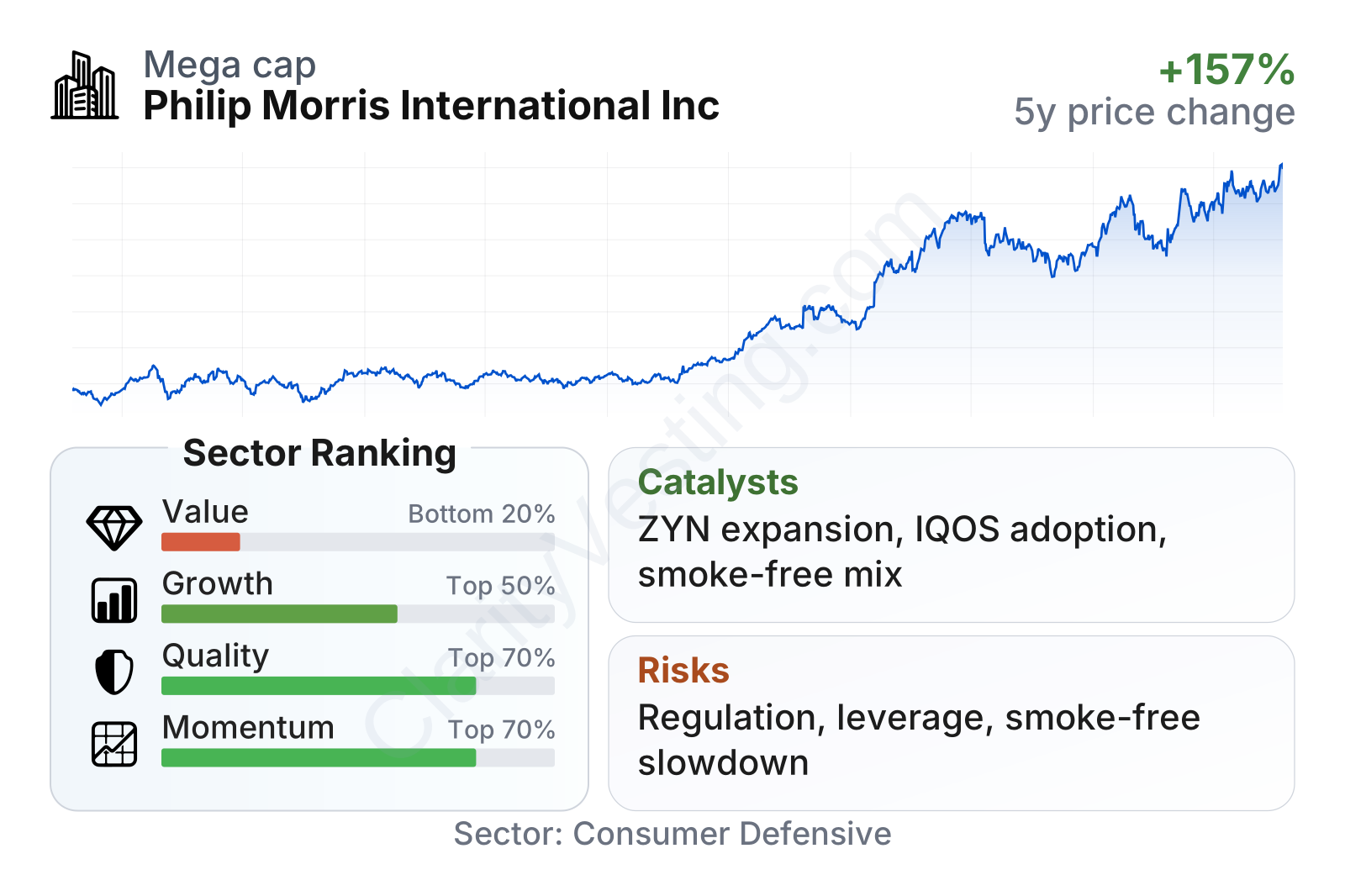
Philip Morris stands out as a very large company with unusually strong quality metrics for its sector. Profitability is well above industry norms, growth is better than the sector median, and recent share-price momentum has been strong. The weak point is valuation: the stock trades at a higher earnings multiple than most consumer defensive peers, so the market is already giving substantial credit to the company’s transition and cash-generation profile.
The stock-price history also shows a major re-rating since 2024. That rise usually means expectations are now higher than they were a few years ago, which can make future results more important for sustaining sentiment.
Growth
Philip Morris operates in a sector that looks weak on the surface but is changing internally. Traditional cigarette demand is generally a declining category in many developed markets, yet nicotine consumption has not disappeared. Instead, growth has shifted toward alternatives such as heated tobacco and oral nicotine pouches. PM has positioned itself directly in that transition, which gives it exposure to the more dynamic parts of the market rather than only the shrinking ones.
The company’s strategy is coherent. IQOS gives it a strong position in heated tobacco, a category where brand loyalty, device ecosystems, regulatory authorization, and distribution scale all matter. The Swedish Match acquisition added ZYN, which has become one of the most important growth assets in nicotine pouches. This combination gives PM exposure to two of the most promising reduced-risk product formats rather than depending on a single platform.
Revenue growth has stayed positive in most recent periods and has moved at a pace clearly above the sector median. That matters because many tobacco businesses are judged mainly on pricing power and cash extraction. PM is showing something stronger: a mix of price, category expansion, and portfolio upgrading.
Free cash flow remains substantial, at more than $12 billion on a trailing basis in the latest snapshot, and the direction has improved from the softer period seen in 2023. For a consumer staples company, that level of cash generation is important because it supports debt service, dividends, product investment, and flexibility for future expansion.
One of the strongest current catalysts is ZYN. Public company updates have highlighted continued capacity expansion and strong demand, especially in the U.S. oral nicotine market. Another catalyst is the continued rollout and penetration of IQOS and related heated-tobacco consumables in international markets. If smoke-free products continue gaining share of revenue and profit, PM’s overall growth profile may keep looking less like a mature tobacco company and more like a nicotine-platform company with multiple growth engines.
Recent company updates have also continued to emphasize smoke-free net revenue growth, shipment expansion in oral products, and ongoing efforts to broaden distribution. Those developments support the idea that PM’s transition is no longer theoretical; it is already visible in the sales mix.
Risks
This article is for informational purposes only and does not constitute financial advice. Some content is AI-generated. See Disclaimer


