Stock Analysis · Plug Power Inc (PLUG)
Overview
Plug Power Inc is a hydrogen and fuel cell company focused on equipment and infrastructure used to power vehicles, industrial sites, and energy systems. In simple terms, it helps customers replace or supplement batteries and fossil-fuel-based systems with hydrogen-powered solutions. Its business spans fuel cell systems, electrolyzers that produce hydrogen from electricity, hydrogen fueling infrastructure, cryogenic equipment, and hydrogen supply.
The company has historically been strongest in material handling, especially fuel cell systems and related hydrogen services used in forklift fleets at large warehouses and distribution centers. Over time, Plug Power expanded into broader hydrogen infrastructure, with the goal of building an end-to-end platform: producing hydrogen, moving it, storing it, and using it in equipment and stationary power applications.
Based on recent annual reporting, Plug Power’s revenue mix is spread across equipment sales, hydrogen-related fuel and service activities, and support arrangements. The exact mix can move meaningfully from year to year because equipment deployments, service contracts, and hydrogen fuel volumes do not grow at the same pace.
- Product revenue: approximately 45% to 55% of revenue in recent periods. This includes fuel cell systems, electrolyzers, stationary power products, and other equipment sales.
- Services performed on fuel cell systems and related infrastructure: approximately 20% to 30%. This includes maintenance, support, and service programs tied to installed systems.
- Fuel delivered to customers: approximately 15% to 25%. This mainly reflects hydrogen supply sold into customer operations.
- Power purchase agreements, leases, and other revenue: generally a smaller share than the categories above. This can include hosted or structured commercial arrangements.
That structure matters because Plug Power is not just selling machines once. It is also trying to build recurring activity around fuel, service, and infrastructure. In theory, that can create a more durable business model over time. In practice, it also exposes the company to execution risk because it must manage equipment margins, service costs, hydrogen sourcing, and project delivery at the same time.
The financial flow shows why the market remains cautious. Revenue has been sizable, but the cost of revenue has stayed above sales for several years, resulting in negative gross profit. Operating costs have also remained heavy even after some reductions, which means the company’s challenge is not demand alone; it is turning revenue into profitable revenue.
Key Figures
| Metric | Value | Sector ⓘ |
|---|---|---|
| Date | Oct 24, 2026 | |
| Context | ||
| Sector | Industrials | |
| Industry | Electrical Equipment & Parts | |
| Market Cap ⓘ | $1.96B | |
| Beta ⓘ | 2.29 | |
Value (Cheapness) | ||
| P/E Ratio ⓘ | N/A | 22.29 |
| P/B Ratio ⓘ | 3.40 | 1.98 |
| FCF Yield ⓘ | -27.41% | 6.26% |
| Dividend Yield ⓘ | N/A | 1.92% |
| EBIT / EV ⓘ | -42.68% | 4.83% |
| PEG ⓘ | 0.84 | |
Growth (Business expansion) | ||
| Revenue Growth ⓘ | 2.50% | 9.30% |
| RPS Growth (5Y CAGR) ⓘ | -9.16% | 7.76% |
| EPS Growth (5Y CAGR) ⓘ | -35.05% | -13.17% |
| BVPS Growth (5Y CAGR) ⓘ | -43.81% | 6.13% |
| Margin Growth (5Y Trend) ⓘ | N/A | 0.74% |
| FCF Growth (5Y CAGR) ⓘ | N/A | 10.79% |
| DPS Growth (5Y CAGR) ⓘ | -36.83% | 9.41% |
Quality (Business durability) | ||
| ROIC (Latest) ⓘ | -80.07% | 10.75% |
| ROA (Latest) ⓘ | -61.97% | 5.41% |
| ROIC (5Y Median) ⓘ | -28.21% | 9.37% |
| ROA (5Y Median) ⓘ | -25.66% | 4.95% |
| Net Debt / EBIT (Latest) ⓘ | N/A | 2.04 |
| Net Debt / EBIT (5Y Median) ⓘ | N/A | 2.27 |
| Net Debt / EBITDA (Latest) ⓘ | N/A | 1.39 |
| Net Debt / Assets ⓘ | 30.16% | 19.27% |
| EBITDA / Interest ⓘ | N/A | 9.58 |
| Operating Margin (Latest) ⓘ | -219.29% | 10.49% |
| Operating Margin (5Y Median) ⓘ | -149.33% | 10.30% |
| Debt to Equity (Latest) ⓘ | 141.49% | 64.82% |
| Profit Margin (Latest) ⓘ | -220.59% | 6.67% |
| Free Cash Flow (Latest) ⓘ | -$536.14M | |
Momentum (Price trend) | ||
| 3Y Return ⓘ | -76.89% | +67.77% |
| 12M Return (excl. last month) ⓘ | -4.13% | +12.05% |
| 6M Return ⓘ | -54.22% | 0.00% |
| Price vs. 200-Day MA ⓘ | -41.97% | +0.67% |
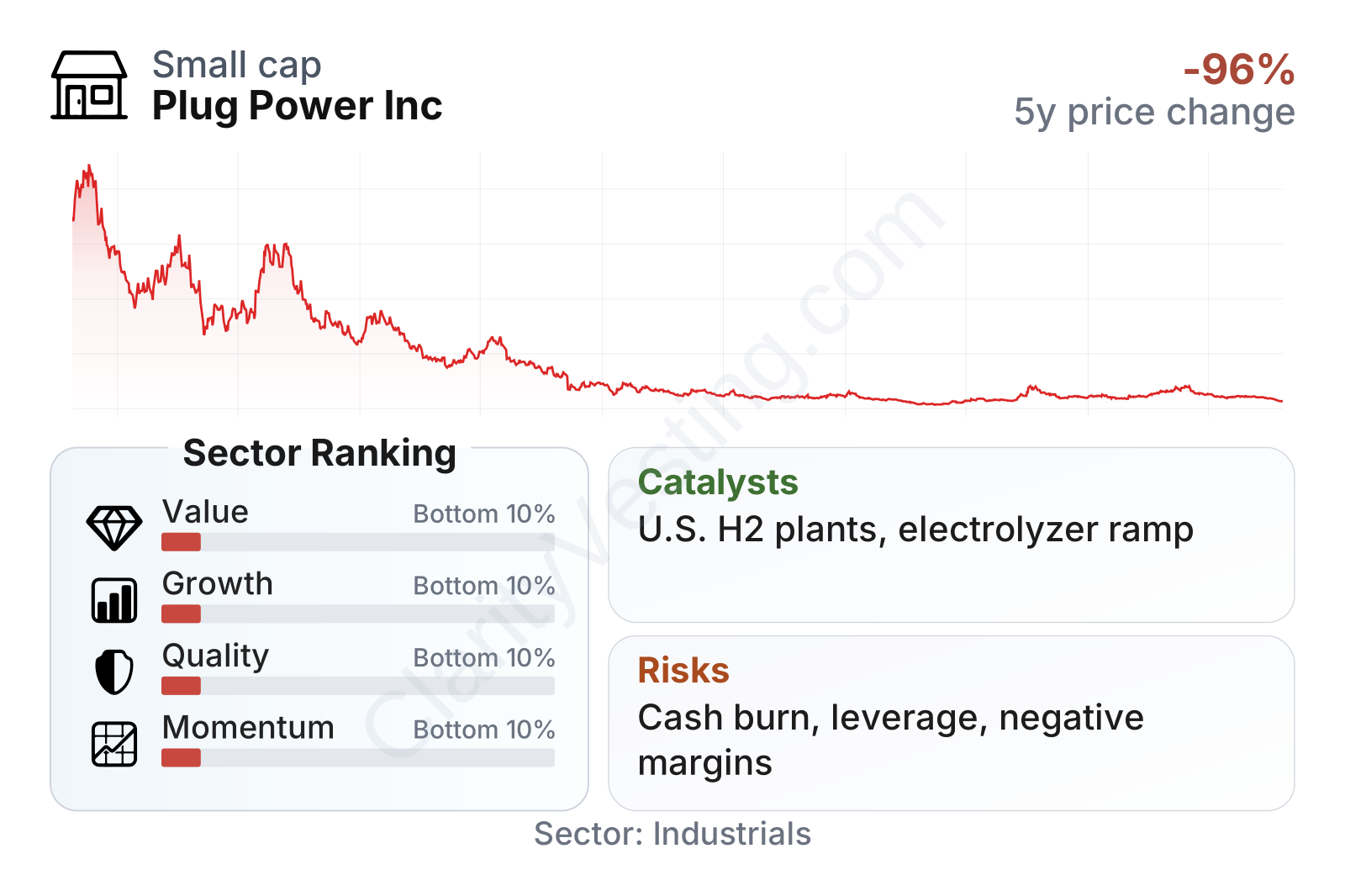
The overall picture is weak across value, growth, and quality compared with the broader industrial sector. Plug Power is now a small-cap company with very high share-price volatility, as shown by its elevated beta and large multi-year stock decline. The table also points to a difficult mix of negative free cash flow, deeply negative returns on capital, and margins far below sector norms. Even where the stock no longer carries the kind of valuation seen during the hydrogen boom, traditional valuation tools remain hard to use because earnings and cash flow are still materially negative.
Growth
Plug Power operates in a sector with real long-term relevance. Hydrogen has potential in areas where batteries can be less convenient, such as heavy-duty operations, backup power, industrial decarbonization, and sites that need fast refueling or long runtime. Electrolyzers also fit into the broader push for low-carbon hydrogen production, especially where renewable power is available. So the industry backdrop is credible, even if the timing of adoption has been slower and more uneven than many expected.
The company’s strategy also makes sense on paper. Rather than selling only fuel cells, Plug Power has tried to build a vertically integrated hydrogen platform. That can be strategically attractive because customers often need a complete solution, not just one piece of hardware. If the company can control more of the hydrogen value chain, it could eventually improve reliability, lower delivered fuel costs, and capture more revenue per customer relationship.
Recent revenue growth, however, has been inconsistent. After very strong expansion earlier in the cycle, growth turned negative in 2024 and then returned to modest positive territory. That pattern suggests the demand opportunity still exists, but order timing, customer rollouts, and project execution remain uneven. It also means the company is still far from proving a smooth scaling path.
Cash burn remains one of the most important signals. Free cash flow is still deeply negative, although the trend has improved from the worst levels seen earlier. That improvement matters because it indicates cost actions and capital discipline may be helping, but the business has not yet reached a self-funded model. For a long-term case to strengthen, improvement in cash consumption is almost as important as headline revenue growth.
One of the main catalysts is the build-out of U.S. hydrogen production capacity and the possible economic support from clean hydrogen incentives. Plug Power has repeatedly emphasized hydrogen plants, electrolyzer deployment, and large commercial partnerships as the foundation for future scale. If those assets ramp as planned and lower the company’s delivered hydrogen costs, growth could become more durable and margins could improve at the same time.
Another important opportunity is that Plug Power already has a recognizable presence in warehouse and logistics applications, where hydrogen has practical advantages such as quick refueling and stable performance over long shifts. That installed base gives the company a reference market from which it can expand into adjacent uses, including stationary backup systems and industrial hydrogen supply.
Risks
This article is for informational purposes only and does not constitute financial advice. Some content is AI-generated. See Disclaimer


