Stock Analysis · Pulse Biosciences Inc (PLSE)
Overview
Pulse Biosciences is a medical technology company developing devices that use short electrical pulses to treat tissue. Its core platform is called Nanosecond Pulsed Field Ablation, or nsPFA. In simple terms, the technology is designed to destroy targeted cells while limiting unwanted heat damage to surrounding tissue. The company is focused on using this approach in procedures performed by physicians, especially in electrophysiology, where doctors treat abnormal heart rhythms, and in certain soft tissue or dermatology-related applications.
At this stage, Pulse Biosciences is still largely a commercial and development-stage business rather than a mature operating company. Revenue has remained very limited, which means the company’s present investment case depends much more on future adoption of its technology than on current sales volume.
Based on recent filings, revenue is currently small and not broadly diversified. The business has generated only modest product-related and other operating revenue, with no large recurring revenue base yet visible. A practical way to think about the current revenue mix is:
- System and procedure-related revenue: approximately 100% of total revenue when revenue is present, tied to the company’s medical technology platform and related commercial activity.
- Other sources: approximately 0% in any meaningful recurring sense, as there is no established contribution from subscriptions, large service contracts, or diversified business lines.
What stands out more than revenue composition is spending allocation. The company has consistently directed a large share of its operating expenses toward research and development, while sales, general, and administrative expenses have also increased as commercialization efforts expanded. That pattern is typical for a company trying to move from promising technology to broader market adoption.
The cost structure shows a business still in build-out mode: research and development remains the main use of operating cash, and losses have persisted because revenue is still too small to absorb that spending.
Key Figures
| Metric | Value | Sector ⓘ |
|---|---|---|
| Date | Oct 24, 2026 | |
| Context | ||
| Sector | Healthcare | |
| Industry | Medical Instruments & Supplies | |
| Market Cap ⓘ | $3.66B | |
| Beta ⓘ | 1.57 | |
Value (Cheapness) | ||
| P/E Ratio ⓘ | N/A | 25.42 |
| P/B Ratio ⓘ | 36.64 | 3.08 |
| FCF Yield ⓘ | -1.68% | 3.12% |
| Dividend Yield ⓘ | N/A | 1.85% |
| EBIT / EV ⓘ | -2.24% | 0.56% |
| PEG ⓘ | N/A | |
Growth (Business expansion) | ||
| Revenue Growth ⓘ | N/A | 7.50% |
| RPS Growth (5Y CAGR) ⓘ | -43.43% | 8.60% |
| EPS Growth (5Y CAGR) ⓘ | -24.91% | -17.73% |
| BVPS Growth (5Y CAGR) ⓘ | -1.60% | 3.72% |
| Margin Growth (5Y Trend) ⓘ | N/A | -0.57% |
| FCF Growth (5Y CAGR) ⓘ | -0.04% | 0.96% |
| DPS Growth (5Y CAGR) ⓘ | N/A | 6.69% |
Quality (Business durability) | ||
| ROIC (Latest) ⓘ | -74.17% | 3.17% |
| ROA (Latest) ⓘ | -71.37% | 2.98% |
| ROIC (5Y Median) ⓘ | -59.37% | 4.56% |
| ROA (5Y Median) ⓘ | -63.68% | 1.87% |
| Net Debt / EBIT (Latest) ⓘ | N/A | 1.34 |
| Net Debt / EBIT (5Y Median) ⓘ | N/A | 1.86 |
| Net Debt / EBITDA (Latest) ⓘ | N/A | 1.00 |
| Net Debt / Assets ⓘ | -82.07% | 5.06% |
| EBITDA / Interest ⓘ | N/A | 9.55 |
| Operating Margin (Latest) ⓘ | -6803.80% | 9.25% |
| Operating Margin (5Y Median) ⓘ | -6368.86% | 7.33% |
| Debt to Equity (Latest) ⓘ | 6.81% | 26.68% |
| Profit Margin (Latest) ⓘ | N/A | 3.34% |
| Free Cash Flow (Latest) ⓘ | -$61.39M | |
Momentum (Price trend) | ||
| 3Y Return ⓘ | +1230.30% | +51.61% |
| 12M Return (excl. last month) ⓘ | +200.06% | +19.90% |
| 6M Return ⓘ | +115.64% | +10.10% |
| Price vs. 200-Day MA ⓘ | +74.53% | +6.44% |
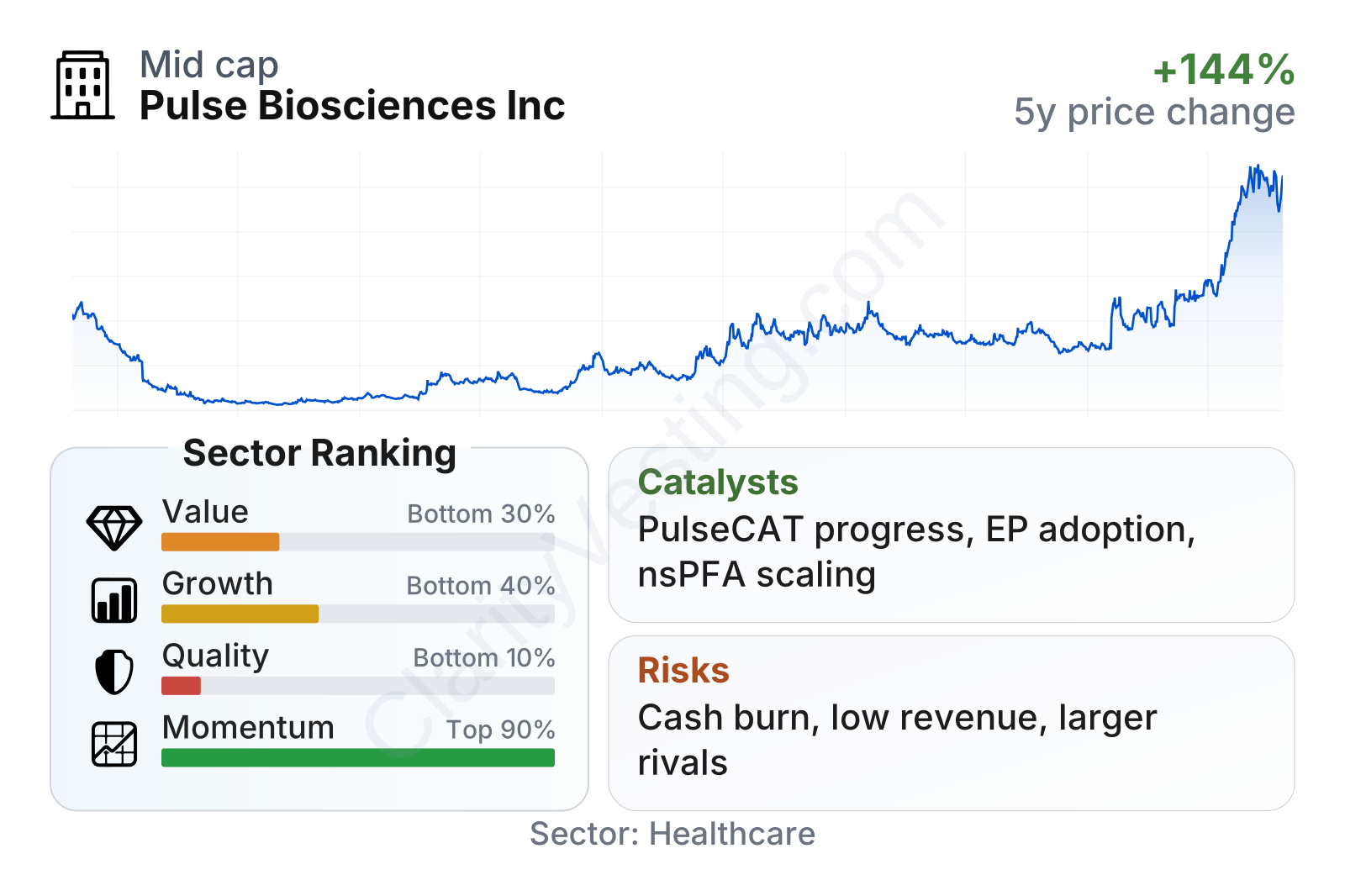
Pulse Biosciences is now a mid-cap healthcare name by market value, but its financial profile still looks much closer to an early-stage medtech company than to an established equipment supplier. Valuation measures sit in the weaker part of the sector, largely because the stock carries a high price-to-book ratio while earnings and cash flow remain negative. Quality metrics are especially weak relative to peers, reflecting heavy losses and poor returns on capital. By contrast, share-price momentum has been exceptionally strong, showing that market expectations have improved much faster than business fundamentals.
The stock’s historical trading pattern also highlights high volatility. After a deep decline earlier in the period shown, the shares recovered sharply and have recently reached much higher levels. That kind of move often signals that investors are assigning greater odds to future commercial success, but it also means sentiment plays a large role in day-to-day valuation.
Growth
Pulse Biosciences operates in an area of healthcare that is structurally attractive. Electrophysiology and minimally invasive energy-based procedures are growing fields because hospitals and physicians continue to look for treatments that are more precise, faster to perform, and potentially safer for patients. Pulsed field ablation, in particular, has become one of the most closely watched technologies in cardiac ablation. That gives the company exposure to a real and expanding market rather than a niche with limited demand.
The strategic logic also makes sense. Instead of competing broadly across many device categories, Pulse Biosciences is concentrating on a platform technology that could be used in multiple clinical settings. If physicians view nsPFA as effective and practical, the same underlying technology could support expansion across additional indications over time. That platform potential is one of the company’s most important long-term growth features.
Reported revenue growth has been erratic and, in some periods, effectively absent. That is not unusual for a company still before broad-scale commercialization, but it does mean traditional sales trend analysis is not yet very informative. The real growth question is whether clinical progress, regulatory milestones, and early physician adoption can eventually convert into repeatable procedure volume and equipment placements.
Cash generation remains negative, and free cash outflow has widened again over the last year. That points to continued investment in development and market preparation rather than operational self-funding. For long-term analysis, the key issue is whether current cash use is building toward a larger commercial opportunity or simply extending the path to profitability.
A notable positive is recent company progress around the cardiac ablation opportunity. Public company communications in 2026 pointed to continued advancement of its cardiac programs, including work tied to the PulseCAT platform and broader electrophysiology ambitions. In this market, even incremental evidence of physician interest, trial execution, or procedural success can materially expand perceived market potential. Because large medtech companies have validated pulsed field ablation as an important category, Pulse Biosciences does not need to prove the market exists; it needs to prove that its own approach can win a durable place within it.
Risks
This article is for informational purposes only and does not constitute financial advice. Some content is AI-generated. See Disclaimer


