Stock Analysis · Palomar Holdings Inc (PLMR)
Overview
Palomar Holdings is a specialty property and casualty insurer focused on risks that are often difficult to price or underserved by larger traditional carriers. The company is best known for earthquake insurance, but it also writes policies tied to hurricanes, floods, inland marine, and other property-related exposures. Rather than trying to be a broad all-purpose insurer, Palomar concentrates on selected markets where data, underwriting discipline, and reinsurance structure can create room for attractive returns.
The business earns most of its money from insurance premiums, then supplements that with fee income and investment income on the assets it holds. Based on recent company disclosures, revenue is primarily tied to gross written premiums across specialty property lines, with earthquake-related products still representing the largest category, though less dominant than in earlier years as the company has diversified. The mix can shift by quarter and catastrophe conditions, but the business is broadly built around the following sources:
- Residential earthquake insurance: approximately 35% to 45% of premiums in recent periods. This includes homeowners’ earthquake coverage, mainly in states with meaningful seismic exposure.
- Commercial earthquake insurance: approximately 15% to 25% of premiums. This covers businesses and commercial properties needing protection against quake-related losses.
- Fronting and other specialty property programs: approximately 15% to 25%. This area includes programs where Palomar provides paper, underwriting, or distribution support for specialty insurance partners.
- Inland marine and other property lines: approximately 10% to 20%. These policies can include mobile or specialized property exposures and other niche commercial risks.
- Hurricane, flood, and wind-related products: approximately 5% to 15% combined, depending on seasonality, underwriting appetite, and geographic expansion.
- Investment and other income: a smaller contribution than underwriting revenue, but still important for overall profitability, especially as interest rates affect portfolio yields.
One notable change in recent years is that Palomar has become less dependent on a single line of business. That matters because specialty insurers can look highly profitable until one exposure becomes too concentrated. A broader product mix does not remove catastrophe risk, but it can improve resilience if management keeps underwriting standards tight.
The profit flow over the last several years shows a business that has scaled rapidly while preserving operating discipline. Revenue and net income both moved sharply higher from 2021 through 2025, and operating income expanded faster than overhead, suggesting that growth has not simply been purchased through rising expenses.
Key Figures
| Metric | Value | Sector ⓘ |
|---|---|---|
| Date | Oct 24, 2026 | |
| Context | ||
| Sector | Financial Services | |
| Industry | Insurance - Property & Casualty | |
| Market Cap ⓘ | $3.69B | |
| Beta ⓘ | 0.35 | |
Value (Cheapness) | ||
| P/E Ratio ⓘ | 18.73 | 12.46 |
| P/B Ratio ⓘ | 3.99 | 1.25 |
| FCF Yield ⓘ | 11.14% | 9.82% |
| Dividend Yield ⓘ | N/A | 2.94% |
| EBIT / EV ⓘ | 7.59% | 8.11% |
| PEG ⓘ | N/A | |
Growth (Business expansion) | ||
| Revenue Growth ⓘ | 54.70% | 9.10% |
| RPS Growth (5Y CAGR) ⓘ | 35.37% | 12.31% |
| EPS Growth (5Y CAGR) ⓘ | 16.17% | -6.97% |
| BVPS Growth (5Y CAGR) ⓘ | 22.77% | 5.02% |
| Margin Growth (5Y Trend) ⓘ | 5.90% | -4.00% |
| FCF Growth (5Y CAGR) ⓘ | 48.37% | 4.71% |
| DPS Growth (5Y CAGR) ⓘ | 28.51% | 8.92% |
Quality (Business durability) | ||
| ROIC (Latest) ⓘ | 19.26% | 9.18% |
| ROE (Latest) ⓘ | 21.86% | 13.93% |
| ROA (Latest) ⓘ | 5.88% | 1.57% |
| ROIC (5Y Median) ⓘ | 17.37% | 7.80% |
| ROE (5Y Median) ⓘ | 18.50% | 12.15% |
| ROA (5Y Median) ⓘ | 5.54% | 1.28% |
| Net Debt / EBIT (Latest) ⓘ | 0.86 | 1.02 |
| Net Debt / EBIT (5Y Median) ⓘ | -0.46 | 0.72 |
| Net Debt / EBITDA (Latest) ⓘ | 0.81 | 0.88 |
| Operating Margin (Latest) ⓘ | 24.87% | 22.30% |
| Operating Margin (5Y Median) ⓘ | 27.50% | 24.50% |
| Debt to Equity (Latest) ⓘ | 30.15% | 59.34% |
| Profit Margin (Latest) ⓘ | 18.62% | 26.42% |
| Free Cash Flow (Latest) ⓘ | $410.85M | |
Momentum (Price trend) | ||
| 3Y Return ⓘ | +198.55% | +95.73% |
| 12M Return (excl. last month) ⓘ | +13.26% | +17.30% |
| 6M Return ⓘ | +12.39% | +6.07% |
| Price vs. 200-Day MA ⓘ | +14.98% | +5.36% |
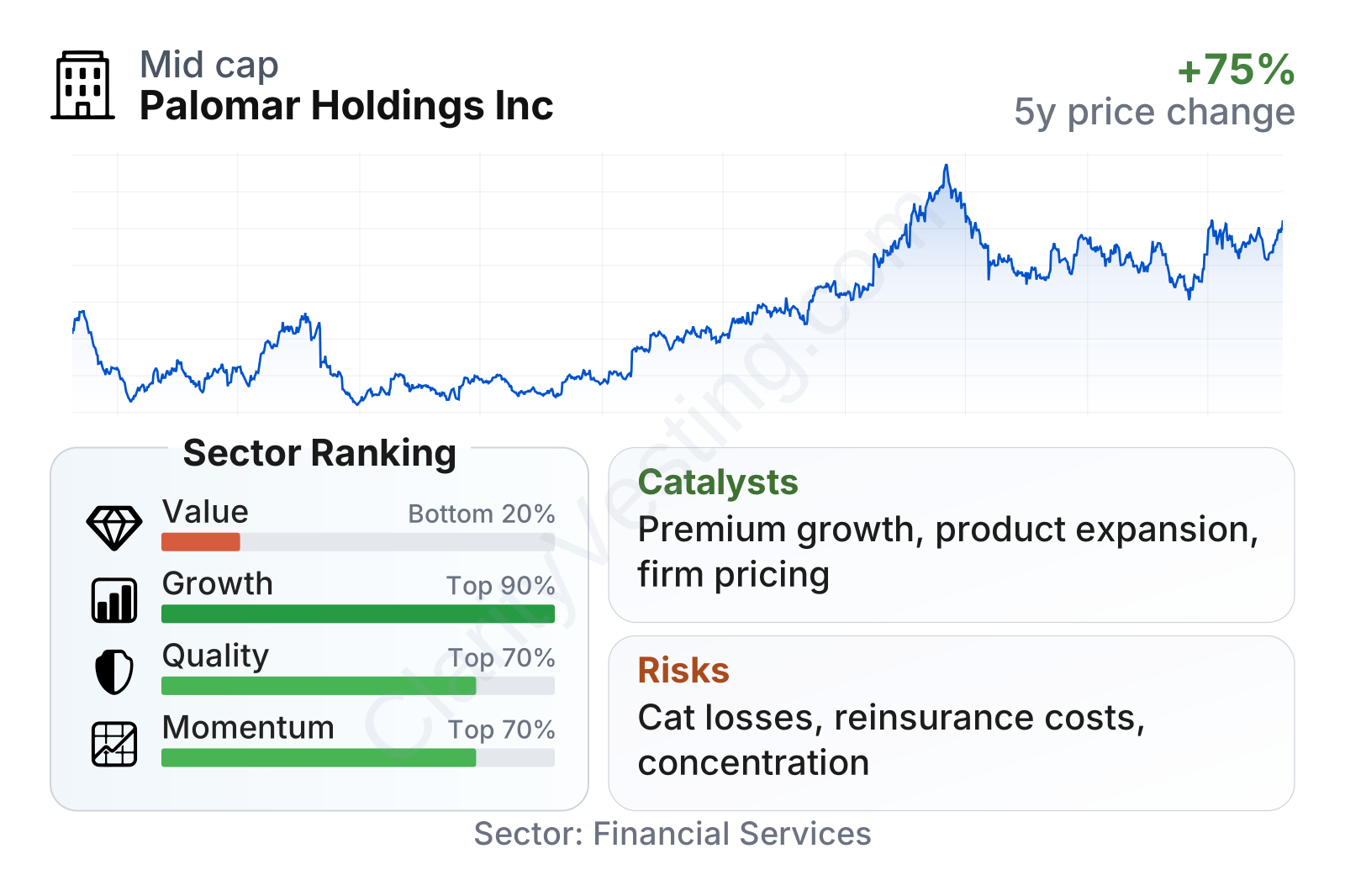
Palomar is still a mid-sized insurer by market value, with a share price history that has been volatile but strongly upward over the last three years. In the factor view, the company stands out most on growth and remains solid on quality. Revenue growth, earnings growth, book value growth, and free cash flow expansion are all well above the sector median. Profitability is also strong, with returns on equity and assets comfortably ahead of peers and leverage below the industry midpoint. The weaker area is valuation, because the stock trades at higher earnings and book multiples than much of the sector, and momentum has cooled recently after a strong multi-year run.
Growth
Palomar operates in a part of insurance that has long-term room for expansion. Natural catastrophe risk is not going away, and in many regions it is becoming more visible because of population growth in exposed areas, rising replacement costs, pressure on state-backed insurance systems, and reduced appetite from standard insurers. That creates space for specialist carriers able to model risk, price carefully, and secure adequate reinsurance.
The company’s strategy appears coherent for that environment. It focuses on niche property risks, expands through both admitted and excess-and-surplus channels, and uses technology and third-party distribution to reach customers without building a massive traditional agency footprint. This is especially relevant in catastrophe-exposed insurance, where speed of pricing and disciplined risk selection can matter more than national brand recognition.
Recent financial progression supports the idea that this strategy has been working. Revenue climbed from about $248 million in 2021 to roughly $876 million in 2025, while net income rose from about $46 million to about $197 million over the same period. That is unusually strong expansion for an insurer, particularly because margins also remained healthy instead of collapsing under the weight of growth.
Earnings per share have moved up sharply over the last five full years shown, from just above $2 to nearly $8 by 2025. Even allowing for normal insurance volatility, that trend suggests growth has not been purely driven by accounting noise or balance-sheet expansion; it has translated into meaningful per-share profit improvement.
Book value per share has also advanced quickly, especially since 2023. For insurers, book value is an important measure because it reflects the capital base supporting underwriting. A rising book value per share often indicates that growth is being built on retained earnings and disciplined capital management rather than excessive dilution or debt.
Another growth support is the broader insurance market backdrop. In catastrophe-exposed property lines, pricing has generally become firmer after years of loss inflation and tighter reinsurance conditions. When weaker competitors pull back, specialists with stronger underwriting infrastructure can gain share at more attractive rates. If Palomar continues broadening beyond earthquake into adjacent products while maintaining underwriting discipline, it may keep benefiting from that favorable setup.
Recent company communications have also highlighted continued product expansion, premium growth, and reinsurance execution. For a company like Palomar, access to reinsurance at workable prices is a central growth enabler because it determines how much risk can be retained and how confidently new business can be written.
Risks
This article is for informational purposes only and does not constitute financial advice. Some content is AI-generated. See Disclaimer


