Stock Analysis · Prologis Inc (PLD)
Overview
Prologis is a real estate investment trust, or REIT, focused on industrial properties. In simple terms, it owns, develops, and manages warehouses, distribution centers, and logistics facilities that help businesses store goods and move them through supply chains. Its customers include e-commerce companies, retailers, manufacturers, transportation providers, and other businesses that need well-located space near large population centers, ports, airports, and major highways.
The company operates at very large scale across the Americas, Europe, and Asia, and that scale is central to its business model. Prologis does not only collect rent from buildings it already owns. It also develops new logistics properties, earns fees from managing capital for investment ventures, and offers adjacent services such as energy and digital infrastructure tied to its real estate footprint. That mix gives it exposure both to recurring rental income and to more cyclical development and transaction-related earnings.
Based on recent company reporting, Prologis’ revenue mix is broadly organized as follows:
- Rental and other real estate operations: approximately 70% to 80% — recurring rent from owned logistics facilities, plus reimbursements and property-related income.
- Strategic capital income: approximately 10% to 15% — fees and incentive income from managing co-investment ventures and funds with institutional partners.
- Development management and other contributions: approximately 10% to 15% — profits tied to property development, land monetization, and other activities that can vary more from year to year.
This is still fundamentally a landlord business, but one aimed at the infrastructure behind modern commerce. Over the last several years, total revenue has expanded strongly, while profitability remained high even as interest expense climbed. The latest pattern also shows that revenue kept rising into 2025, although the mix became less favorable as financing costs increased and development-related economics became less supportive than in earlier years.
Revenue has grown substantially since 2021, and the company has kept a large share of that revenue as operating profit. The more recent shift is that interest costs have risen much faster than revenue, which helps explain why earnings growth has been less smooth than top-line growth.
Key Figures
| Metric | Value | Sector ⓘ |
|---|---|---|
| Date | Oct 19, 2026 | |
| Context | ||
| Sector | Real Estate | |
| Industry | REIT - Industrial | |
| Market Cap ⓘ | $122.24B | |
| Beta ⓘ | 1.32 | |
Value (Cheapness) | ||
| P/E Ratio ⓘ | 27.70 | 17.38 |
| P/B Ratio ⓘ | 2.46 | 0.85 |
| FCF Yield ⓘ | 4.29% | 7.38% |
| Dividend Yield ⓘ | 3.32% | 4.85% |
| EBIT / EV ⓘ | 3.55% | 3.78% |
| PEG ⓘ | 116.61 | |
Growth (Business expansion) | ||
| Revenue Growth ⓘ | 10.20% | 5.30% |
| RPS Growth (5Y CAGR) ⓘ | 10.94% | 6.02% |
| EPS Growth (5Y CAGR) ⓘ | 0.06% | -11.37% |
| BVPS Growth (5Y CAGR) ⓘ | 4.57% | 0.45% |
| Margin Growth (5Y Trend) ⓘ | -23.05% | -0.22% |
| FCF Growth (5Y CAGR) ⓘ | 13.71% | 5.40% |
| DPS Growth (5Y CAGR) ⓘ | 13.31% | 5.02% |
Quality (Business durability) | ||
| ROIC (Latest) ⓘ | 5.95% | 5.69% |
| ROE (Latest) ⓘ | 8.64% | 7.56% |
| ROA (Latest) ⓘ | 4.22% | 2.85% |
| ROIC (5Y Median) ⓘ | 5.69% | 4.22% |
| ROE (5Y Median) ⓘ | 7.62% | 6.03% |
| ROA (5Y Median) ⓘ | 3.96% | 2.44% |
| Net Debt / EBIT (Latest) ⓘ | 6.17 | 7.59 |
| Net Debt / EBIT (5Y Median) ⓘ | 6.09 | 8.40 |
| Net Debt / EBITDA (Latest) ⓘ | 4.15 | 5.27 |
| Net Debt / Assets ⓘ | 34.33% | 37.76% |
| EBITDA / Interest ⓘ | 7.93 | 4.10 |
| Operating Margin (Latest) ⓘ | 61.38% | 35.29% |
| Operating Margin (5Y Median) ⓘ | 60.38% | 37.31% |
| Debt to Equity (Latest) ⓘ | 67.83% | 88.87% |
| Profit Margin (Latest) ⓘ | 43.07% | 19.61% |
| Free Cash Flow (Latest) ⓘ | $5.24B | |
Momentum (Price trend) | ||
| 3Y Return ⓘ | +28.09% | +30.75% |
| 12M Return (excl. last month) ⓘ | +20.97% | +4.36% |
| 6M Return ⓘ | -10.20% | -2.52% |
| Price vs. 200-Day MA ⓘ | -7.66% | -2.34% |
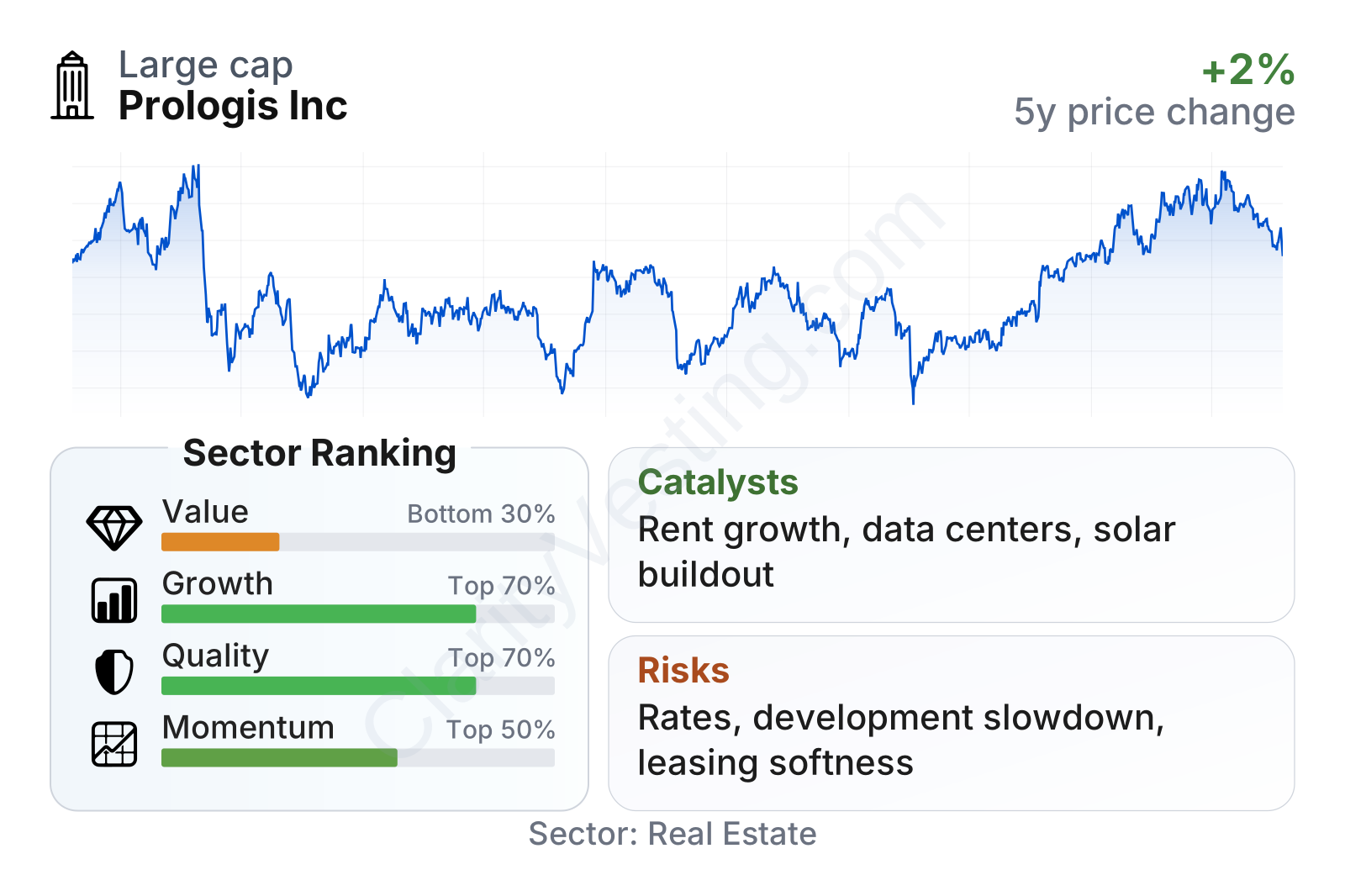
Prologis is one of the largest listed real estate companies in the market, and its quality and growth indicators are generally stronger than much of the real estate sector. Profitability stands out: operating margin is around 61%, profit margin is above 40%, and returns on assets and equity are ahead of sector medians. Growth has also been solid, with revenue growth near 10% year over year and five-year expansion in revenue per share and dividends clearly above typical peers. The weaker area is valuation, where multiples such as price-to-earnings and price-to-book sit above sector norms, suggesting the market already recognizes its scale, asset quality, and strategic position.
The stock history shows meaningful swings, which is normal for REITs when interest-rate expectations change. Even so, the longer view suggests that the market has generally attached a premium to Prologis relative to many property peers.
Growth
Prologis operates in a part of real estate that has attractive long-term drivers. Demand for modern logistics facilities has been supported by e-commerce, faster delivery expectations, inventory repositioning, and the need for resilient supply chains. Even when growth in goods demand cools, companies still need well-located warehouse space, especially in dense markets where land is scarce and replacement costs are high.
The company’s strategy is also coherent for future expansion. It combines three engines: stable rent collection from an existing global portfolio, development of new facilities in constrained markets, and capital recycling through partnerships and asset sales. This model allows Prologis to keep compounding from existing assets while also creating value through development and embedded land opportunities. Its scale can be a practical advantage here because large occupiers often want a landlord that can serve them across multiple regions.
Revenue per share has moved steadily higher over the last five years, rising from a little above $6 to more than $9. That matters because it suggests growth has not come only from financial engineering or balance-sheet expansion; on a per-share basis, the business has still been getting larger.
Dividend per share has also advanced consistently, with five-year growth in the low teens annually. For a REIT, that is an important sign of operating momentum because dividends are closely tied to the cash-generating capacity of the portfolio.
Recent company updates have also highlighted several opportunity areas beyond traditional warehouse leasing. Prologis has been building out its energy and sustainability platform, including rooftop solar and storage, and has increased attention on data-center-related opportunities within parts of its land and power footprint. Those initiatives are still smaller than the core property business, but they could deepen customer relationships and create additional monetization paths from assets the company already controls.
A further catalyst is the supply side of the market. In many logistics corridors, new construction has become more selective because financing and development costs are higher than they were a few years ago. That can help owners of existing high-quality space by limiting future competition and supporting rent growth over time, particularly for infill locations that are difficult to replicate.
Risks
This article is for informational purposes only and does not constitute financial advice. Some content is AI-generated. See Disclaimer


