Stock Analysis · Planet Labs PBC (PL)
Overview
Planet Labs PBC operates one of the world’s largest fleets of Earth-imaging satellites. Its business is built around taking frequent pictures of the planet and turning those images into useful information for customers. Governments, defense and intelligence agencies, agriculture companies, mapmakers, environmental organizations, insurers, and infrastructure operators use Planet’s products to monitor change over time. The company’s core value is not only image quality, but also revisit rate: it can capture the same location repeatedly, which is especially useful for tracking crops, supply chains, borders, construction activity, natural disasters, and military movement.
Planet reports revenue mainly by customer type rather than by product family. Based on the latest annual filing, the business is concentrated in government customers, with commercial customers making up the rest. In simple terms, Planet sells subscriptions and services that give clients access to satellite imagery, analytical tools, and mission-specific data products.
- Government revenue: about 59% of total revenue in fiscal 2026. This includes defense, intelligence, civil government, and international public-sector contracts. These customers often want recurring monitoring, archive access, and custom capabilities.
- Commercial revenue: about 41% of total revenue in fiscal 2026. This includes agriculture, mapping, forestry, sustainability, insurance, and other enterprise uses, typically sold through subscriptions or platform-based access.
Within those categories, the company’s offerings broadly include PlanetScope for high-frequency global monitoring, SkySat for higher-resolution tasking, and analytics capabilities that help customers extract insights rather than just raw images. This matters because software and analytical layers can deepen customer relationships and make revenue more recurring over time.
The business model has shown a favorable top-line pattern over several years: revenue has expanded meaningfully, gross profit has improved, and interest expense has remained limited. The weaker point is that operating costs, especially research and development plus selling and administrative spending, still consume more than the gross profit generated, which explains why accounting losses remain large despite sales growth.
Key Figures
| Metric | Value | Sector ⓘ |
|---|---|---|
| Date | Oct 24, 2026 | |
| Context | ||
| Sector | Industrials | |
| Industry | Aerospace & Defense | |
| Market Cap ⓘ | $4.88B | |
| Beta ⓘ | 2.17 | |
Value (Cheapness) | ||
| P/E Ratio ⓘ | N/A | 22.29 |
| P/B Ratio ⓘ | 8.74 | 1.98 |
| FCF Yield ⓘ | 0.48% | 6.26% |
| Dividend Yield ⓘ | N/A | 1.92% |
| EBIT / EV ⓘ | -6.25% | 4.83% |
| PEG ⓘ | N/A | |
Growth (Business expansion) | ||
| Revenue Growth ⓘ | 58.10% | 9.30% |
| RPS Growth (5Y CAGR) ⓘ | 18.89% | 7.76% |
| EPS Growth (5Y CAGR) ⓘ | -41.02% | -13.17% |
| BVPS Growth (5Y CAGR) ⓘ | -29.46% | 6.13% |
| Margin Growth (5Y Trend) ⓘ | N/A | 0.74% |
| FCF Growth (5Y CAGR) ⓘ | N/A | 10.79% |
| DPS Growth (5Y CAGR) ⓘ | N/A | 9.41% |
Quality (Business durability) | ||
| ROIC (Latest) ⓘ | -32.69% | 10.75% |
| ROA (Latest) ⓘ | -28.37% | 5.41% |
| ROIC (5Y Median) ⓘ | -20.53% | 9.37% |
| ROA (5Y Median) ⓘ | -20.58% | 4.95% |
| Net Debt / EBIT (Latest) ⓘ | N/A | 2.04 |
| Net Debt / EBIT (5Y Median) ⓘ | N/A | 2.27 |
| Net Debt / EBITDA (Latest) ⓘ | N/A | 1.39 |
| Net Debt / Assets ⓘ | 2.31% | 19.27% |
| EBITDA / Interest ⓘ | N/A | 9.58 |
| Operating Margin (Latest) ⓘ | -92.36% | 10.49% |
| Operating Margin (5Y Median) ⓘ | -77.59% | 10.30% |
| Debt to Equity (Latest) ⓘ | 79.43% | 64.82% |
| Profit Margin (Latest) ⓘ | -95.13% | 6.67% |
| Free Cash Flow (Latest) ⓘ | $23.43M | |
Momentum (Price trend) | ||
| 3Y Return ⓘ | +540.65% | +67.77% |
| 12M Return (excl. last month) ⓘ | +53.65% | +12.05% |
| 6M Return ⓘ | -63.95% | 0.00% |
| Price vs. 200-Day MA ⓘ | -49.38% | +0.67% |
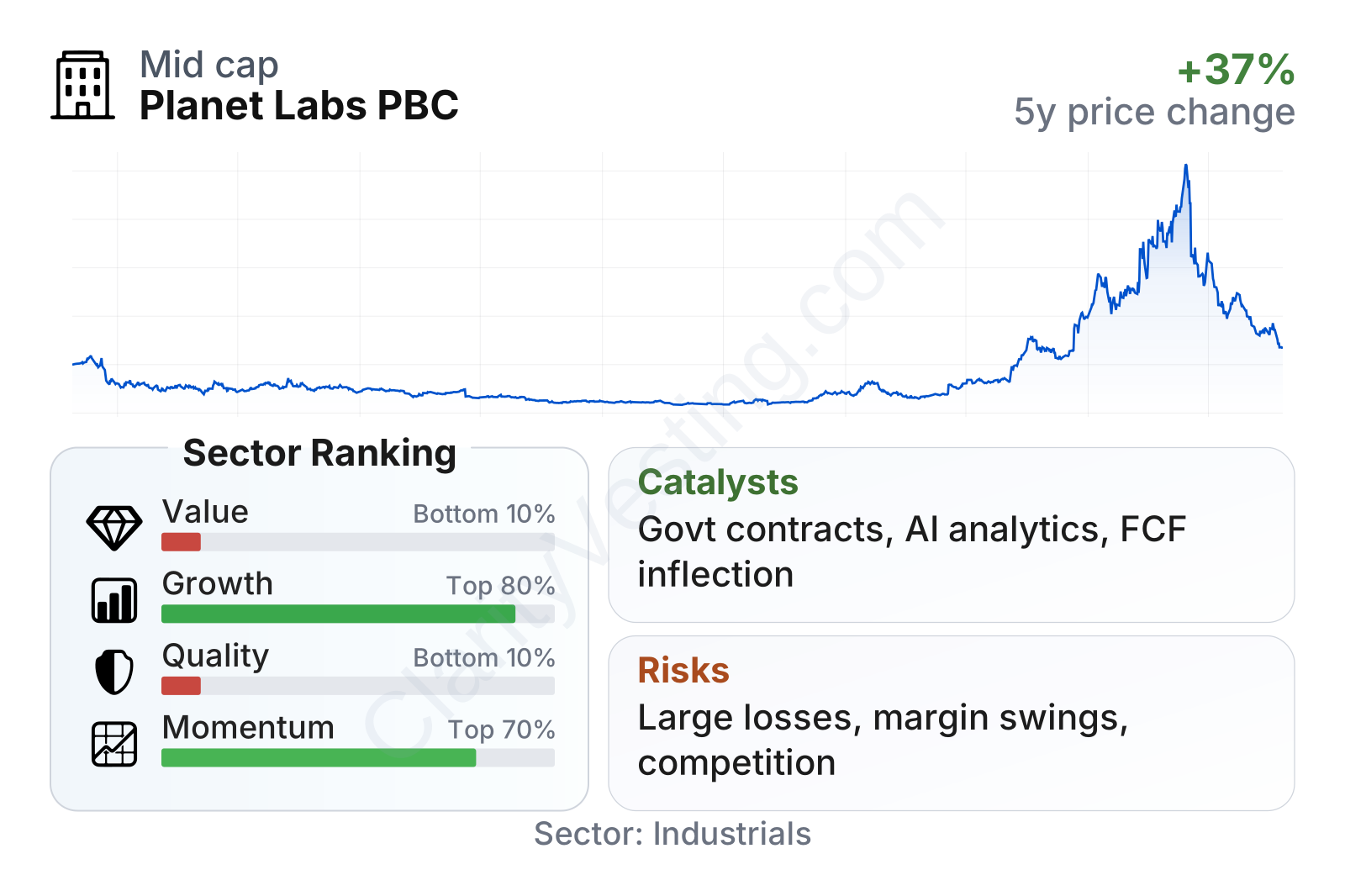
Planet is now a mid-cap company with a stock that has been extremely volatile. The share price climbed sharply over the last three years, but the path has been uneven, including a large pullback in recent months from earlier 2026 highs. In the factor breakdown, growth and longer-term momentum rank well versus the sector, while value and quality rank near the bottom. That combination usually reflects a company that is scaling quickly and attracting market attention, but still has weak profitability and a demanding valuation relative to current fundamentals.
The balance sheet picture is mixed. Free cash flow has recently turned positive, which is an important operational milestone, but traditional profitability measures remain deeply negative. The company also trades at a high price-to-book multiple compared with the sector median, suggesting the market is pricing in significant future expansion rather than current earnings power.
Growth
Planet operates in a sector with favorable long-term drivers. Earth observation is becoming more useful as customers increasingly want real-time or near-real-time awareness of physical activity across the globe. Demand is supported by defense modernization, geopolitical tensions, climate monitoring, disaster response, food security, and the broader shift toward AI systems that need large streams of current visual information. This is one reason the company’s market opportunity can expand even if satellite hardware itself becomes more common: the real value increasingly sits in rapid collection, historical archives, and software that helps users interpret what they see.
Its strategy is logical for that backdrop. Planet has built a large imaging network, then layered software and analytics on top of it, aiming to move from image seller to information platform. That approach can support recurring subscriptions, wider use inside customer organizations, and higher switching costs over time. It also gives the company multiple ways to grow: more government contracts, broader commercial adoption, upselling to analytics products, and expanded use cases tied to AI and machine learning.
Recent revenue growth has accelerated materially. After slowing into early 2025, year-over-year growth re-expanded and moved into the 40% to nearly 60% range by mid-2026, far above the sector median. That suggests the company is not only participating in a growing niche, but also capturing share or benefiting from larger contract wins. For a business that had previously been criticized for uneven execution, that rebound is one of the more encouraging operating developments.
Another important change is cash generation. Free cash flow was negative for several years, then turned positive over the trailing twelve months. For a satellite company, this is meaningful because the business requires ongoing investment in spacecraft, launches, and platform capabilities. Positive free cash flow does not mean Planet has solved profitability, but it does indicate that operational discipline is improving and that growth is no longer relying entirely on cash burn.
A visible catalyst has come from the public sector. Planet has continued to highlight momentum in government demand, particularly defense and intelligence-related uses where persistent global monitoring is valuable. The company has also emphasized AI-enabled products and partnerships that make its imagery easier to search, analyze, and integrate into customer workflows. In practical terms, these developments matter because they can increase the usefulness of Planet’s large image archive, which is one of its harder assets to replicate quickly.
Risks
This article is for informational purposes only and does not constitute financial advice. Some content is AI-generated. See Disclaimer


