Stock Analysis · Park Hotels & Resorts Inc (PK)
Overview
Park Hotels & Resorts Inc. is a lodging real estate investment trust, or REIT. In simple terms, it owns hotels and resorts and earns money from the cash those properties generate. The company focuses on upper-upscale and luxury assets, with many of its properties operating under well-known brands such as Hilton, Waldorf Astoria, Conrad, DoubleTree, and Marriott. Its portfolio is concentrated in major urban and resort markets, which means results are tied closely to business travel, group events, and leisure demand.
Because Park Hotels is a hotel REIT, its revenue mix is more property-level than product-based. The biggest source is room revenue, followed by food and beverage, then resort and other guest-related income such as parking, meeting space, and ancillary services. Based on the company’s recent annual reporting pattern, a reasonable breakdown is:
- Rooms: approximately 65% to 70% of total hotel revenue. This is driven by occupancy and average daily room rates.
- Food and beverage: approximately 20% to 25%. This includes restaurants, bars, banquets, and catering tied to meetings and events.
- Other hotel revenue: approximately 8% to 12%. This typically includes resort fees, parking, retail rents, spa-related income, and other on-property services.
Unlike many diversified REITs, Park Hotels is not spread across apartments, offices, or warehouses. Its business is almost entirely linked to hotel performance. That creates more volatility than many other real estate categories, but it also gives the company direct exposure to recoveries in travel and convention activity.
The multi-year financial flow shows a strong rebound after the pandemic period, with revenue rising sharply from 2021 through 2024 before profitability weakened again in 2025. The most important takeaway is that Park Hotels can generate very large sales volumes when travel demand is healthy, but earnings remain sensitive to operating costs, property disruptions, and interest expense.
Key Figures
| Metric | Value | Sector ⓘ |
|---|---|---|
| Date | Oct 17, 2026 | |
| Context | ||
| Sector | Real Estate | |
| Industry | REIT - Hotel & Motel | |
| Market Cap ⓘ | $3.05B | |
| Beta ⓘ | 1.37 | |
Value (Cheapness) | ||
| P/E Ratio ⓘ | N/A | 17.38 |
| P/B Ratio ⓘ | 1.00 | 0.85 |
| FCF Yield ⓘ | 7.47% | 7.38% |
| Dividend Yield ⓘ | 6.41% | 4.85% |
| EBIT / EV ⓘ | 1.51% | 3.78% |
| PEG ⓘ | 0.64 | |
Growth (Business expansion) | ||
| Revenue Growth ⓘ | 1.00% | 5.30% |
| RPS Growth (5Y CAGR) ⓘ | 21.96% | 6.02% |
| EPS Growth (5Y CAGR) ⓘ | 29.21% | -11.37% |
| BVPS Growth (5Y CAGR) ⓘ | -4.28% | 0.45% |
| Margin Growth (5Y Trend) ⓘ | 13.98% | -0.22% |
| FCF Growth (5Y CAGR) ⓘ | N/A | 5.40% |
| DPS Growth (5Y CAGR) ⓘ | 8.34% | 5.02% |
Quality (Business durability) | ||
| ROIC (Latest) ⓘ | 1.44% | 5.69% |
| ROE (Latest) ⓘ | -4.95% | 7.56% |
| ROA (Latest) ⓘ | -1.97% | 2.85% |
| ROIC (5Y Median) ⓘ | 3.38% | 4.22% |
| ROE (5Y Median) ⓘ | 2.35% | 6.03% |
| ROA (5Y Median) ⓘ | 1.01% | 2.44% |
| Net Debt / EBIT (Latest) ⓘ | 36.90 | 7.59 |
| Net Debt / EBIT (5Y Median) ⓘ | 10.00 | 8.40 |
| Net Debt / EBITDA (Latest) ⓘ | 10.13 | 5.27 |
| Net Debt / Assets ⓘ | 49.83% | 37.76% |
| EBITDA / Interest ⓘ | 1.63 | 4.10 |
| Operating Margin (Latest) ⓘ | 4.09% | 35.29% |
| Operating Margin (5Y Median) ⓘ | 14.68% | 37.31% |
| Debt to Equity (Latest) ⓘ | 132.75% | 88.87% |
| Profit Margin (Latest) ⓘ | -6.41% | 19.61% |
| Free Cash Flow (Latest) ⓘ | $228.00M | |
Momentum (Price trend) | ||
| 3Y Return ⓘ | +84.15% | +30.75% |
| 12M Return (excl. last month) ⓘ | +37.51% | +4.36% |
| 6M Return ⓘ | +43.35% | -2.52% |
| Price vs. 200-Day MA ⓘ | +25.47% | -2.34% |
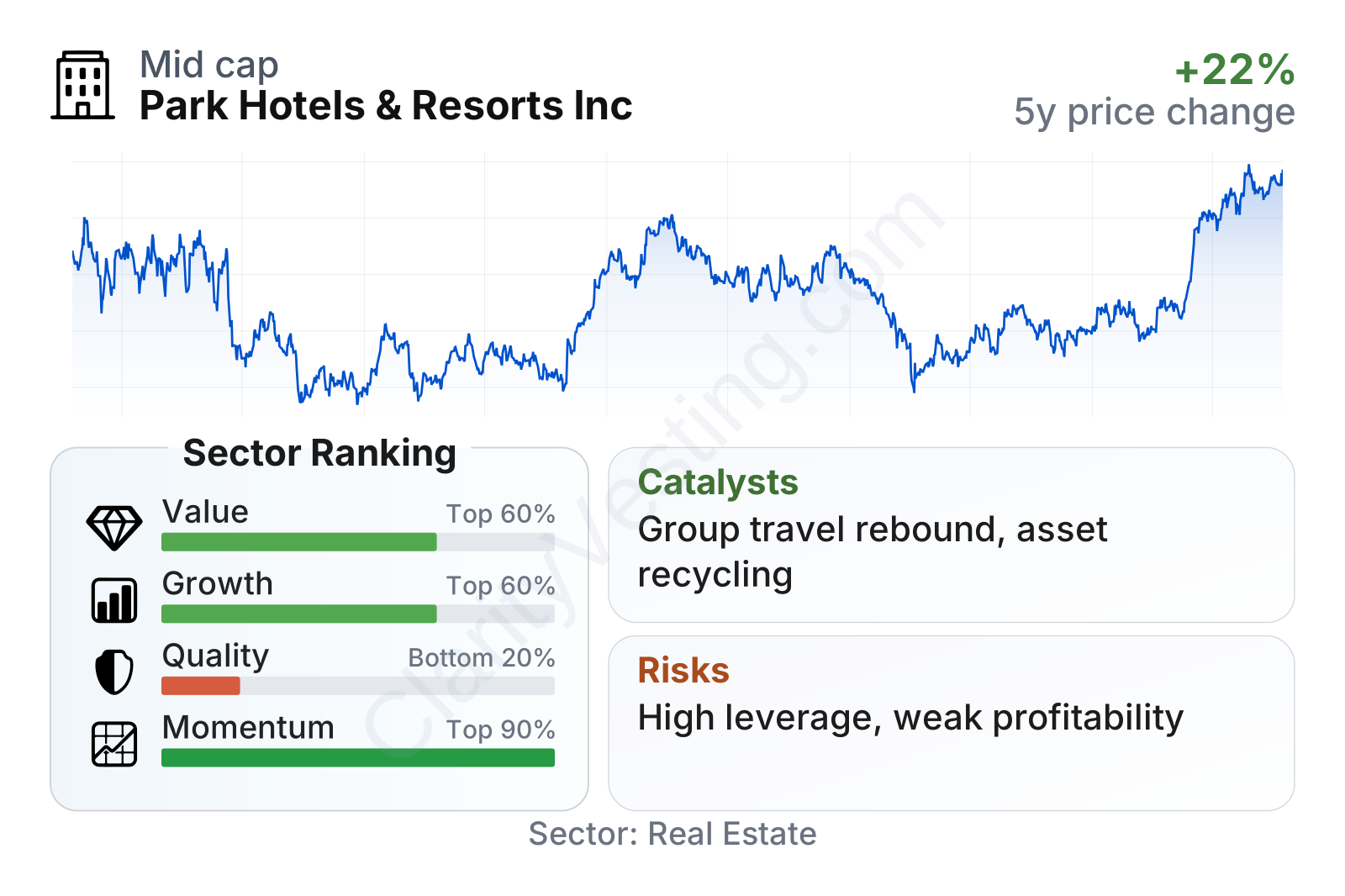
Park Hotels is a mid-sized public hotel REIT with a stock that has been quite volatile over the last several years, which is normal for a business tied to travel cycles. Recent market performance has been much stronger than the sector median, but the underlying fundamentals are more mixed. On valuation and growth, the company sits around the better half of the sector rather than at the top. On quality, however, it ranks weakly, mainly because profitability is currently low, leverage is elevated, and interest coverage is thin. The dividend yield stands above the sector median, and free cash flow generation is still meaningful, but those positives sit beside weaker returns on assets and equity.
Growth
The long-term sector backdrop is supportive, but not in a straight line. Hotel demand benefits from several durable trends: continued leisure travel, the normalization of corporate trips, large events returning to convention-oriented cities, and the pricing power that quality hotels can sometimes exercise during strong demand periods. Park Hotels is positioned to benefit from this because it owns many large, recognizable assets in destination and gateway markets rather than commodity roadside lodging.
The company’s strategy has generally centered on concentrating capital in high-value hotels, recycling assets when needed, and using renovations to raise room rates and property cash flow. That approach makes strategic sense in lodging, where upgraded assets can often command better pricing even when occupancy growth is modest. For Park Hotels, the key question is not whether people will keep traveling over time, but whether the company can translate demand into higher margins after interest costs and capital needs.
Revenue per share has risen sharply over the last five years, moving from depressed pandemic-era levels to a much higher base. Growth has slowed recently, but the broader recovery is still visible. This helps explain why the company’s five-year revenue-per-share growth rate remains far ahead of the sector median even though near-term year-over-year growth has cooled to around 1%.
The dividend path also reflects both opportunity and cyclicality. Park Hotels cut distributions heavily during the travel shock, then rebuilt them as operations improved. Over five years, dividend per share growth still compares favorably with the sector median, but the yearly pattern has been uneven. That matters for long-term analysis because hotel REIT payouts are usually less predictable than those of more stable property types.
A meaningful catalyst is the continued recovery of group and business travel at large hotels and resorts, especially in convention-heavy destinations. Another potential driver is value creation through renovations, redevelopments, and targeted asset sales or capital recycling. Recent company communications have also highlighted active portfolio management and efforts to strengthen operating performance at key assets, which could improve earnings if demand remains healthy.
Risks
This article is for informational purposes only and does not constitute financial advice. Some content is AI-generated. See Disclaimer


