Stock Analysis · PJT Partners Inc (PJT)
Overview
PJT Partners is an independent investment bank and advisory firm. In simple terms, it helps large corporations, private equity firms, shareholders, boards, and governments make important financial decisions. Its work is centered on advice rather than lending money or taking deposits, which makes it different from large universal banks such as JPMorgan or Goldman Sachs.
The company organizes its business mainly around advisory activities and a smaller placement business. Based on recent company disclosures, revenue is primarily generated from the following areas:
- Strategic Advisory: approximately 70% to 80% of revenue in recent years. This includes mergers and acquisitions advice, restructuring and liability management, shareholder advisory, activism defense, and other board-level strategic assignments.
- Park Hill: approximately 20% to 30% of revenue. This business advises on private capital fundraising and secondary market transactions for private equity, real estate, hedge funds, and other alternative asset managers.
That mix matters because it gives PJT exposure to two attractive parts of finance. Strategic Advisory can benefit when companies are reshaping themselves, including during periods of stressed credit markets. Park Hill is tied more closely to long-term growth in private markets, where fundraising, secondaries, and capital solutions have become larger and more specialized over time.
The business model is also fairly asset-light. PJT does not need large factories or heavy balance-sheet investment to grow. Its main assets are its bankers, client relationships, reputation, and ability to attract top advisory talent. That can lead to strong profitability when deal activity is healthy, but it also means compensation expense tends to move up with revenue.
Over the last several years, the company’s revenue and profit base has expanded meaningfully, even with some year-to-year volatility that is typical for advisory firms. The broad trend has been one of rising revenue and improved earnings after a softer 2022-2023 period.
The financial flow shows a business that has grown revenue materially since 2021, with operating income and net income recovering strongly after the 2023 dip. Like most advisory firms, a large share of revenue is absorbed by compensation and related costs, so margins can move with the deal environment.
Key Figures
| Metric | Value | Sector ⓘ |
|---|---|---|
| Date | Nov 14, 2026 | |
| Context | ||
| Sector | Financial Services | |
| Industry | Capital Markets | |
| Market Cap ⓘ | $6.51B | |
| Beta ⓘ | 0.87 | |
Value (Cheapness) | ||
| P/E Ratio ⓘ | 21.85 | 12.38 |
| P/B Ratio ⓘ | 13.92 | 1.54 |
| FCF Yield ⓘ | 10.56% | 8.62% |
| Dividend Yield ⓘ | 0.65% | 2.91% |
| EBIT / EV ⓘ | 9.47% | 8.22% |
| PEG ⓘ | 1.36 | |
Growth (Business expansion) | ||
| Revenue Growth ⓘ | -13.90% | 7.00% |
| RPS Growth (5Y CAGR) ⓘ | 26.46% | 12.30% |
| EPS Growth (5Y CAGR) ⓘ | 6.25% | -0.81% |
| BVPS Growth (5Y CAGR) ⓘ | N/A | 4.87% |
| Margin Growth (5Y Trend) ⓘ | -3.56% | -4.00% |
| FCF Growth (5Y CAGR) ⓘ | 42.14% | 4.68% |
| DPS Growth (5Y CAGR) ⓘ | -17.39% | 8.77% |
Quality (Business durability) | ||
| ROIC (Latest) ⓘ | 105.58% | 9.69% |
| ROE (Latest) ⓘ | 73.81% | 14.05% |
| ROA (Latest) ⓘ | 10.13% | 1.58% |
| ROIC (5Y Median) ⓘ | 123.82% | 7.79% |
| ROE (5Y Median) ⓘ | N/A | 12.05% |
| ROA (5Y Median) ⓘ | 8.88% | 1.28% |
| Net Debt / EBIT (Latest) ⓘ | 0.45 | 0.97 |
| Net Debt / EBIT (5Y Median) ⓘ | -0.18 | 0.73 |
| Net Debt / EBITDA (Latest) ⓘ | 0.42 | 0.75 |
| Operating Margin (Latest) ⓘ | 20.93% | 23.57% |
| Operating Margin (5Y Median) ⓘ | 21.17% | 24.30% |
| Debt to Equity (Latest) ⓘ | 117.77% | 59.34% |
| Profit Margin (Latest) ⓘ | 10.50% | 26.53% |
| Free Cash Flow (Latest) ⓘ | $687.98M | |
Momentum (Price trend) | ||
| 3Y Return ⓘ | +85.78% | +85.82% |
| 12M Return (excl. last month) ⓘ | -24.01% | +16.88% |
| 6M Return ⓘ | -5.17% | +8.29% |
| Price vs. 200-Day MA ⓘ | -2.41% | +5.17% |
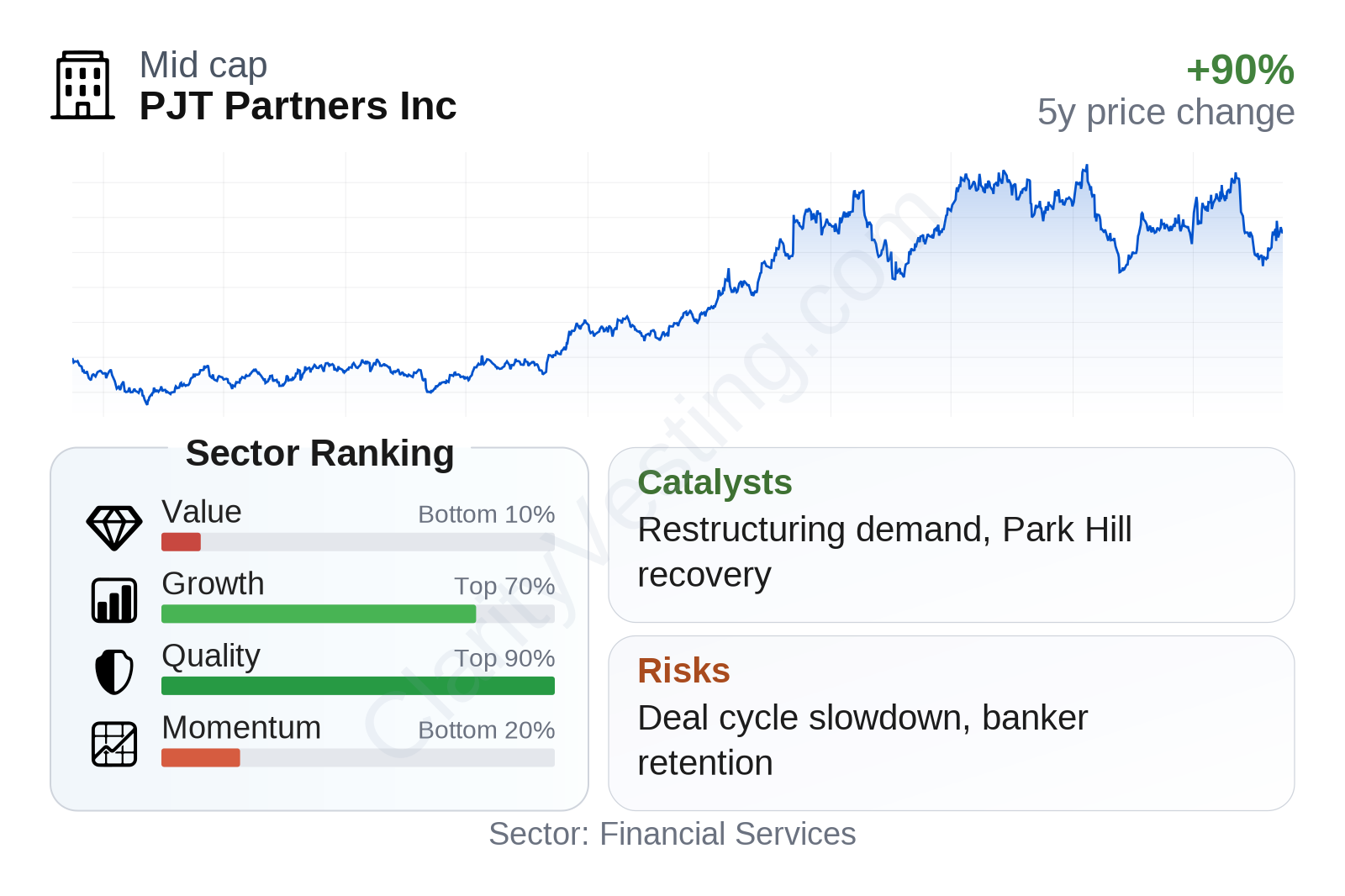
PJT is a mid-sized capital markets company with below-market share price volatility, which is somewhat notable for a business tied to deal cycles. On quality measures it ranks very strongly versus much of the financial sector, supported by high returns on capital and solid cash generation. Growth has been mixed in the short term because recent year-over-year revenue declined, but the longer-term picture is much stronger, with revenue per share and free cash flow growing well ahead of sector norms over five years. The weak spot is valuation: both earnings and especially book-based multiples sit far above sector medians, while recent price momentum has been soft after a strong multi-year run.
Growth
PJT operates in parts of finance that can grow over time, even though the path is rarely smooth from one year to the next. One engine is corporate advisory. Companies continue to merge, divest assets, refinance liabilities, defend against activists, and respond to changing regulation and interest rates. Another engine is private capital advisory through Park Hill, where private market assets have expanded over many years and created demand for fundraising and secondary transaction expertise.
The company’s strategy is logical for that environment. PJT focuses on advisory work where reputation, senior relationships, and execution quality matter more than balance-sheet size. That allows it to compete with much larger banks without needing to match them in lending capacity. It also gives the firm some resilience because restructuring and liability-management work can remain active even when traditional merger volumes slow.
A useful point for long-term analysis is that the firm is not relying on just one type of market backdrop. In buoyant markets, mergers, acquisitions, and private capital fundraising can support growth. In stressed markets, restructuring and capital structure advice can become more important. That mix does not eliminate cyclicality, but it can soften it.
The earnings trend reflects that pattern. After falling from 2021 through 2023, earnings per share rebounded strongly in 2024 and 2025, and the latest trailing figures still point to a much healthier earnings base than the low point of the cycle. That suggests the franchise remained intact during the softer period and was able to convert a better advisory environment into renewed profit growth.
Book value per share is less helpful here than it would be for a traditional bank or insurer because PJT is an advisory firm with a people-driven model, share repurchases, and accounting effects that can make book equity look unusually low or even negative. For this type of business, earnings power, margins, and cash generation usually say more than book value alone.
As for recent opportunity signals, management has continued to emphasize strength in restructuring, liability management, and private capital solutions. Those areas have become more relevant as higher interest rates and tighter financing conditions have forced many companies and sponsors to rethink capital structures. If private equity exits and fundraising activity improve over time, Park Hill could also benefit from a broader recovery in private market transaction volumes.
Risks
This article is for informational purposes only and does not constitute financial advice. Some content is AI-generated. See Disclaimer