Stock Analysis · Pilbara Minerals Limited (PILBF)
Overview
Pilbara Minerals Limited is an Australian lithium producer best known for its 100%-owned Pilgangoora operation in Western Australia. The company mines hard-rock spodumene ore and processes it into spodumene concentrate, a key raw material used in the lithium-ion battery supply chain for electric vehicles, energy storage systems, and consumer electronics. In simple terms, Pilbara sits near the beginning of the battery materials chain: it extracts and upgrades lithium-bearing rock, then sells that concentrate to chemical converters that turn it into battery-grade lithium products.
The business is still highly concentrated. Based on recent annual reporting, revenue comes overwhelmingly from lithium concentrate sales, with a much smaller contribution from other activities such as by-product and ancillary sales.
- Spodumene concentrate sales: approximately more than 95% of revenue. This is the company’s core business and reflects sales from the Pilgangoora lithium operation.
- Other revenue: approximately less than 5% of revenue. This can include smaller operational items and ancillary income, but it is not the main driver of performance.
This concentration matters because Pilbara’s results are tied closely to two variables: how much spodumene it ships and the realized price it receives. The company has expanded from a single-asset miner into a large-scale lithium supplier, but the economics still move mainly with lithium market conditions. Over the last several years, revenue and profitability have shown how powerful that exposure can be: earnings surged during the lithium price boom, weakened sharply during the downturn, and then improved again as volumes and market conditions recovered.
The income flow also shows a cyclical profile rather than a smooth one. Revenue climbed dramatically in fiscal 2023, contracted in fiscal 2024 and fiscal 2025 as lithium prices fell, and then rebounded in fiscal 2026. Costs have remained meaningful but manageable relative to revenue, while operating income and net income have been far more volatile than production volumes, which is typical for commodity producers.
The main takeaway from the operating flow is the sharp swing in profitability across the cycle. Fiscal 2025 was notably weak, but fiscal 2026 shows a meaningful recovery in revenue, operating earnings, and net income, suggesting the company remains very sensitive to lithium pricing while still retaining operating leverage when conditions improve.
Key Figures
| Metric | Value | Sector ⓘ |
|---|---|---|
| Date | Oct 17, 2026 | |
| Context | ||
| Sector | Basic Materials | |
| Industry | Other Industrial Metals & Mining | |
| Market Cap ⓘ | $7.23B | |
| Beta ⓘ | 0.82 | |
Value (Cheapness) | ||
| P/E Ratio ⓘ | 20.36 | 16.90 |
| P/B Ratio ⓘ | 1.75 | 1.65 |
| FCF Yield ⓘ | 6.93% | 5.76% |
| Dividend Yield ⓘ | 2.16% | 2.13% |
| EBIT / EV ⓘ | N/A | 6.30% |
| PEG ⓘ | N/A | |
Growth (Business expansion) | ||
| Revenue Growth ⓘ | 281.70% | 11.10% |
| RPS Growth (5Y CAGR) ⓘ | 11.02% | 4.49% |
| EPS Growth (5Y CAGR) ⓘ | N/A | -13.47% |
| BVPS Growth (5Y CAGR) ⓘ | 30.94% | 5.51% |
| Margin Growth (5Y Trend) ⓘ | -22.29% | -1.54% |
| FCF Growth (5Y CAGR) ⓘ | 18.22% | 0.37% |
| DPS Growth (5Y CAGR) ⓘ | 94.63% | 6.08% |
Quality (Business durability) | ||
| ROIC (Latest) ⓘ | N/A | 9.26% |
| ROA (Latest) ⓘ | 6.31% | 4.91% |
| ROIC (5Y Median) ⓘ | 35.32% | 7.70% |
| ROA (5Y Median) ⓘ | 9.62% | 3.86% |
| Net Debt / EBIT (Latest) ⓘ | -1.54 | 1.40 |
| Net Debt / EBIT (5Y Median) ⓘ | -0.89 | 1.70 |
| Net Debt / EBITDA (Latest) ⓘ | -0.88 | 0.95 |
| Net Debt / Assets ⓘ | -16.90% | 13.69% |
| EBITDA / Interest ⓘ | 11.97 | 12.34 |
| Operating Margin (Latest) ⓘ | 24.28% | 13.20% |
| Operating Margin (5Y Median) ⓘ | 43.06% | 11.80% |
| Debt to Equity (Latest) ⓘ | 30.22% | 40.56% |
| Profit Margin (Latest) ⓘ | 27.19% | 6.43% |
| Free Cash Flow (Latest) ⓘ | $500.82M | |
Momentum (Price trend) | ||
| 3Y Return ⓘ | -14.69% | +68.89% |
| 12M Return (excl. last month) ⓘ | +138.15% | +30.21% |
| 6M Return ⓘ | -42.59% | -4.16% |
| Price vs. 200-Day MA ⓘ | -36.83% | -1.27% |
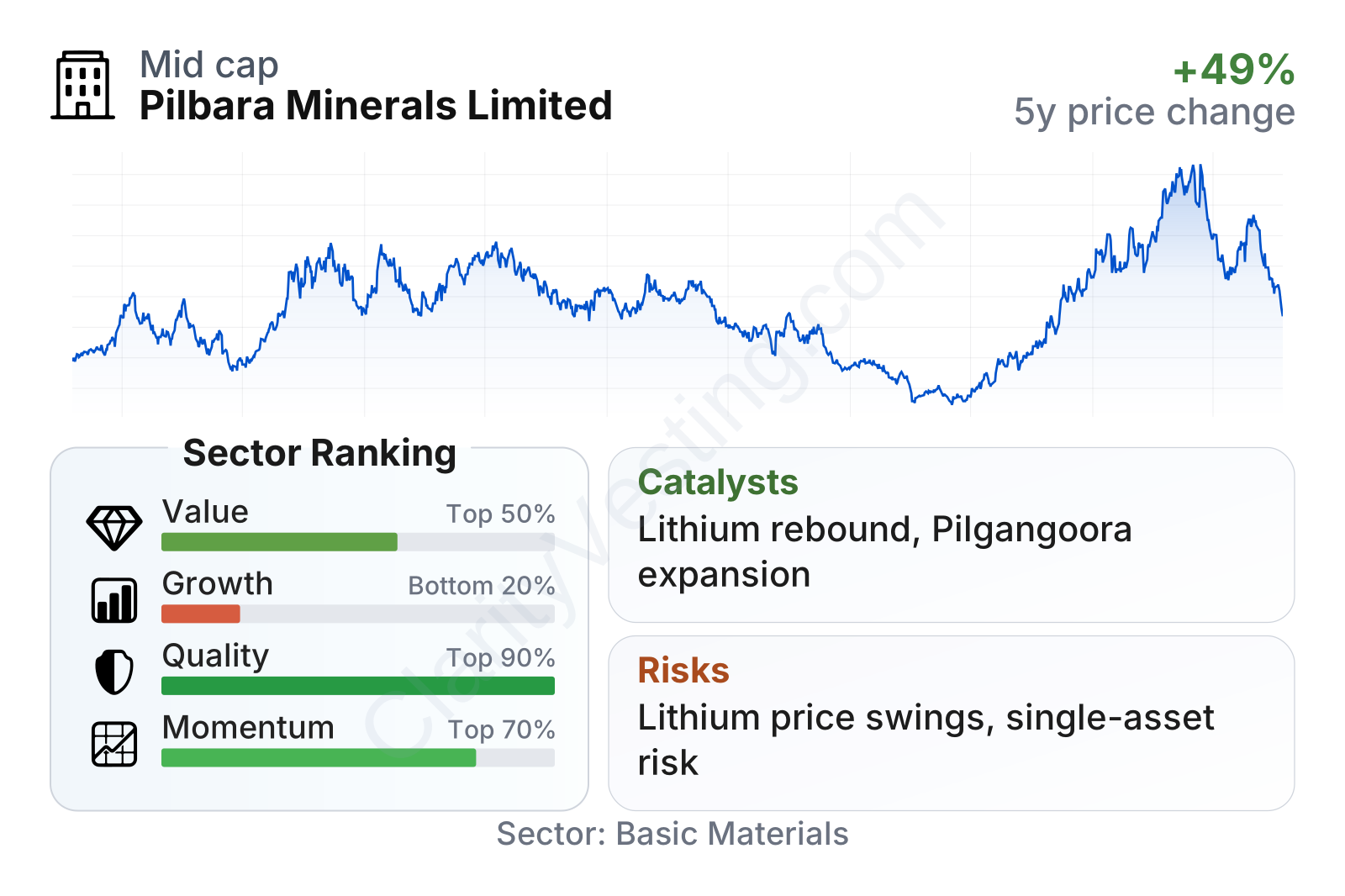
Pilbara is now a large lithium-focused mining company by market value, with share price behavior that has been highly volatile over the last few years even though the stock’s beta is not especially high. The metrics table points to a mixed picture: quality is strong, with profitability and balance sheet measures ranking well against much of the sector, while value and growth rankings are weaker because headline valuation is not especially cheap and recent comparisons still reflect a difficult period for lithium prices. The company’s balance sheet remains an important strength, with net cash rather than heavy net debt, and returns on capital over a multiyear period have been well above sector norms. At the same time, valuation multiples sit above sector medians, which suggests the market is already recognizing some recovery potential.
Growth
Pilbara operates in a sector with long-term structural support. Lithium demand is tied mainly to battery manufacturing, especially for electric vehicles and stationary energy storage. That does not mean annual growth will be smooth, because lithium prices can move sharply as new supply enters the market and customer inventories rise or fall. Still, the broad industry direction remains favorable over a multiyear horizon because battery adoption is still expanding globally.
Management’s growth strategy is relatively easy to understand: increase production efficiency at Pilgangoora, preserve cost competitiveness, and move further into downstream processing where economics justify it. The company has also developed a stronger position through partnerships and investments across the lithium value chain, including its involvement in the POSCO joint venture linked to chemical conversion capacity in South Korea. For a miner, this matters because it can broaden exposure beyond pure concentrate sales and strengthen relationships with end-market participants.
Recent revenue growth has rebounded strongly from the prior weak phase, which shows that Pilbara still has meaningful operational and pricing leverage when market conditions improve. That said, one good year does not remove the cyclicality of the business; it mainly confirms that the asset can generate large swings in financial outcomes as the lithium market turns.
Free cash flow has been uneven, which is not unusual during expansion spending and commodity price weakness. A negative trailing pattern in the recent past should be viewed alongside the company’s larger balance sheet strength and the recovery in earnings. If Pilbara can combine stable production with improved realized prices, cash generation can recover materially, but it is unlikely to be linear from quarter to quarter.
A significant catalyst is the company’s ability to benefit from any sustained tightening in lithium market conditions after a period of oversupply and weaker prices. In addition, continued ramp-up, optimization work, and downstream integration efforts could improve realized economics over time. Recent company updates have also emphasized operational progress at Pilgangoora and ongoing development of growth pathways rather than a retreat into pure cost cutting, which supports the case that management is positioning the business for the next upcycle rather than just surviving the current one.
Risks
This article is for informational purposes only and does not constitute financial advice. Some content is AI-generated. See Disclaimer


