Stock Analysis · Primary Health Properties PLC (PHPRF)
Overview
Primary Health Properties PLC is a healthcare real estate investment trust, or REIT. Instead of operating medical services itself, it owns properties that are used by healthcare providers and rents them out on long leases. Its portfolio is concentrated in modern primary care facilities, especially doctors’ surgeries, health centers, and other community-based medical buildings in the United Kingdom and Ireland.
The business model is designed around stable rent collection. Many of its properties are occupied by general practitioners, government-backed healthcare bodies, pharmacies, and related tenants. That matters because a large part of the rental income is linked, directly or indirectly, to public healthcare systems, which tends to make occupancy and rent collection more resilient than in many other real estate segments.
Based on company reporting, revenue is overwhelmingly rental income from healthcare properties, with only a small contribution from other property-related items such as service charges and development-related activity. A simple way to think about the mix is:
- Rental income from healthcare properties: approximately 90% to 95% of total revenue. This is the core business and includes rent from primary care centers, GP surgeries, and community health facilities.
- Recoverable property and service income: approximately 3% to 7%. This can include service charges and other property cost recoveries linked to managed buildings.
- Other income: usually less than 3%. This may include smaller property-related items and non-recurring contributions.
What stands out is how focused the company is. This is not a diversified landlord across offices, shopping centers, and warehouses. It is a specialist owner in one niche: healthcare property tied to day-to-day medical use.
The profit structure shows a business with high operating margins, which is common for landlords with recurring rent income, but it also shows how sensitive earnings can be to financing costs. Interest expense has become a more important drag in recent years, so the quality of the rental stream is a major support for the model.
Key Figures
| Metric | Value | Sector ⓘ |
|---|---|---|
| Date | Oct 17, 2026 | |
| Context | ||
| Sector | Real Estate | |
| Industry | REIT - Healthcare Facilities | |
| Market Cap ⓘ | $3.11B | |
| Beta ⓘ | 0.77 | |
Value (Cheapness) | ||
| P/E Ratio ⓘ | 15.00 | 17.38 |
| P/B Ratio ⓘ | 1.58 | 0.85 |
| FCF Yield ⓘ | 8.73% | 7.38% |
| Dividend Yield ⓘ | 6.00% | 4.85% |
| EBIT / EV ⓘ | N/A | 3.78% |
| PEG ⓘ | N/A | |
Growth (Business expansion) | ||
| Revenue Growth ⓘ | 118.90% | 5.30% |
| RPS Growth (5Y CAGR) ⓘ | -8.82% | 6.02% |
| EPS Growth (5Y CAGR) ⓘ | -40.27% | -11.37% |
| BVPS Growth (5Y CAGR) ⓘ | 0.30% | 0.45% |
| Margin Growth (5Y Trend) ⓘ | 16.34% | -0.22% |
| FCF Growth (5Y CAGR) ⓘ | -7.23% | 5.40% |
| DPS Growth (5Y CAGR) ⓘ | 3.57% | 5.02% |
Quality (Business durability) | ||
| ROIC (Latest) ⓘ | 5.85% | 5.69% |
| ROE (Latest) ⓘ | 11.45% | 7.56% |
| ROA (Latest) ⓘ | 5.07% | 2.85% |
| ROIC (5Y Median) ⓘ | 4.13% | 4.22% |
| ROE (5Y Median) ⓘ | 3.78% | 6.03% |
| ROA (5Y Median) ⓘ | 1.97% | 2.44% |
| Net Debt / EBIT (Latest) ⓘ | 13.30 | 7.59 |
| Net Debt / EBIT (5Y Median) ⓘ | 13.14 | 8.40 |
| Net Debt / EBITDA (Latest) ⓘ | 13.21 | 5.27 |
| Net Debt / Assets ⓘ | 54.24% | 37.76% |
| EBITDA / Interest ⓘ | 1.33 | 4.10 |
| Operating Margin (Latest) ⓘ | 60.42% | 35.29% |
| Operating Margin (5Y Median) ⓘ | 66.39% | 37.31% |
| Debt to Equity (Latest) ⓘ | 130.42% | 88.87% |
| Profit Margin (Latest) ⓘ | 43.32% | 19.61% |
| Free Cash Flow (Latest) ⓘ | $271.95M | |
Momentum (Price trend) | ||
| 3Y Return ⓘ | +29.12% | +30.75% |
| 12M Return (excl. last month) ⓘ | +7.85% | +4.36% |
| 6M Return ⓘ | +12.84% | -2.52% |
| Price vs. 200-Day MA ⓘ | -3.89% | -2.34% |
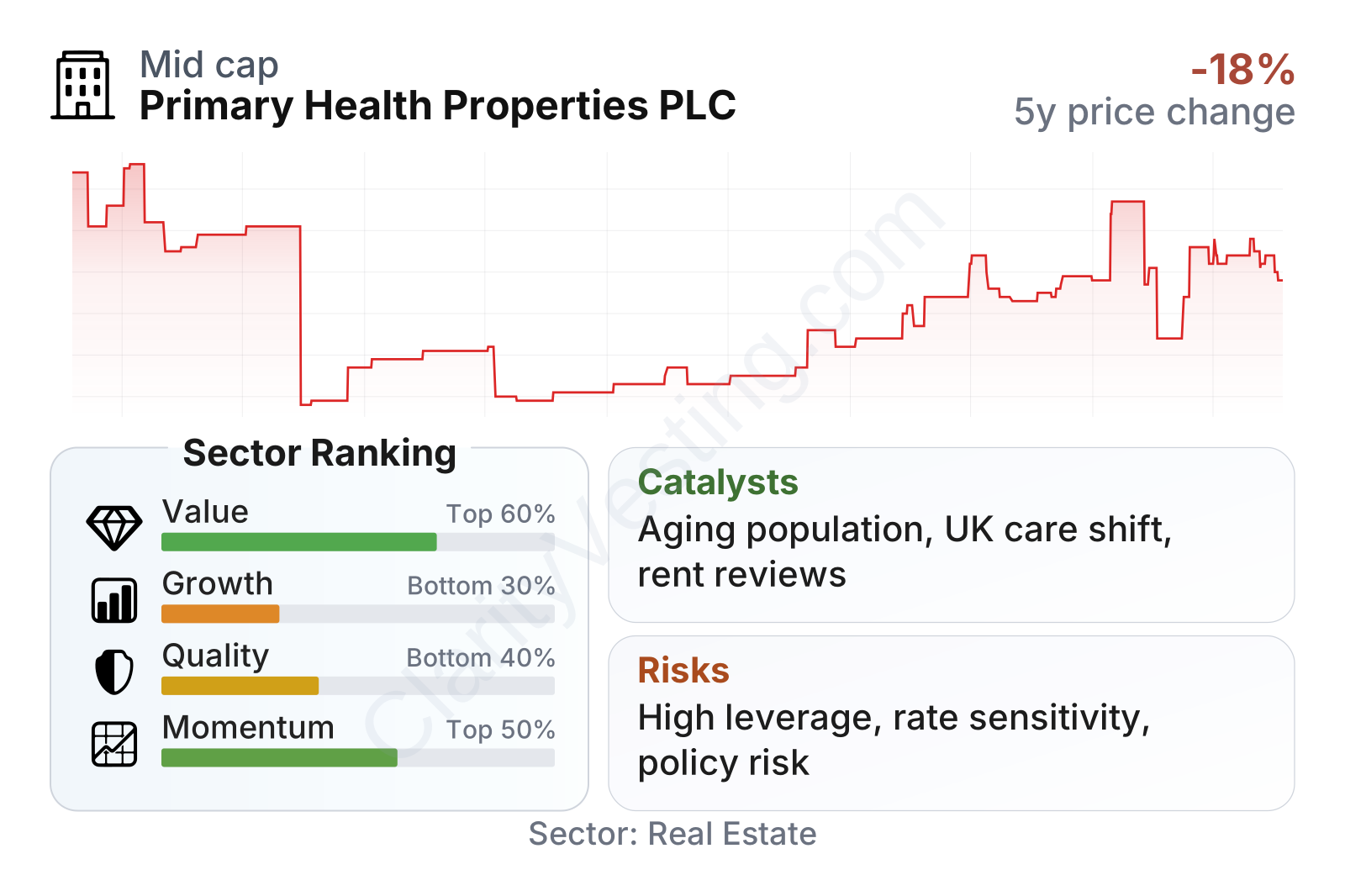
Primary Health Properties sits in the mid-sized range within listed real estate and has shown relatively low share-price volatility, with a beta below 1. On valuation, earnings and cash flow measures look broadly reasonable versus the sector, while the dividend yield is above the real estate median. The more mixed area is growth and balance-sheet strength: recent yearly revenue growth is strong, but longer-term per-share growth has been weak, and leverage is clearly heavier than the sector norm. Profitability margins are strong for the sector, yet debt and interest coverage remain important constraints.
The share price history also reflects the interest-rate cycle. The stock fell sharply during the 2022 rate shock, then gradually recovered through 2025 and into 2026. That pattern is typical of income-oriented REITs: when bond yields rise quickly, valuation pressure can be severe even if the underlying properties remain occupied and cash-generative.
Growth
The company operates in a part of real estate that benefits from long-term healthcare demand rather than consumer spending trends. An aging population, growing chronic disease management, and pressure to move care away from large hospitals toward local community settings all support demand for primary care buildings. In that sense, the sector has a durable structural tailwind.
Primary Health Properties’ strategy also fits that trend. It focuses on assets that are hard to replace, are essential to local healthcare delivery, and are often backed by public-sector funding flows. It has historically grown through acquisitions, selective developments, and rent reviews built into leases. That combination can work well over time because new medical facilities require planning, capital, and coordination with healthcare systems, creating barriers to entry.
Revenue per share has been uneven over the last five years rather than consistently compounding. There was a notable rebound after weaker periods, but the longer-term trend still looks soft on a per-share basis. That suggests portfolio growth has not always translated cleanly into stronger value for each share, partly because of financing conditions and capital issuance over time.
The dividend record is one of the more supportive parts of the long-term profile. The payout increased steadily for several years before a modest pullback in the latest period shown. Even with that dip, the broader pattern still points to a company built around recurring income distribution, which is central to how the market tends to assess healthcare REITs.
A meaningful catalyst is the continuing need for investment in frontline healthcare infrastructure in the UK and Ireland. Governments want more care delivered outside hospitals, but many existing buildings are outdated. A landlord with specialist relationships, a ready portfolio, and experience funding new projects can benefit if public healthcare systems continue modernizing their estate.
Another potential growth support is valuation recovery across rate-sensitive property stocks if financing markets remain more stable than they were in 2022 and 2023. For this company, lower pressure from discount rates can matter almost as much as rental growth because property values and financing costs strongly influence reported results.
Risks
This article is for informational purposes only and does not constitute financial advice. Some content is AI-generated. See Disclaimer


