Stock Analysis · Parker-Hannifin Corporation (PH)
Overview
Parker-Hannifin is a large industrial company that makes motion and control technologies. In simple terms, it provides the components and systems that help machines move, steer, lift, seal, filter, cool, and operate with precision. Its products are used across factory automation, mobile equipment, energy, life sciences, transportation, and aerospace.
The business is organized around two main segments. Diversified Industrial serves a very broad set of end markets, while Aerospace Systems supplies aircraft and related platforms. Based on the latest annual structure and recent company reporting, revenue is approximately split as follows:
- Diversified Industrial North America: about 52% of revenue. This includes hydraulics, pneumatics, filtration, fluid and gas handling, process control, engineered materials, and automation products sold into industrial machinery, mobile equipment, energy, and other general industrial uses.
- Diversified Industrial International: about 28% of revenue. This is broadly the same product mix as North America, but sold across Europe, Asia-Pacific, Latin America, and other international markets.
- Aerospace Systems: about 20% of revenue. This business provides flight control, fuel, fluid conveyance, thermal management, and other systems for commercial aircraft, military programs, and aftermarket support.
That mix matters because it gives Parker-Hannifin both diversification and a useful balance between shorter-cycle industrial demand and longer-cycle aerospace programs. The industrial operations provide scale and broad customer exposure, while aerospace tends to bring higher technical barriers and long-lived platforms.
The business model is also supported by a large aftermarket component. Many Parker products are essential but relatively small in the total cost of the customer’s machine or aircraft, which can make reliability and replacement demand more important than headline price alone.
The overall earnings flow shows a business that has expanded revenue steadily over the last several years while improving gross profit and net income materially. Interest expense has also moved down from earlier post-acquisition levels, which supports profit conversion.
Key Figures
| Metric | Value | Sector ⓘ |
|---|---|---|
| Date | Oct 24, 2026 | |
| Context | ||
| Sector | Industrials | |
| Industry | Specialty Industrial Machinery | |
| Market Cap ⓘ | $119.13B | |
| Beta ⓘ | 1.12 | |
Value (Cheapness) | ||
| P/E Ratio ⓘ | 33.17 | 22.29 |
| P/B Ratio ⓘ | 7.95 | 1.98 |
| FCF Yield ⓘ | 3.28% | 6.26% |
| Dividend Yield ⓘ | 0.77% | 1.92% |
| EBIT / EV ⓘ | 3.83% | 4.83% |
| PEG ⓘ | 3.23 | |
Growth (Business expansion) | ||
| Revenue Growth ⓘ | 9.80% | 9.30% |
| RPS Growth (5Y CAGR) ⓘ | 8.37% | 7.76% |
| EPS Growth (5Y CAGR) ⓘ | 14.63% | -13.17% |
| BVPS Growth (5Y CAGR) ⓘ | 15.39% | 6.13% |
| Margin Growth (5Y Trend) ⓘ | 11.30% | 0.74% |
| FCF Growth (5Y CAGR) ⓘ | 15.27% | 10.79% |
| DPS Growth (5Y CAGR) ⓘ | 13.70% | 9.41% |
Quality (Business durability) | ||
| ROIC (Latest) ⓘ | 16.47% | 10.75% |
| ROA (Latest) ⓘ | 11.85% | 5.41% |
| ROIC (5Y Median) ⓘ | 14.26% | 9.37% |
| ROA (5Y Median) ⓘ | 9.60% | 4.95% |
| Net Debt / EBIT (Latest) ⓘ | 1.66 | 2.04 |
| Net Debt / EBIT (5Y Median) ⓘ | 2.57 | 2.27 |
| Net Debt / EBITDA (Latest) ⓘ | 1.40 | 1.39 |
| Net Debt / Assets ⓘ | 26.66% | 19.27% |
| EBITDA / Interest ⓘ | 14.72 | 9.58 |
| Operating Margin (Latest) ⓘ | 23.09% | 10.49% |
| Operating Margin (5Y Median) ⓘ | 20.58% | 10.30% |
| Debt to Equity (Latest) ⓘ | 56.69% | 64.82% |
| Profit Margin (Latest) ⓘ | 16.97% | 6.67% |
| Free Cash Flow (Latest) ⓘ | $3.90B | |
Momentum (Price trend) | ||
| 3Y Return ⓘ | +164.89% | +67.77% |
| 12M Return (excl. last month) ⓘ | +27.85% | +12.05% |
| 6M Return ⓘ | -1.07% | 0.00% |
| Price vs. 200-Day MA ⓘ | +1.16% | +0.67% |
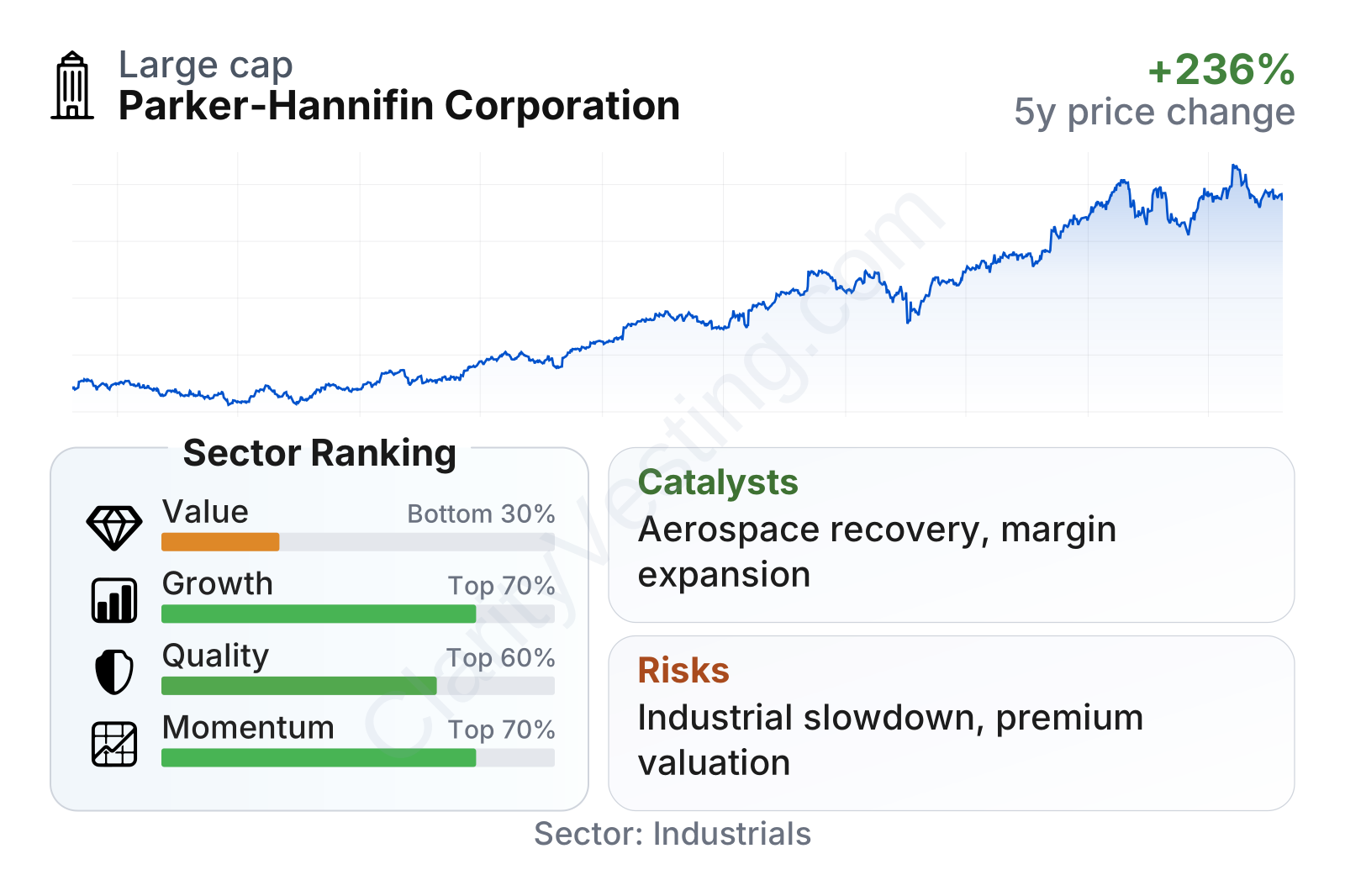
Parker-Hannifin stands out more for business quality than for cheapness. Profitability metrics are clearly above the sector median, with operating margin around the low-20% range and profit margin near 17%, both well ahead of many industrial peers. Returns on capital and assets are also strong. Growth has been respectable over multi-year periods, especially in earnings and free cash flow, while valuation metrics sit on the richer side of the sector. Market performance has been very strong over the last three years, which helps explain why the stock now screens as expensive on several measures.
Growth
Parker-Hannifin operates in markets with durable long-term demand drivers rather than in a single fast-growing niche. Industrial automation, electrification, energy efficiency, aerospace production, defense demand, and factory productivity all support the need for motion and control components. These are not always high-growth markets every year, but they tend to offer long run expansion through replacement demand, engineering upgrades, and tighter performance requirements.
The company’s strategy also makes sense for future growth. Management has spent years simplifying the portfolio, emphasizing higher-margin businesses, applying its operating system across divisions, and using acquisitions to deepen technical capabilities. The 2022 Meggitt acquisition was especially important because it expanded Parker’s aerospace exposure and increased its presence in engineered, mission-critical systems with long program lives.
Recent revenue growth has not been perfectly smooth, which is normal for an industrial company, but the pattern shows that growth reaccelerated after a softer period. The latest year-over-year pace is around 10%, slightly above the sector median, suggesting the company is still finding ways to grow despite normal cyclical pressure in parts of industrial demand.
Cash generation is one of the more attractive parts of the profile. Free cash flow has climbed meaningfully over the last several years and is now near the upper end of its historical range. That gives Parker-Hannifin flexibility to reduce debt, support dividends, repurchase shares, and pursue selective acquisitions without depending entirely on external financing.
A meaningful catalyst is aerospace. Commercial aircraft build rates and aftermarket activity have been recovering, and defense spending remains supportive in many regions. Because Parker supplies highly engineered systems into these platforms, stronger aircraft production and fleet utilization can translate into multi-year revenue visibility. Another catalyst is margin expansion through operational execution: the company has already shown it can turn moderate sales growth into faster earnings growth by improving mix, pricing, and productivity.
Recent company updates have also pointed to continued demand in aerospace and a business mix that favors higher-value, less commoditized products. That does not remove cyclicality, but it does reinforce the idea that Parker-Hannifin is not relying on volume alone to grow.
Risks
This article is for informational purposes only and does not constitute financial advice. Some content is AI-generated. See Disclaimer