Stock Analysis · Pge Polska Energ Unsp/ (PGPKY)
Overview
PGE Polska Grupa Energetyczna is one of the largest electricity groups in Poland. It produces power, distributes electricity through regulated networks, sells electricity and gas to end customers, and also operates district heating assets. In simple terms, it is a vertically integrated utility: part of the business generates electricity, part moves it through the grid, and part bills households, businesses, and public institutions.
The group has historically been closely tied to Poland’s conventional power system, especially lignite and hard coal, but its long-term strategy is increasingly centered on lower-carbon generation, electricity networks, and heating modernization. That matters because utilities are usually judged not only on what they earn today, but on whether their asset base fits the future energy system.
PGE’s revenue mix can move meaningfully from year to year because wholesale power prices, regulation, subsidies, fuel costs, and accounting effects can all change reported sales. Based on the company’s segment structure, the main economic sources of revenue and earnings are broadly the following:
- Electricity generation and wholesale power sales – the largest activity, supported by conventional plants and growing renewable capacity. This usually represents the biggest share of group revenue and remains the core driver of exposure to Poland’s power market.
- Distribution – a regulated network business that earns returns for delivering electricity to customers. This is typically one of the most stable and important profit contributors because regulated networks are less exposed to swings in commodity prices.
- Retail supply – sale of electricity and gas to households and commercial users. Revenue can be large here, but margins are often thinner and can be affected by price caps and policy decisions.
- District heating – heat production and supply, mainly for urban systems. This is smaller than power generation and distribution, but still strategically relevant in Poland’s energy transition.
- Renewables and capacity-related support mechanisms – still smaller than the legacy business, but increasingly important as new wind, solar, storage, and grid-linked projects are developed.
Over the last several years, the business has shown a clear pattern: revenue expanded sharply during the energy price surge, but profitability became much more volatile, reflecting how sensitive parts of the group remain to market conditions and policy design. At the same time, the company’s relatively low balance-sheet leverage gives it more room than many peers to fund a long investment cycle.
The flow of revenue and costs shows how unstable earnings have been. Sales rose strongly into 2023, then fell back, while operating income and net income swung from profit to loss and back again. That is a reminder that scale alone does not guarantee smooth results when fuel costs, power prices, and regulatory effects move sharply.
Key Figures
| Metric | Value | Sector ⓘ |
|---|---|---|
| Date | Nov 21, 2026 | |
| Context | ||
| Sector | Utilities | |
| Industry | Utilities - Regulated Electric | |
| Market Cap ⓘ | $7.90B | |
| Beta ⓘ | 0.67 | |
Value (Cheapness) | ||
| P/E Ratio ⓘ | 3.76 | 17.21 |
| P/B Ratio ⓘ | N/A | 1.97 |
| FCF Yield ⓘ | -5.26% | -0.81% |
| Dividend Yield ⓘ | N/A | 3.67% |
| EBIT / EV ⓘ | 19.85% | 5.78% |
| PEG ⓘ | N/A | |
Growth (Business expansion) | ||
| Revenue Growth ⓘ | 10.60% | 8.30% |
| RPS Growth (5Y CAGR) ⓘ | -0.74% | 3.61% |
| EPS Growth (5Y CAGR) ⓘ | N/A | -2.03% |
| BVPS Growth (5Y CAGR) ⓘ | -8.09% | 4.29% |
| Margin Growth (5Y Trend) ⓘ | -13.08% | 3.68% |
| FCF Growth (5Y CAGR) ⓘ | -8.52% | -8.99% |
| DPS Growth (5Y CAGR) ⓘ | -47.25% | 4.70% |
Quality (Business durability) | ||
| ROIC (Latest) ⓘ | 10.76% | 6.37% |
| ROA (Latest) ⓘ | 7.48% | 3.14% |
| ROIC (5Y Median) ⓘ | 0.74% | 5.97% |
| ROA (5Y Median) ⓘ | -2.91% | 2.74% |
| Net Debt / EBIT (Latest) ⓘ | 0.19 | 7.15 |
| Net Debt / EBIT (5Y Median) ⓘ | 0.94 | 7.25 |
| Net Debt / EBITDA (Latest) ⓘ | 0.12 | 4.42 |
| Net Debt / Assets ⓘ | 1.34% | 38.03% |
| EBITDA / Interest ⓘ | 7.57 | 4.57 |
| Operating Margin (Latest) ⓘ | 11.87% | 20.06% |
| Operating Margin (5Y Median) ⓘ | 0.85% | 19.99% |
| Debt to Equity (Latest) ⓘ | 33.50% | 137.61% |
| Profit Margin (Latest) ⓘ | 12.10% | 10.90% |
| Free Cash Flow (Latest) ⓘ | -$415.40M | |
Momentum (Price trend) | ||
| 3Y Return ⓘ | +107.06% | +47.60% |
| 12M Return (excl. last month) ⓘ | +15.01% | +6.07% |
| 6M Return ⓘ | +17.33% | 0.00% |
| Price vs. 200-Day MA ⓘ | +27.47% | +1.40% |
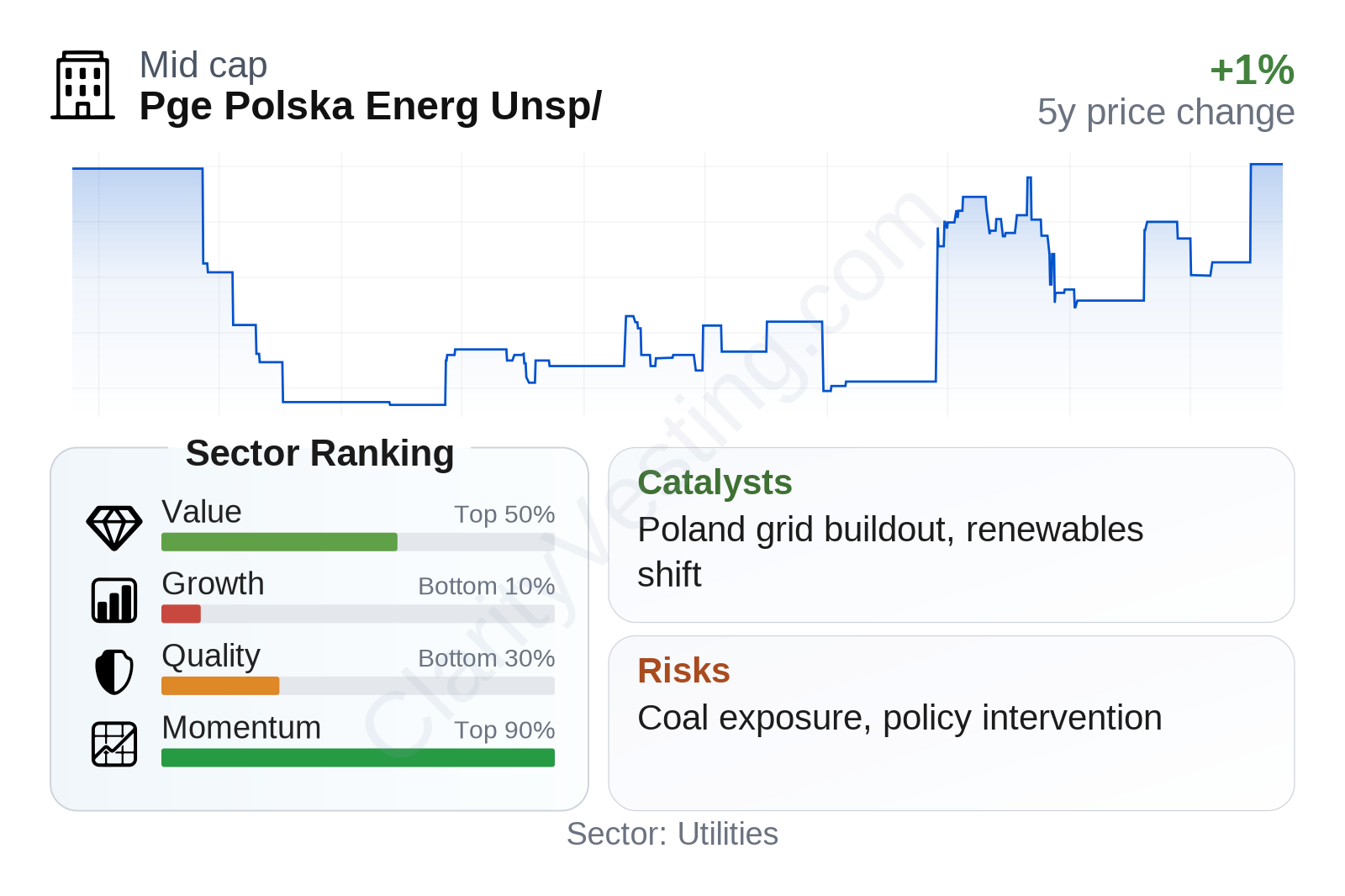
PGE stands out as a large utility with a low-volatility trading profile, shown by a beta well below 1. On valuation multiples, the shares look inexpensive relative to much of the regulated utility sector, especially on earnings-based measures. However, that headline cheapness comes with weak growth rankings, mixed quality signals over a full cycle, and negative recent free cash flow. In contrast, recent market momentum has been strong, meaning the stock has recovered considerably even though the operating picture is still uneven.
The stock chart reflects that tension. The shares fell heavily during the energy crisis period, then rebounded in stages. That recovery suggests improving sentiment around Polish utilities and energy-transition positioning, but it also shows that the market has already repriced some of the pessimism seen earlier.
Growth
PGE operates in a sector that is changing structurally rather than disappearing. Electricity demand over the long run is supported by electrification, grid upgrades, heat-system modernization, and the broader shift away from more carbon-intensive energy use. In Europe, and especially in Poland, that creates a large investment runway in power networks, cleaner generation, storage, and flexible system assets. For a utility of PGE’s size, this is a real growth opportunity, even if near-term accounting results remain noisy.
The company’s strategy broadly makes industrial sense. Poland needs major investment in transmission links, distribution networks, renewable generation, and lower-emission heating. PGE already has a strong domestic footprint and can build on existing customer relationships, infrastructure, and operational scale. A utility with a large regulated network business and a national role in power supply can benefit as the country upgrades its energy system.
Revenue per share illustrates why the growth picture needs nuance. There was a sharp rise through 2023, followed by a meaningful decline in 2024 and 2025. So the business has captured periods of favorable pricing, but it has not yet converted that into a steady multi-year growth pattern. This helps explain why the company’s longer-term growth ranking remains weak compared with many sector peers, even though more recent year-over-year revenue growth has improved.
Cash generation is another important piece. Free cash flow has been highly volatile, alternating between strongly positive and negative readings. That is common during large utility investment cycles, but it means growth is currently more about building future capacity and strategic positioning than about producing smooth excess cash today. For long-term analysis, this makes project quality and regulatory returns more important than a single year’s cash number.
A major catalyst is Poland’s and the European Union’s push to modernize the energy system. PGE has emphasized renewables, grids, storage, and cleaner heat assets as priority areas. Public-policy support, grid spending, and capacity replacement needs could all expand the company’s regulated or semi-regulated earnings base over time. Another catalyst is that the group starts this period with lower leverage than many utilities, which gives it financial flexibility while competitors may be more constrained.
Recent developments also support the idea of a large long-term opportunity. Poland continues to pursue energy independence, lower emissions, and infrastructure renewal, all of which require exactly the kinds of assets PGE already owns or is seeking to expand. In practical terms, the company is operating where national energy spending is likely to remain elevated for years.
Risks
This article is for informational purposes only and does not constitute financial advice. Some content is AI-generated. See Disclaimer