Stock Analysis · Progyny Inc (PGNY)
Overview
Progyny is a healthcare benefits company focused on fertility, family building, and women’s health. It works mainly with large employers and health plans that want to offer fertility-related coverage to employees or members in a more organized and clinically managed way. Instead of operating clinics itself, Progyny designs benefit plans, builds provider networks, manages authorizations and claims, and supports members through patient care advocates. The business sits at the intersection of employer-sponsored healthcare, specialty benefits, and reproductive health.
Its revenue model is relatively straightforward, although the company reports it through a few different streams. Based on recent company filings, the largest source is medical services revenue tied to fertility and pharmacy benefit utilization, with a smaller portion from care management and support services.
- Fertility benefits services: the core activity and the clear majority of revenue. This includes treatment episodes, claims administration, network management, and member support for fertility and family building services.
- Pharmacy-related revenue: a significant secondary stream connected to fertility medication management and coordination through Progyny Rx. This is tied closely to use of covered treatment cycles.
- Women’s health and related services: a smaller but expanding contribution that includes broader support beyond fertility, such as maternity and menopause-related navigation where offered.
Public disclosures indicate that most revenue still comes from the fertility benefit platform, while newer women’s health offerings remain a smaller layer. In practical terms, the company is still primarily a fertility benefits specialist rather than a broad health insurer.
The business model has shown a favorable pattern over the last several years: revenue has expanded materially since 2021, gross profit has also grown, and operating income has improved despite higher administrative spending. That suggests scaling benefits are present, even if margins can move around from year to year depending on utilization and client mix.
The long-term picture is one of a company that has grown its top line from roughly $500 million in 2021 to about $1.3 billion in 2025 while staying profitable, which is notable in healthcare services where many specialized platforms remain loss-making for long periods.
Key Figures
| Metric | Value | Sector ⓘ |
|---|---|---|
| Date | Oct 17, 2026 | |
| Context | ||
| Sector | Healthcare | |
| Industry | Healthcare Plans | |
| Market Cap ⓘ | $2.14B | |
| Beta ⓘ | 1.02 | |
Value (Cheapness) | ||
| P/E Ratio ⓘ | 30.26 | 24.79 |
| P/B Ratio ⓘ | 4.98 | 3.08 |
| FCF Yield ⓘ | 10.20% | 3.15% |
| Dividend Yield ⓘ | N/A | 1.94% |
| EBIT / EV ⓘ | 6.78% | 0.57% |
| PEG ⓘ | N/A | |
Growth (Business expansion) | ||
| Revenue Growth ⓘ | 5.30% | 7.45% |
| RPS Growth (5Y CAGR) ⓘ | 30.36% | 8.61% |
| EPS Growth (5Y CAGR) ⓘ | 31.61% | -17.81% |
| BVPS Growth (5Y CAGR) ⓘ | 23.13% | 3.72% |
| Margin Growth (5Y Trend) ⓘ | 0.93% | -0.62% |
| FCF Growth (5Y CAGR) ⓘ | 68.29% | 1.04% |
| DPS Growth (5Y CAGR) ⓘ | N/A | 6.77% |
Quality (Business durability) | ||
| ROIC (Latest) ⓘ | 15.98% | 3.24% |
| ROA (Latest) ⓘ | 10.41% | 3.01% |
| ROIC (5Y Median) ⓘ | 12.48% | 4.60% |
| ROA (5Y Median) ⓘ | 8.67% | 1.89% |
| Net Debt / EBIT (Latest) ⓘ | -1.05 | 1.34 |
| Net Debt / EBIT (5Y Median) ⓘ | -1.72 | 1.84 |
| Net Debt / EBITDA (Latest) ⓘ | -0.99 | 1.00 |
| Net Debt / Assets ⓘ | -17.55% | 5.45% |
| EBITDA / Interest ⓘ | N/A | 9.64 |
| Operating Margin (Latest) ⓘ | 9.14% | 9.27% |
| Operating Margin (5Y Median) ⓘ | 6.49% | 7.38% |
| Debt to Equity (Latest) ⓘ | 5.95% | 28.58% |
| Profit Margin (Latest) ⓘ | 6.00% | 3.59% |
| Free Cash Flow (Latest) ⓘ | $217.99M | |
Momentum (Price trend) | ||
| 3Y Return ⓘ | -15.08% | +42.80% |
| 12M Return (excl. last month) ⓘ | +25.44% | +18.50% |
| 6M Return ⓘ | +57.88% | +7.57% |
| Price vs. 200-Day MA ⓘ | +13.16% | +5.12% |
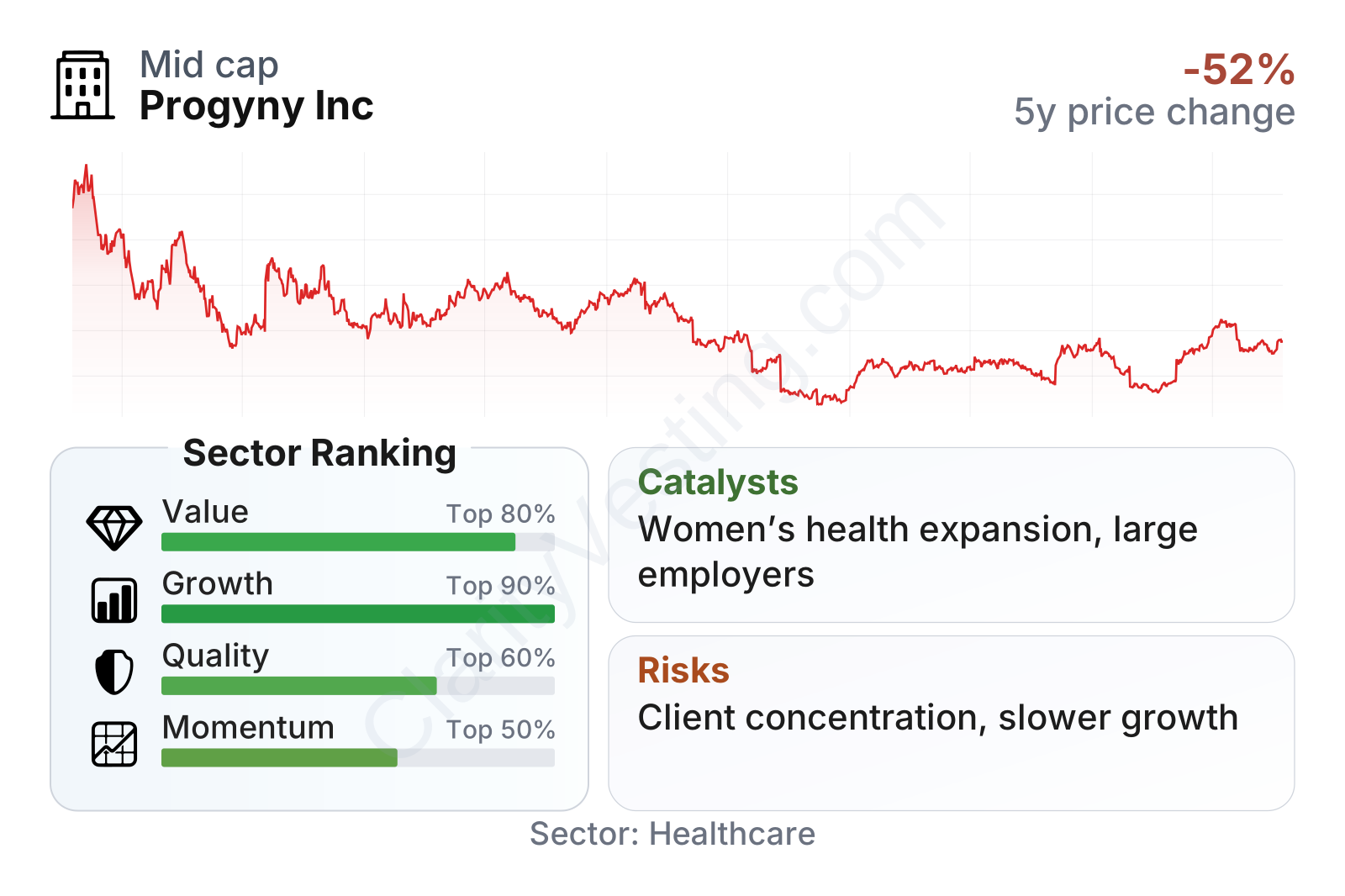
Progyny stands out most on growth, cash generation, and balance sheet strength. Five-year growth rates in revenue per share, earnings per share, book value per share, and free cash flow are well ahead of sector norms. Profitability and returns on capital are also stronger than many healthcare peers, while leverage remains very low. The weaker area is market performance: the stock has been volatile, and its longer-term share price return has lagged much of the sector despite a recent rebound.
Growth
Progyny operates in a part of healthcare that still has room to expand. Fertility benefits have moved from being a niche employer perk to a more mainstream offering among larger companies competing for talent. The broader trend also supports demand: delayed parenthood, increasing use of assisted reproductive technologies, and a growing willingness by employers to cover these services all point to a structurally expanding market. On top of that, women’s health remains underserved in employer benefits, giving Progyny adjacent categories to pursue beyond IVF alone.
The company’s strategy for future growth is logical. It is built around winning employer clients, expanding covered lives, increasing utilization within those accounts, and broadening the product set. That approach matters because Progyny is not dependent on a single treatment type. Once an employer adopts the platform, the company can deepen the relationship through pharmacy services, care navigation, and broader women’s health offerings. This can raise revenue per client while making the relationship harder to displace.
Growth has clearly normalized from the unusually high pace seen in 2022 and 2023. More recently, year-over-year revenue growth has slowed into the low- to mid-single digits, with some quarters modestly better than others. That deceleration is important: it suggests Progyny is moving from an early hyper-growth phase into a more mature expansion stage. Even so, the company’s five-year growth record remains exceptionally strong for the healthcare plans category.
Cash generation is one of the more convincing parts of the growth profile. Free cash flow rose sharply over the last several years and remains at a healthy level, even with some moderation more recently. That gives Progyny flexibility to invest in sales, product development, and potential partnerships without depending heavily on external financing. For a long-term business analysis, that is a meaningful support because it reduces the risk that growth must be funded by debt or dilution.
A recent opportunity worth noting is the continued expansion of women’s health services around the fertility platform. Management has been positioning Progyny as more than an IVF benefits administrator, with offerings that can support members through different life stages. If adoption broadens, that could enlarge the addressable market and reduce dependence on a single specialty category. Another ongoing catalyst is the company’s ability to add large self-insured employers and health plan partners, where each new client can bring a sizable population onto the platform.
Risks
This article is for informational purposes only and does not constitute financial advice. Some content is AI-generated. See Disclaimer


