Stock Analysis · Precigen Inc (PGEN)
Overview
Precigen is a biotechnology company focused on advanced gene and cell therapies. In simple terms, it develops treatments designed to modify or direct cells and genes to fight disease. The company’s work is concentrated in areas with high unmet medical need, especially cancer and certain immune-related conditions. Its platform approach combines in-house research tools with therapeutic programs, with the goal of creating more targeted treatments than traditional drugs.
At this stage, Precigen is still primarily a development-stage biotech rather than a mature commercial pharmaceutical business. That matters for long-term analysis because the company’s value depends much more on clinical progress, regulatory decisions, and future product launches than on a stable base of current sales.
Based on recent company filings, Precigen’s revenue remains small and uneven, and it comes mainly from collaboration, licensing, and service-related activities rather than broad product sales. The business mix can shift sharply from one period to another depending on milestone timing and partner activity. The main sources of revenue are:
- Collaboration and licensing revenue — the largest source in recent periods, typically tied to research agreements, technology access, development milestones, and similar arrangements.
- Product and service-related revenue — a smaller contribution, including legacy activities and other operating revenue streams that are not yet large enough to define the company financially.
- Future potential commercial product revenue — currently limited, but strategically important if late-stage programs eventually reach the market.
The broader financial picture shows a company spending heavily on research and administration while revenue remains relatively low. Operating losses have stayed large, which is common in biotech, but Precigen’s gap between revenue and expenses is still wide enough to make execution on clinical milestones especially important.
The pattern over the last several years shows a business with modest revenue, high research spending, and persistent losses. Revenue has improved from the weakest levels, but the cost base remains far above sales, so the investment case still rests mostly on pipeline success rather than current operating economics.
Key Figures
| Metric | Value | Sector ⓘ |
|---|---|---|
| Date | Oct 17, 2026 | |
| Context | ||
| Sector | Healthcare | |
| Industry | Biotechnology | |
| Market Cap ⓘ | $2.62B | |
| Beta ⓘ | 0.92 | |
Value (Cheapness) | ||
| P/E Ratio ⓘ | N/A | 24.79 |
| P/B Ratio ⓘ | 68.31 | 3.08 |
| FCF Yield ⓘ | -4.42% | 3.15% |
| Dividend Yield ⓘ | N/A | 1.94% |
| EBIT / EV ⓘ | -5.44% | 0.57% |
| PEG ⓘ | N/A | |
Growth (Business expansion) | ||
| Revenue Growth ⓘ | 6322.70% | 7.45% |
| RPS Growth (5Y CAGR) ⓘ | -18.53% | 8.61% |
| EPS Growth (5Y CAGR) ⓘ | N/A | -17.81% |
| BVPS Growth (5Y CAGR) ⓘ | -40.37% | 3.72% |
| Margin Growth (5Y Trend) ⓘ | N/A | -0.62% |
| FCF Growth (5Y CAGR) ⓘ | N/A | 1.04% |
| DPS Growth (5Y CAGR) ⓘ | -63.64% | 6.77% |
Quality (Business durability) | ||
| ROIC (Latest) ⓘ | -92.33% | 3.24% |
| ROA (Latest) ⓘ | -92.34% | 3.01% |
| ROIC (5Y Median) ⓘ | -51.95% | 4.60% |
| ROA (5Y Median) ⓘ | -52.26% | 1.89% |
| Net Debt / EBIT (Latest) ⓘ | N/A | 1.34 |
| Net Debt / EBIT (5Y Median) ⓘ | N/A | 1.84 |
| Net Debt / EBITDA (Latest) ⓘ | N/A | 1.00 |
| Net Debt / Assets ⓘ | 48.16% | 5.45% |
| EBITDA / Interest ⓘ | N/A | 9.64 |
| Operating Margin (Latest) ⓘ | -172.64% | 9.27% |
| Operating Margin (5Y Median) ⓘ | -1540.47% | 7.38% |
| Debt to Equity (Latest) ⓘ | 225.69% | 28.58% |
| Profit Margin (Latest) ⓘ | -183.98% | 3.59% |
| Free Cash Flow (Latest) ⓘ | -$115.83M | |
Momentum (Price trend) | ||
| 3Y Return ⓘ | +514.96% | +42.80% |
| 12M Return (excl. last month) ⓘ | +94.99% | +18.50% |
| 6M Return ⓘ | +84.49% | +7.57% |
| Price vs. 200-Day MA ⓘ | +39.54% | +5.12% |
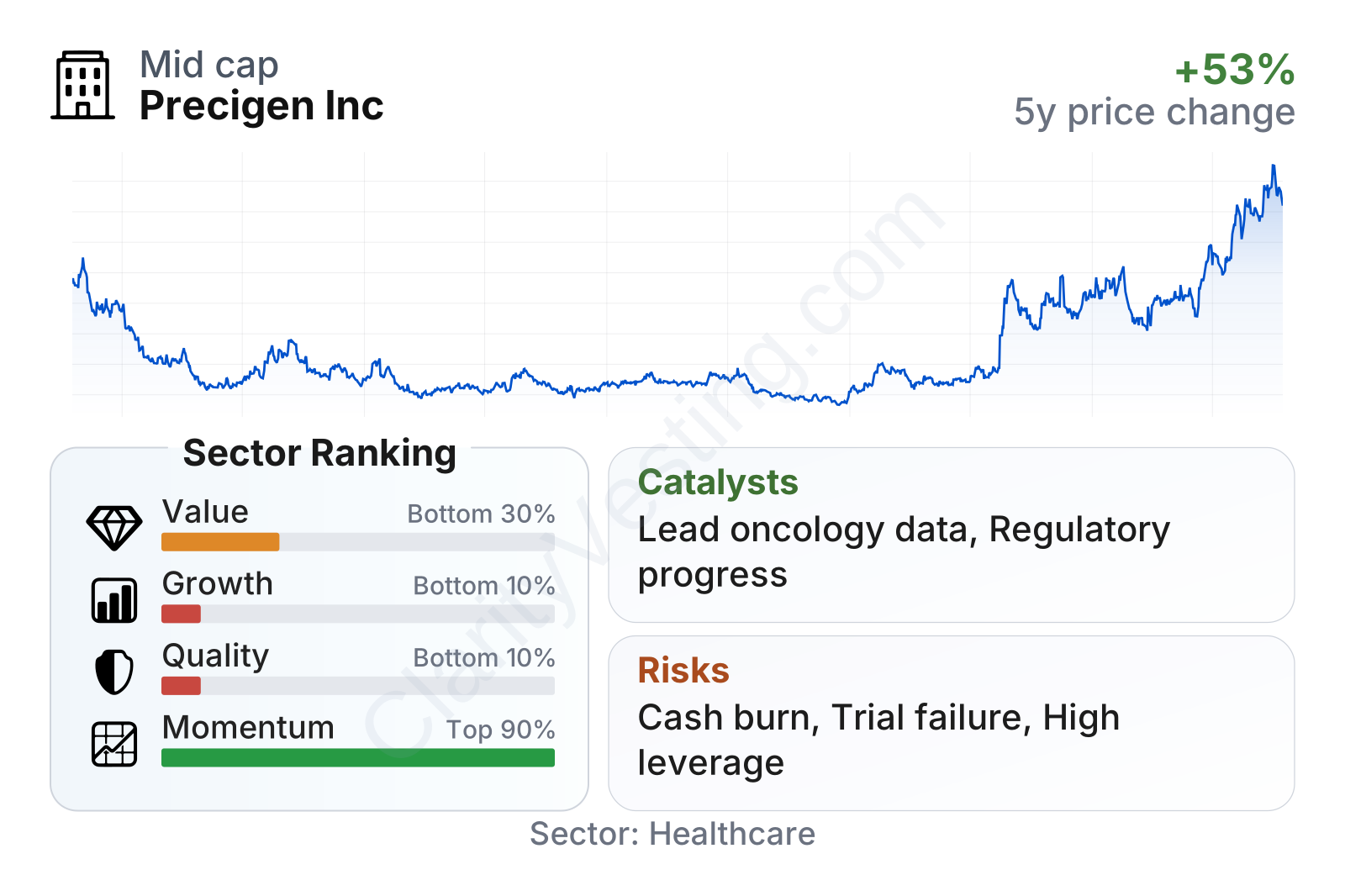
Precigen is a small-cap biotech with share-price momentum that has recently been much stronger than the broader healthcare group, but its underlying fundamentals remain weak. The metrics point to a company that ranks well on recent market performance while sitting near the bottom of the sector on profitability, balance-sheet strength, and long-term business quality. Growth also needs to be read carefully: the latest year-over-year revenue rebound is strong, but it comes after a very low base and does not yet indicate a durable commercial scale.
Growth
Precigen operates in a sector with long-term structural growth potential. Gene therapy, cell therapy, and other precision biologic treatments continue to attract industry interest because they aim to treat diseases more directly and, in some cases, more durably than conventional medicines. If even a limited number of these platforms prove effective and manufacturable, the commercial opportunity can be meaningful.
For Precigen specifically, the growth logic is centered on turning its technology platform into late-stage or commercial assets. The company has put increasing emphasis on its most advanced therapeutic candidates rather than spreading resources across too many early projects. That narrower focus makes strategic sense for a company of its size because it can reduce complexity and direct capital toward the programs most likely to create value through trial data, regulatory progress, or partnerships.
Revenue growth has accelerated sharply in the most recent readings, with year-over-year gains far above the sector median. Still, the history is highly volatile. Earlier years included repeated declines, which suggests recent improvement should be viewed as a sign of momentum rather than proof that the business has reached a stable growth path. In biotechnology, revenue can rise quickly when milestone payments arrive and fall just as quickly when they do not recur.
Cash generation remains the main constraint on the growth narrative. Free cash flow has stayed deeply negative and has worsened over time, showing that the company continues to consume significant capital to fund operations and development. That does not invalidate the opportunity, but it means future growth depends not only on science and regulation, but also on access to financing.
A meaningful catalyst is Precigen’s lead clinical pipeline, particularly programs in oncology and immunotherapy where a successful trial update can reshape how the market values a development-stage biotech. Recent company updates have continued to emphasize progress in its lead assets and regulatory interactions. In a business with limited current revenue, favorable clinical data or a clearer registration path can matter more than near-term sales trends.
Risks
This article is for informational purposes only and does not constitute financial advice. Some content is AI-generated. See Disclaimer


