Stock Analysis · Provident Financial Services Inc (PFS)
Overview
Provident Financial Services is the parent company of Provident Bank, a regional bank serving individuals, businesses, and local communities in the Northeast, with a strong presence in New Jersey and nearby markets. Like most regional banks, it makes money primarily by gathering deposits from customers and lending that money out at higher rates, while also earning fees from banking services.
Its revenue mix is centered on traditional banking activities. Based on recent annual filings, the largest sources of revenue are:
- Net interest income: approximately 85% to 90% of total revenue in recent periods. This is the spread between interest earned on loans and securities and interest paid on deposits and borrowings.
- Wealth management and trust-related fees: a smaller but recurring contributor, generally in the low single-digit percentage range of revenue. This includes fiduciary, investment management, and related client services.
- Bank service charges and fees: also a low single-digit percentage share. This covers deposit account fees, treasury management, card-related services, and other customer banking charges.
- Loan-related and other noninterest income: another modest contributor, including items such as mortgage banking, BOLI income, and miscellaneous banking income.
The company’s business became larger and more diversified after its merger with Lakeland Bancorp, which expanded the loan book, deposit base, and branch footprint. That matters because scale is important in regional banking: a larger deposit base can support lending growth, and a broader network can improve customer retention and operating efficiency over time.
One notable trend in recent years is that total revenue has increased meaningfully, but profitability has been more uneven because funding costs and interest expense rose sharply during the higher-rate period. In other words, the bank has grown, but the benefit has not flowed evenly into earnings every year.
The revenue picture has clearly expanded since 2021, especially after the Lakeland combination, but expenses and interest costs also rose materially. The more favorable recent pattern is that earnings recovered after a weaker 2024, suggesting that integration benefits and a more stable funding environment are starting to matter.
Key Figures
| Metric | Value | Sector ⓘ |
|---|---|---|
| Date | Oct 24, 2026 | |
| Context | ||
| Sector | Financial Services | |
| Industry | Banks - Regional | |
| Market Cap ⓘ | $2.94B | |
| Beta ⓘ | 0.82 | |
Value (Cheapness) | ||
| P/E Ratio ⓘ | 9.39 | 12.46 |
| P/B Ratio ⓘ | 1.04 | 1.25 |
| FCF Yield ⓘ | 12.34% | 9.82% |
| Dividend Yield ⓘ | 2.13% | 2.94% |
| EBIT / EV ⓘ | 7.70% | 8.11% |
| PEG ⓘ | 1.61 | |
Growth (Business expansion) | ||
| Revenue Growth ⓘ | 3.80% | 9.10% |
| RPS Growth (5Y CAGR) ⓘ | 13.48% | 12.31% |
| EPS Growth (5Y CAGR) ⓘ | -16.23% | -6.97% |
| BVPS Growth (5Y CAGR) ⓘ | -40.37% | 5.02% |
| Margin Growth (5Y Trend) ⓘ | -16.91% | -4.00% |
| FCF Growth (5Y CAGR) ⓘ | 31.42% | 4.71% |
| DPS Growth (5Y CAGR) ⓘ | 0.82% | 8.92% |
Quality (Business durability) | ||
| ROIC (Latest) ⓘ | 5.73% | 9.18% |
| ROE (Latest) ⓘ | 11.02% | 13.93% |
| ROA (Latest) ⓘ | 1.24% | 1.57% |
| ROIC (5Y Median) ⓘ | 5.90% | 7.80% |
| ROE (5Y Median) ⓘ | 5.38% | 12.15% |
| ROA (5Y Median) ⓘ | 1.19% | 1.28% |
| Net Debt / EBIT (Latest) ⓘ | 10.61 | 1.02 |
| Net Debt / EBIT (5Y Median) ⓘ | 5.65 | 0.72 |
| Net Debt / EBITDA (Latest) ⓘ | 9.18 | 0.88 |
| Operating Margin (Latest) ⓘ | 31.17% | 22.30% |
| Operating Margin (5Y Median) ⓘ | 29.52% | 24.50% |
| Debt to Equity (Latest) ⓘ | 164.83% | 59.34% |
| Profit Margin (Latest) ⓘ | 34.97% | 26.42% |
| Free Cash Flow (Latest) ⓘ | $362.66M | |
Momentum (Price trend) | ||
| 3Y Return ⓘ | +93.72% | +95.73% |
| 12M Return (excl. last month) ⓘ | +19.84% | +17.30% |
| 6M Return ⓘ | +5.03% | +6.07% |
| Price vs. 200-Day MA ⓘ | +3.92% | +5.36% |
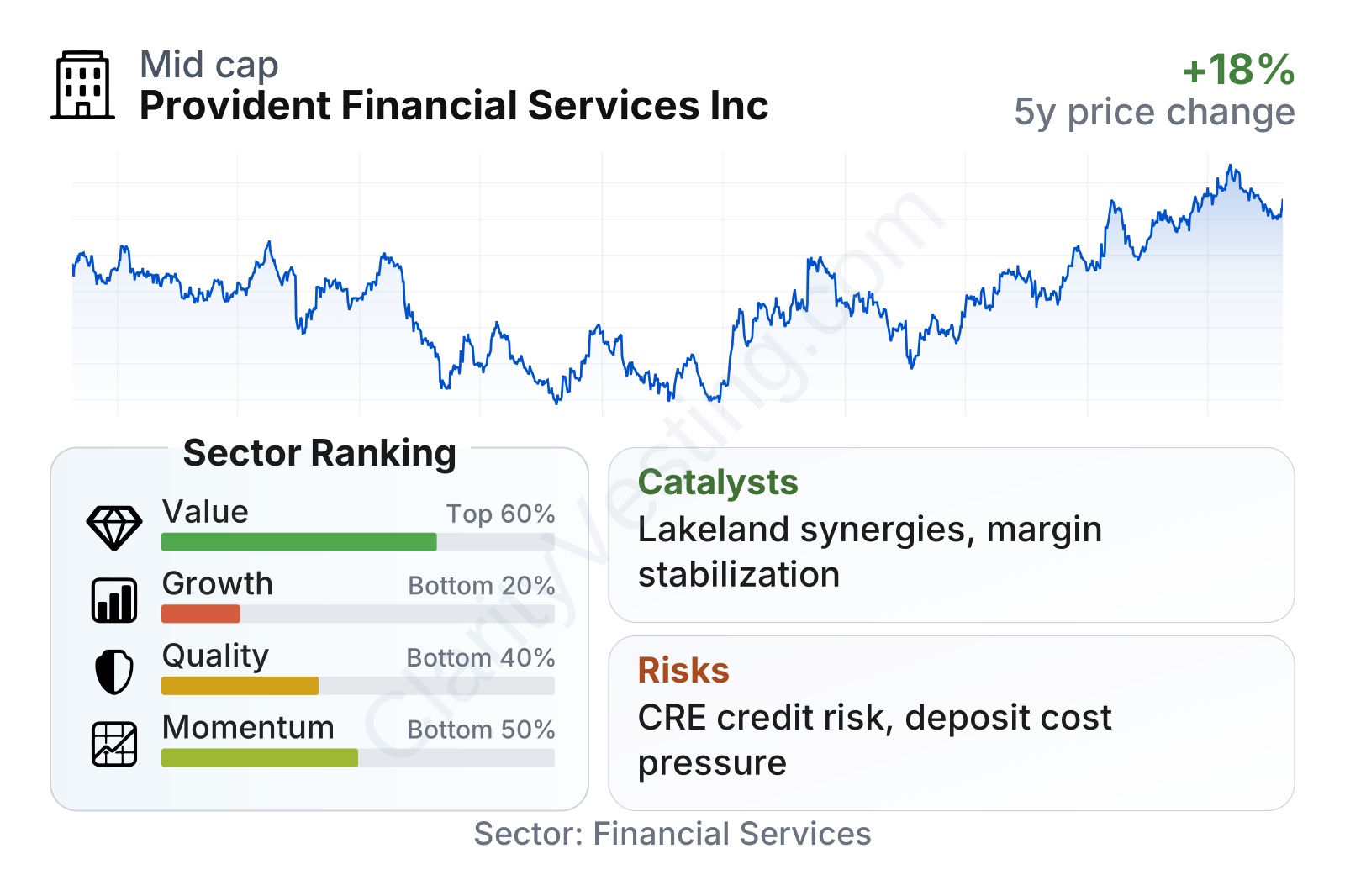
Provident Financial Services is a mid-sized regional bank with a stock that has recovered strongly from the 2023-2024 stress period for the banking sector. On valuation, it screens somewhat cheaper than the sector on earnings and book value, while its recent share-price trend has improved. The weaker area is growth and overall quality relative to many peers: profitability has recovered, but return measures still sit below sector medians, and long-term earnings compounding has been uneven.
Growth
Regional banking is not a high-growth industry in the same way as software or semiconductors, but it remains a large and necessary part of the economy. Banks like Provident can grow through a mix of loan expansion, deposit gathering, fee-based services, and acquisitions. In this case, the most important strategic move has been consolidation. The Lakeland merger added scale, expanded the franchise, and created room for cost savings and cross-selling across a broader customer base.
That strategy makes sense for a regional bank. Larger scale can help absorb compliance and technology costs, improve branch productivity, and create a more competitive platform for commercial clients. Provident also operates in relatively attractive markets with dense populations and business activity, which can support steady demand for commercial real estate, business banking, and consumer banking products.
Earnings per share show why the company is currently in a rebuilding phase rather than a smooth compounding phase. EPS fell noticeably in 2023 and 2024 as the industry dealt with higher funding costs and margin pressure, then rebounded in 2025. That rebound is important because it suggests the earlier weakness was not simply a permanent deterioration in the franchise. The key question now is whether the company can turn that recovery into a steadier multi-year trend.
Book value per share has also been mixed. After improving following the merger period, it pulled back again more recently. For banks, book value is a useful anchor because it reflects the balance-sheet base supporting future earnings. A stable or rising book value usually supports confidence in long-term earning power, while volatility can signal pressure from credit costs, capital actions, or merger accounting effects.
A meaningful catalyst for future growth is the possibility of margin stabilization if deposit costs stop rising faster than asset yields. Another is merger integration: if management continues to capture expense synergies and deepen customer relationships in the enlarged footprint, earnings capacity could improve without requiring unusually fast economic growth. Recent company updates have also pointed to continued focus on commercial banking, core deposit retention, and operating efficiency, all of which are central to longer-term progress.
Risks
This article is for informational purposes only and does not constitute financial advice. Some content is AI-generated. See Disclaimer


