Stock Analysis · Pfizer Inc (PFE)
Overview
Pfizer is one of the world’s largest pharmaceutical companies. It develops, manufactures, and sells medicines and vaccines used in areas such as oncology, vaccines, internal medicine, inflammation and immunology, and rare disease. Its business is built around discovering new drugs, expanding approved products into more patients and countries, and using acquisitions and partnerships to refresh its pipeline as older products lose exclusivity.
Revenue is spread across a broad portfolio, but a few products still matter a lot. Based on Pfizer’s recent annual reporting and product disclosures, the main revenue sources can be summarized approximately as follows:
- Oncology medicines: roughly 25% to 30% of revenue. This includes products such as Ibrance, Xtandi alliance revenue, Padcev-related exposure through Seagen, Adcetris, and other cancer assets added through the Seagen acquisition.
- COVID-related products: roughly 10% to 15%. This mainly includes Comirnaty and Paxlovid, which are far below their pandemic peak but still contribute meaningful sales.
- Vaccines excluding COVID: roughly 10% to 15%. Key products include Prevnar family pneumococcal vaccines and newer adult vaccine launches.
- Specialty and hospital medicines: roughly 20% to 25%. This includes sterile injectables, anti-infectives, and other hospital-focused products.
- Internal medicine and inflammation/immunology: roughly 20% to 25%. This includes products across cardiovascular, migraine, ulcerative colitis, and other chronic disease categories.
- Rare disease: roughly 5% to 10%. This includes therapies for hemophilia and other less common conditions.
The bigger picture is that Pfizer is no longer driven mainly by pandemic products. Its current profile is moving back toward a traditional large pharmaceutical company: a diversified set of branded medicines, a large research budget, and a constant need to replace older products with new launches.
The long-term business mix has also become more oncology-heavy after the Seagen acquisition, which gives Pfizer a larger presence in one of the most attractive parts of the drug industry. At the same time, the company still benefits from its global manufacturing footprint, scale in commercialization, and financial capacity to support research and licensing deals.
The profit structure shows how unusual the last few years have been. Revenue and earnings surged during the pandemic, dropped sharply as COVID demand normalized, and then began to stabilize. Research spending remained high throughout, which is important because it shows Pfizer is still funding future products even after the COVID windfall faded.
Key Figures
| Metric | Value | Sector ⓘ |
|---|---|---|
| Date | Oct 17, 2026 | |
| Context | ||
| Sector | Healthcare | |
| Industry | Drug Manufacturers - General | |
| Market Cap ⓘ | $166.49B | |
| Beta ⓘ | 0.28 | |
Value (Cheapness) | ||
| P/E Ratio ⓘ | 38.43 | 24.79 |
| P/B Ratio ⓘ | 1.98 | 3.08 |
| FCF Yield ⓘ | 6.60% | 3.15% |
| Dividend Yield ⓘ | 6.06% | 1.94% |
| EBIT / EV ⓘ | 3.26% | 0.57% |
| PEG ⓘ | 12.89 | |
Growth (Business expansion) | ||
| Revenue Growth ⓘ | 2.60% | 7.45% |
| RPS Growth (5Y CAGR) ⓘ | -6.24% | 8.61% |
| EPS Growth (5Y CAGR) ⓘ | -32.36% | -17.81% |
| BVPS Growth (5Y CAGR) ⓘ | 2.89% | 3.72% |
| Margin Growth (5Y Trend) ⓘ | -15.21% | -0.62% |
| FCF Growth (5Y CAGR) ⓘ | -25.75% | 1.04% |
| DPS Growth (5Y CAGR) ⓘ | 2.96% | 6.77% |
Quality (Business durability) | ||
| ROIC (Latest) ⓘ | 4.49% | 3.24% |
| ROA (Latest) ⓘ | 2.12% | 3.01% |
| ROIC (5Y Median) ⓘ | 7.16% | 4.60% |
| ROA (5Y Median) ⓘ | 3.69% | 1.89% |
| Net Debt / EBIT (Latest) ⓘ | 9.01 | 1.34 |
| Net Debt / EBIT (5Y Median) ⓘ | 5.93 | 1.84 |
| Net Debt / EBITDA (Latest) ⓘ | 4.61 | 1.00 |
| Net Debt / Assets ⓘ | 30.93% | 5.45% |
| EBITDA / Interest ⓘ | 5.00 | 9.64 |
| Operating Margin (Latest) ⓘ | 10.84% | 9.27% |
| Operating Margin (5Y Median) ⓘ | 17.47% | 7.38% |
| Debt to Equity (Latest) ⓘ | 74.18% | 28.58% |
| Profit Margin (Latest) ⓘ | 6.80% | 3.59% |
| Free Cash Flow (Latest) ⓘ | $10.99B | |
Momentum (Price trend) | ||
| 3Y Return ⓘ | +7.32% | +42.80% |
| 12M Return (excl. last month) ⓘ | +23.00% | +18.50% |
| 6M Return ⓘ | +11.99% | +7.57% |
| Price vs. 200-Day MA ⓘ | +13.22% | +5.12% |
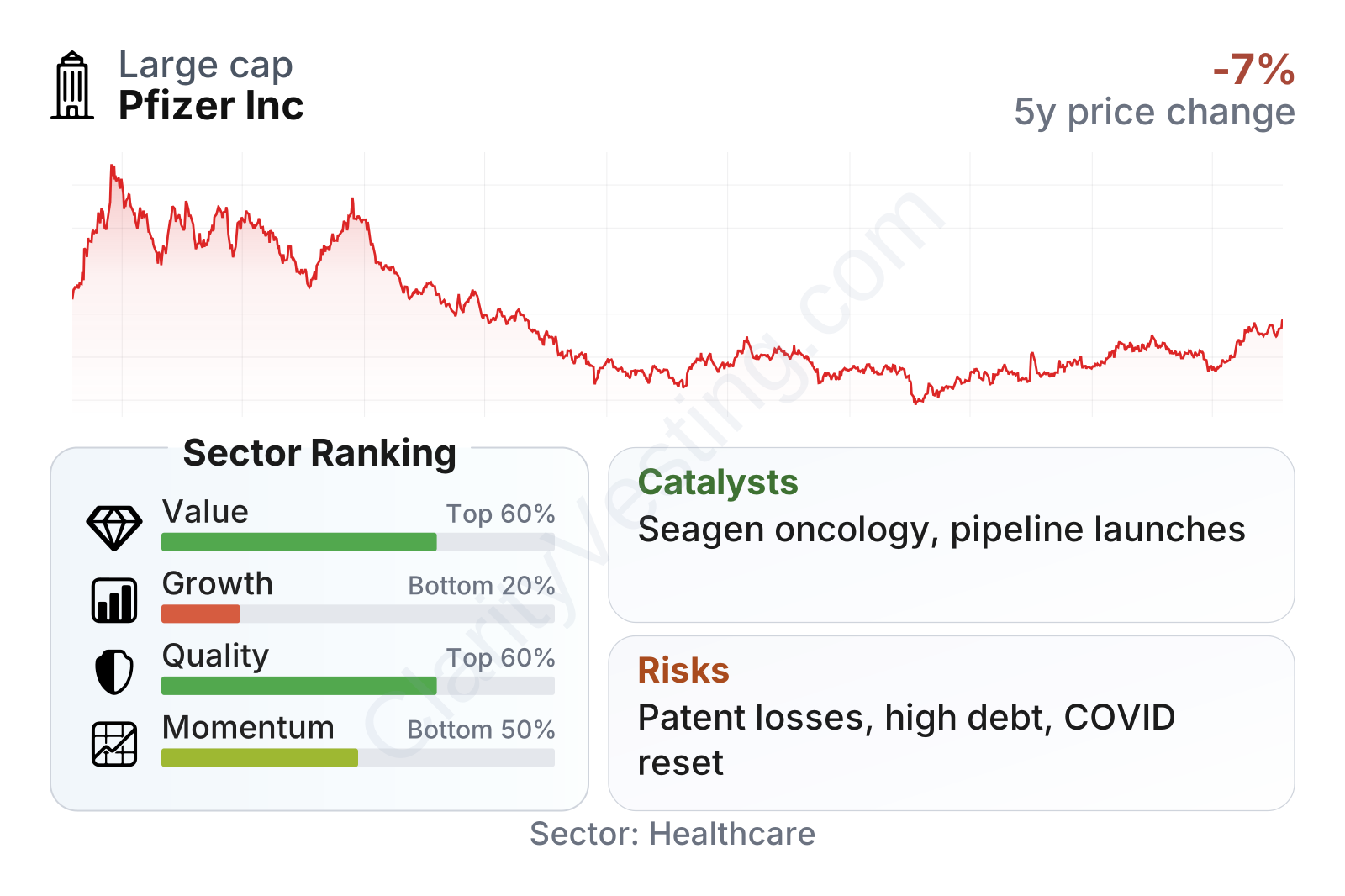
Pfizer remains a very large healthcare company, and its share price has been much less volatile than the broader market, with a beta around 0.30. The factor snapshot is mixed. Value metrics look stronger than the sector in areas tied to cash generation and shareholder payout, while growth ranks near the bottom of the group. Quality is more balanced: margins are still above the sector median, but leverage is clearly heavier than many peers.
The stock chart reflects that reset. After peaking during the COVID period, the shares spent several years repricing lower as pandemic revenue faded and the market waited for a more durable post-COVID earnings base. More recently, the stock has shown periods of stabilization rather than a clear long-term uptrend.
Growth
Pharmaceuticals remain a structurally growing sector over the long run. Demand is supported by aging populations, rising rates of chronic disease, broader access to medicines in emerging markets, and continued innovation in areas such as cancer, immunology, and rare disease. Within that broad backdrop, oncology is one of the most attractive segments, and Pfizer has been increasing its exposure there.
Pfizer’s current growth strategy has three main pillars: improve performance of its existing portfolio, launch new medicines from internal research, and use acquisitions to strengthen high-growth therapeutic areas. The Seagen acquisition is central to this plan because it expands Pfizer’s position in antibody-drug conjugates, a fast-growing cancer treatment category with strong industry interest.
Revenue growth has been volatile because the comparison base was distorted by pandemic sales. The important point is not the sharp declines seen after the COVID peak, but the more recent return to modest positive growth. That suggests the non-COVID portfolio is gradually taking on a larger role, although the pace remains slower than the healthcare sector median.
Cash generation also went through a major reset. Free cash flow fell steeply from extraordinary pandemic-era levels, then recovered to a more normal range. Even after that decline, Pfizer still generates billions of dollars in annual free cash flow, which gives it room to fund research, support its dividend, and work down acquisition-related debt over time.
Recent company updates have emphasized several potential catalysts: oncology integration from Seagen, ongoing product launches such as vaccines and specialty medicines, and a broader pipeline that includes cancer, obesity-related programs through partnerships, and additional late-stage assets. None of these alone replaces the scale of past COVID revenue, but together they can rebuild the company’s growth base over the next several years.
Risks
This article is for informational purposes only and does not constitute financial advice. Some content is AI-generated. See Disclaimer


