Stock Analysis · Penumbra Inc (PEN)
Overview
Penumbra is a medical device company focused on treating serious conditions involving blocked blood vessels and blood clots. Its products are used mainly by physicians in hospitals, especially in procedures for stroke, pulmonary embolism, deep vein thrombosis, and other vascular conditions. The company has built its business around devices that remove clots through minimally invasive procedures, which can be attractive because they aim to improve outcomes while avoiding more invasive surgery.
Its revenue is primarily generated by selling medical devices and related disposables used in interventional procedures. Based on recent company reporting, revenue is concentrated in thrombectomy and other vascular intervention categories, with a smaller but meaningful contribution from embolization products.
- Thrombectomy products: approximately 75% to 85% of revenue. This includes systems used to remove clots in ischemic stroke and venous thromboembolism, such as aspiration-based platforms and related catheters.
- Embolization and access products: approximately 15% to 25% of revenue. This includes coils and related tools used to block or reduce blood flow in targeted vessels, as well as select access-related products.
- Geographic mix: the United States remains the largest market, while international sales represent a smaller but growing share of revenue.
Over the last several years, Penumbra’s business mix has increasingly reflected its larger thrombectomy franchise. Profitability has also changed materially: revenue has risen steadily, gross profit has expanded faster than cost of revenue, and operating income has improved from losses or very small profits earlier in the period to much stronger earnings more recently. Selling and administrative costs are still large, which is common for device companies building commercial reach, but the overall trajectory has become more favorable.
Key Figures
| Metric | Value | Sector ⓘ |
|---|---|---|
| Date | Oct 24, 2026 | |
| Context | ||
| Sector | Healthcare | |
| Industry | Medical Devices | |
| Market Cap ⓘ | $12.74B | |
| Beta ⓘ | 0.70 | |
Value (Cheapness) | ||
| P/E Ratio ⓘ | 79.50 | 25.42 |
| P/B Ratio ⓘ | 8.40 | 3.08 |
| FCF Yield ⓘ | 1.69% | 3.12% |
| Dividend Yield ⓘ | N/A | 1.85% |
| EBIT / EV ⓘ | 1.69% | 0.56% |
| PEG ⓘ | 3.60 | |
Growth (Business expansion) | ||
| Revenue Growth ⓘ | 14.90% | 7.50% |
| RPS Growth (5Y CAGR) ⓘ | 15.99% | 8.60% |
| EPS Growth (5Y CAGR) ⓘ | 90.14% | -17.73% |
| BVPS Growth (5Y CAGR) ⓘ | 9.60% | 3.72% |
| Margin Growth (5Y Trend) ⓘ | 15.71% | -0.57% |
| FCF Growth (5Y CAGR) ⓘ | N/A | 0.96% |
| DPS Growth (5Y CAGR) ⓘ | N/A | 6.69% |
Quality (Business durability) | ||
| ROIC (Latest) ⓘ | 11.16% | 3.17% |
| ROA (Latest) ⓘ | 8.64% | 2.98% |
| ROIC (5Y Median) ⓘ | 1.28% | 4.56% |
| ROA (5Y Median) ⓘ | 0.91% | 1.87% |
| Net Debt / EBIT (Latest) ⓘ | 0.04 | 1.34 |
| Net Debt / EBIT (5Y Median) ⓘ | 0.49 | 1.86 |
| Net Debt / EBITDA (Latest) ⓘ | 0.03 | 1.00 |
| Net Debt / Assets ⓘ | 0.38% | 5.06% |
| EBITDA / Interest ⓘ | 171.11 | 9.55 |
| Operating Margin (Latest) ⓘ | 13.63% | 9.25% |
| Operating Margin (5Y Median) ⓘ | 1.87% | 7.33% |
| Debt to Equity (Latest) ⓘ | 13.90% | 26.68% |
| Profit Margin (Latest) ⓘ | 10.67% | 3.34% |
| Free Cash Flow (Latest) ⓘ | $215.91M | |
Momentum (Price trend) | ||
| 3Y Return ⓘ | +56.93% | +51.61% |
| 12M Return (excl. last month) ⓘ | +25.91% | +19.90% |
| 6M Return ⓘ | -2.18% | +10.10% |
| Price vs. 200-Day MA ⓘ | -0.70% | +6.44% |
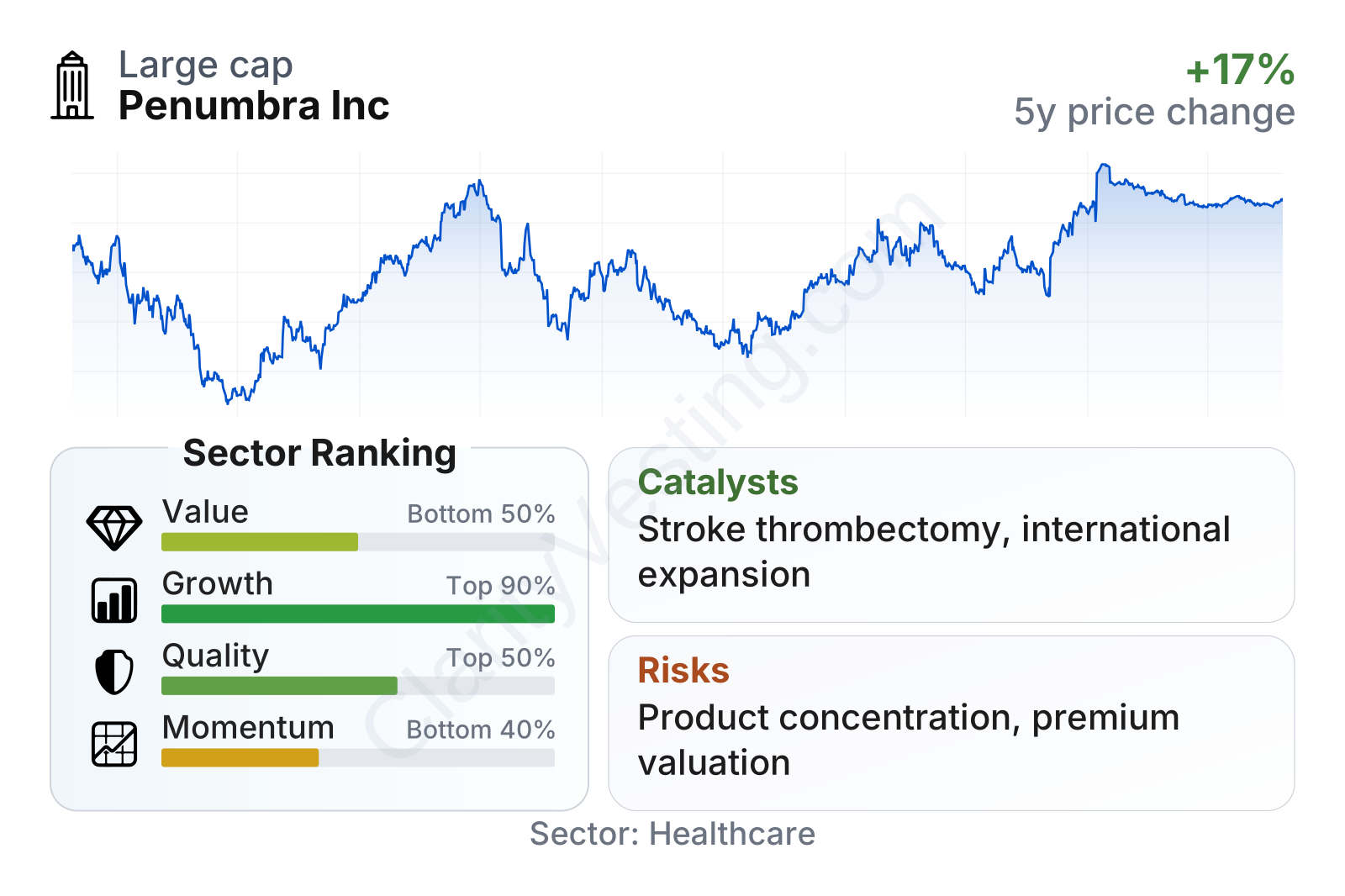
Penumbra is now a mid-to-large medical device company by healthcare standards, with relatively low share-price volatility for an individual growth stock. The most notable feature in the metrics is the contrast between strong business progress and a demanding valuation. Growth ranks near the top of the sector, quality is solid, and leverage is very low. At the same time, valuation multiples remain well above sector norms, while recent share-price momentum has been weaker than much of the healthcare group.
Growth
Penumbra operates in a part of healthcare that benefits from several long-term trends: aging populations, higher diagnosis rates for stroke and venous disease, broader use of minimally invasive procedures, and continued physician adoption of catheter-based clot removal. These are not short-lived themes. They reflect structural demand in hospital care, especially where faster treatment and better patient outcomes can support adoption.
The company’s strategy broadly makes sense for future expansion. It is centered on building specialized product families for high-acuity vascular procedures, widening the physician base that uses those systems, and expanding internationally. In medical devices, scale matters not just in manufacturing, but also in clinical evidence, training, sales coverage, and relationships with hospitals. Penumbra has been investing in these areas for years, which helps explain why revenue has continued to grow at a pace clearly above the sector median.
Revenue growth has cooled from the very high rates seen in some earlier periods, but it still remains strong in the mid-teens recently, which is roughly double the sector median. More importantly, this does not look like growth bought at the expense of economics. Operating margin trends have improved significantly over five years, suggesting that the company is gaining scale rather than simply adding volume without discipline.
Cash generation has strengthened meaningfully. Free cash flow moved from negative territory a few years ago to clearly positive levels, recently above $200 million on a trailing basis. That matters because it shows Penumbra is no longer just a revenue-growth business; it is increasingly turning sales into cash that can support product development, manufacturing expansion, acquisitions, or balance-sheet flexibility.
A major catalyst is continued adoption of mechanical thrombectomy for stroke and venous indications. Another is international expansion, where penetration is still lower than in the United States. Product launches, broader clinical evidence, and physician training can also create additional room for growth. Recent company updates have continued to point to commercial execution and portfolio expansion rather than a one-time event, which is usually a healthier sign for long-duration growth.
Risks
This article is for informational purposes only and does not constitute financial advice. Some content is AI-generated. See Disclaimer


