Stock Analysis · Pennon Group Plc (PEGRF)
Overview
Pennon Group Plc is a U.K. utility company focused on regulated water and wastewater services. Its main operating business is South West Water, which serves customers in the South West of England and also includes Bristol Water. In practical terms, the company runs essential infrastructure: supplying drinking water, collecting wastewater, treating sewage, and maintaining the networks and treatment assets needed to keep those services operating.
For a long-term reader, the important point is that Pennon operates in a highly regulated part of the utility sector. Demand for water services is generally stable because households and businesses need them regardless of the economic cycle. That usually makes revenue less volatile than in many other industries, although returns are strongly influenced by regulation, financing costs, and the pace of capital spending.
Pennon’s revenue base is concentrated, with regulated water and wastewater services providing the clear majority of sales. Based on the company’s recent reporting structure and operating profile, the revenue mix is best understood as follows:
- Water and wastewater retail and network services: about 85% to 95% of revenue. This includes household and non-household water supply, sewerage services, and related regulated charges.
- Infrastructure, construction, and other water-related services: about 5% to 15% of revenue. This includes developer services, contracting activity, and smaller non-core or ancillary activities linked to water operations.
The business has become simpler than it was several years ago, with a stronger focus on core regulated water activities rather than a more diversified waste-and-water model. That matters because a more focused utility can be easier to understand, but it also means Pennon is more exposed to the economics and regulatory outcomes of one main sector.
The operating flow has recently improved, with revenue rising materially into fiscal 2026 and operating income recovering strongly after a weaker stretch. At the same time, interest expense has become a major drain on earnings, which shows how important debt costs are in the investment case.
Key Figures
| Metric | Value | Sector ⓘ |
|---|---|---|
| Date | Oct 17, 2026 | |
| Context | ||
| Sector | Utilities | |
| Industry | Utilities - Regulated Water | |
| Market Cap ⓘ | $3.32B | |
| Beta ⓘ | 0.55 | |
Value (Cheapness) | ||
| P/E Ratio ⓘ | 20.87 | 17.28 |
| P/B Ratio ⓘ | 1.33 | 1.51 |
| FCF Yield ⓘ | -20.55% | 0.65% |
| Dividend Yield ⓘ | 6.10% | 3.77% |
| EBIT / EV ⓘ | N/A | 5.01% |
| PEG ⓘ | 8.04 | |
Growth (Business expansion) | ||
| Revenue Growth ⓘ | 21.70% | 6.10% |
| RPS Growth (5Y CAGR) ⓘ | 2.10% | 3.87% |
| EPS Growth (5Y CAGR) ⓘ | N/A | -11.30% |
| BVPS Growth (5Y CAGR) ⓘ | -7.42% | 4.23% |
| Margin Growth (5Y Trend) ⓘ | -3.17% | 3.57% |
| FCF Growth (5Y CAGR) ⓘ | N/A | -8.84% |
| DPS Growth (5Y CAGR) ⓘ | -51.34% | 4.84% |
Quality (Business durability) | ||
| ROIC (Latest) ⓘ | 6.92% | 6.53% |
| ROA (Latest) ⓘ | 0.68% | 3.20% |
| ROIC (5Y Median) ⓘ | 2.58% | 5.95% |
| ROA (5Y Median) ⓘ | 0.00% | 2.75% |
| Net Debt / EBIT (Latest) ⓘ | 10.62 | 7.13 |
| Net Debt / EBIT (5Y Median) ⓘ | 25.83 | 7.23 |
| Net Debt / EBITDA (Latest) ⓘ | 5.58 | 4.31 |
| Net Debt / Assets ⓘ | 60.28% | 38.42% |
| EBITDA / Interest ⓘ | 1.88 | 4.58 |
| Operating Margin (Latest) ⓘ | 20.46% | 20.83% |
| Operating Margin (5Y Median) ⓘ | 16.32% | 20.08% |
| Debt to Equity (Latest) ⓘ | 347.81% | 137.69% |
| Profit Margin (Latest) ⓘ | 7.09% | 11.37% |
| Free Cash Flow (Latest) ⓘ | -$682.70M | |
Momentum (Price trend) | ||
| 3Y Return ⓘ | -35.64% | +52.37% |
| 12M Return (excl. last month) ⓘ | +1.51% | +8.84% |
| 6M Return ⓘ | -43.61% | -3.95% |
| Price vs. 200-Day MA ⓘ | -34.93% | -0.79% |
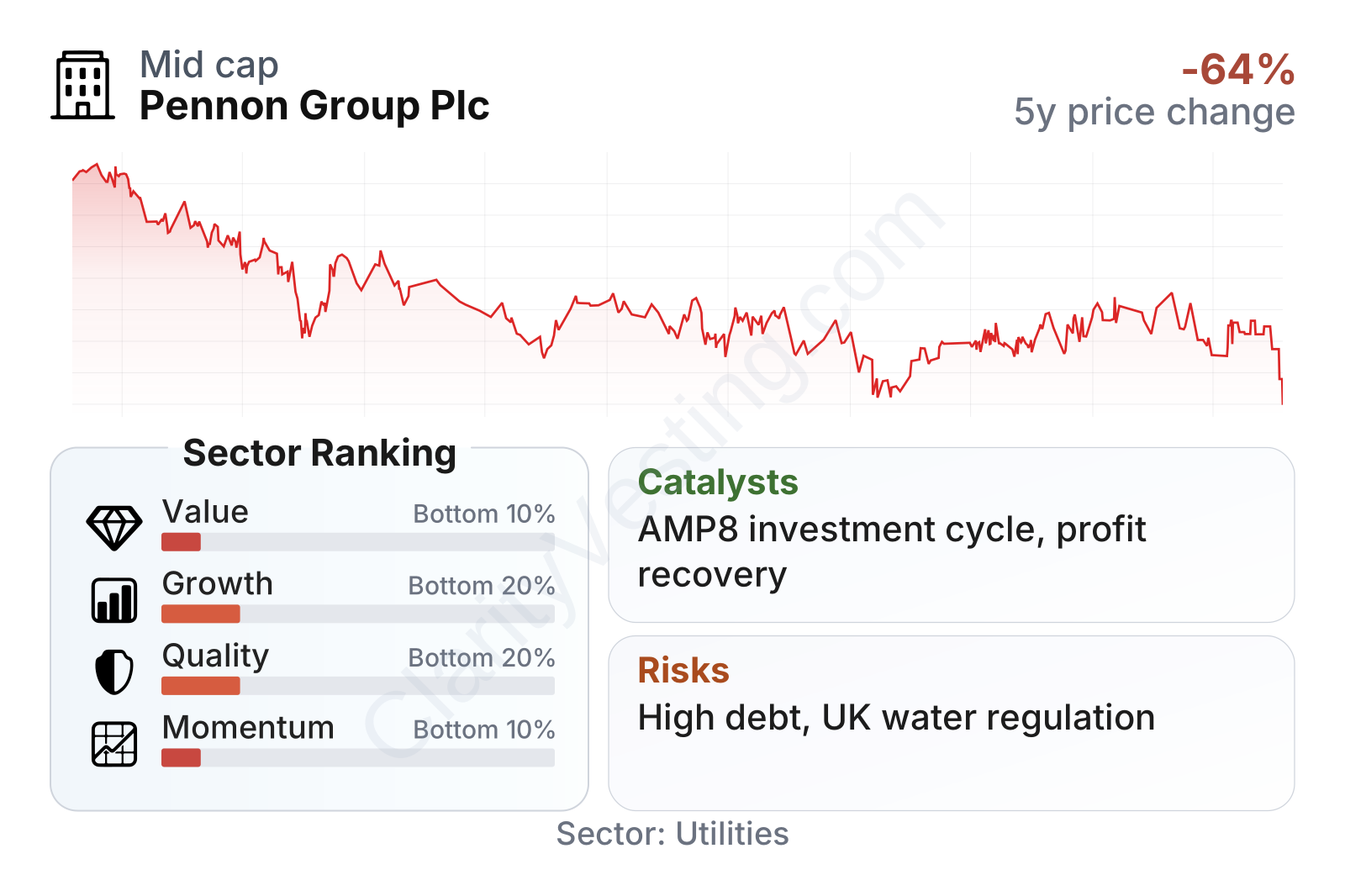
Pennon is a mid-sized regulated utility with relatively low share-price volatility, as shown by its beta well below 1. The stock’s factor profile is less flattering. Value metrics sit in the lower end of the sector, largely because the shares trade above the sector median on earnings and book value while free cash flow remains negative. Quality and growth also rank weakly versus peers, reflecting heavy leverage, modest profitability, and a mixed multiyear record even though recent year-over-year revenue growth has been strong. Momentum has also lagged over longer periods, with the stock still well below where it traded several years ago.
Growth
Water utilities are not usually high-growth businesses, but they can grow steadily through regulated increases in their asset base, inflation-linked pricing features, population demand, and large investment programs approved by regulators. In that sense, Pennon operates in a sector where growth is typically measured more by expanding infrastructure and allowed returns than by rapid customer growth.
Pennon’s strategy broadly fits that model. The company has been investing heavily in network resilience, water quality, wastewater systems, and environmental performance. If executed well, that can support future regulated returns because utilities are often allowed to earn on the capital they put into approved assets. This creates a fairly clear logic for long-term growth: spend on essential infrastructure now, improve service and compliance, and build a larger regulated asset base over time.
A meaningful catalyst is the U.K. water sector’s next regulatory period, which can shape allowed investment and returns for years. Companies with credible capital plans and acceptable operational performance may be able to secure a larger investment runway. Pennon has also highlighted major spending plans tied to water security, pollution reduction, and network upgrades, which fit political and environmental priorities in the U.K.
The longer-term revenue-per-share trend was positive through fiscal 2025 before dropping in fiscal 2026, so the path has not been consistently upward on a per-share basis. That pattern suggests the company’s recent expansion in total revenue has not yet translated into a smooth multiyear compounding profile for each share outstanding. For a utility, that is not fatal, but it does weaken the growth picture compared with stronger peers.
Recent company reporting nevertheless points to a better near-term operating backdrop than the market saw during the more pressured 2023 to 2025 period. Revenue and operating profit improved sharply in fiscal 2026, and that matters because it shows Pennon still has earnings recovery potential when pricing, regulation, and operations align more favorably.
Risks
This article is for informational purposes only and does not constitute financial advice. Some content is AI-generated. See Disclaimer


