Stock Analysis · Energi Mega Persada (PEGIY)
Overview
Energi Mega Persada is an Indonesian upstream energy company focused on exploring for, developing, and producing oil and natural gas. In simple terms, it looks for hydrocarbon reserves, brings them into production, and then sells crude oil and gas into domestic and export markets. The company’s assets are concentrated in Indonesia, with producing fields and participation in several blocks, which makes it closely tied to the country’s energy demand, regulation, and resource base.
The business is mainly driven by hydrocarbon sales. Public company materials indicate that revenue is largely generated from crude oil and natural gas, while smaller contributions can come from condensate and related lifting arrangements depending on the field mix and period.
- Crude oil sales: typically the largest source of revenue, supported by production from mature and developing Indonesian fields.
- Natural gas sales: an important second revenue stream, with exposure to domestic industrial and power demand where gas can provide more stable offtake than oil.
- Condensate and other petroleum-related sales: a smaller contributor that depends on production mix in specific blocks.
Over the last several years, the company has combined moderate top-line growth with unusually strong operating profitability for its peer group. Revenue has moved from roughly $400 million in 2021 to just under $500 million in 2025, while operating income and net income also improved over that period. That profile suggests a producer that has been able to keep costs under control while benefiting from a better production and pricing mix.
The business mix shows a company that converts a meaningful share of sales into operating profit. Revenue and net income both trended upward from 2021 to 2025, while cost of revenue remained manageable enough to support healthy margins. Interest expense has also become a more visible earnings drag than in 2023, so financing costs deserve attention even though profitability remains solid.
Key Figures
| Metric | Value | Sector ⓘ |
|---|---|---|
| Date | Oct 17, 2026 | |
| Context | ||
| Sector | Energy | |
| Industry | Oil & Gas E&P | |
| Market Cap ⓘ | $2.37B | |
| Beta ⓘ | 0.20 | |
Value (Cheapness) | ||
| P/E Ratio ⓘ | 27.25 | 15.44 |
| P/B Ratio ⓘ | 2.04 | 1.73 |
| FCF Yield ⓘ | 2.27% | 8.20% |
| Dividend Yield ⓘ | N/A | 3.59% |
| EBIT / EV ⓘ | 6.74% | 7.46% |
| PEG ⓘ | N/A | |
Growth (Business expansion) | ||
| Revenue Growth ⓘ | 20.00% | 26.90% |
| RPS Growth (5Y CAGR) ⓘ | -4.16% | 6.90% |
| EPS Growth (5Y CAGR) ⓘ | -12.16% | -15.73% |
| BVPS Growth (5Y CAGR) ⓘ | 6.37% | 6.07% |
| Margin Growth (5Y Trend) ⓘ | -2.89% | 0.58% |
| FCF Growth (5Y CAGR) ⓘ | 28.52% | 1.86% |
| DPS Growth (5Y CAGR) ⓘ | N/A | 16.79% |
Quality (Business durability) | ||
| ROIC (Latest) ⓘ | N/A | 11.40% |
| ROA (Latest) ⓘ | 5.51% | 6.06% |
| ROIC (5Y Median) ⓘ | 10.39% | 10.30% |
| ROA (5Y Median) ⓘ | 5.34% | 5.42% |
| Net Debt / EBIT (Latest) ⓘ | 2.06 | 1.64 |
| Net Debt / EBIT (5Y Median) ⓘ | 1.76 | 1.83 |
| Net Debt / EBITDA (Latest) ⓘ | 1.15 | 1.08 |
| Net Debt / Assets ⓘ | 19.68% | 17.29% |
| EBITDA / Interest ⓘ | 9.61 | 9.64 |
| Operating Margin (Latest) ⓘ | 34.83% | 16.27% |
| Operating Margin (5Y Median) ⓘ | 30.95% | 20.39% |
| Debt to Equity (Latest) ⓘ | 52.28% | 54.76% |
| Profit Margin (Latest) ⓘ | 18.63% | 8.82% |
| Free Cash Flow (Latest) ⓘ | $53.75M | |
Momentum (Price trend) | ||
| 3Y Return ⓘ | +338.12% | +67.38% |
| 12M Return (excl. last month) ⓘ | +370.82% | +49.19% |
| 6M Return ⓘ | +323.23% | +7.07% |
| Price vs. 200-Day MA ⓘ | +38.27% | +9.56% |
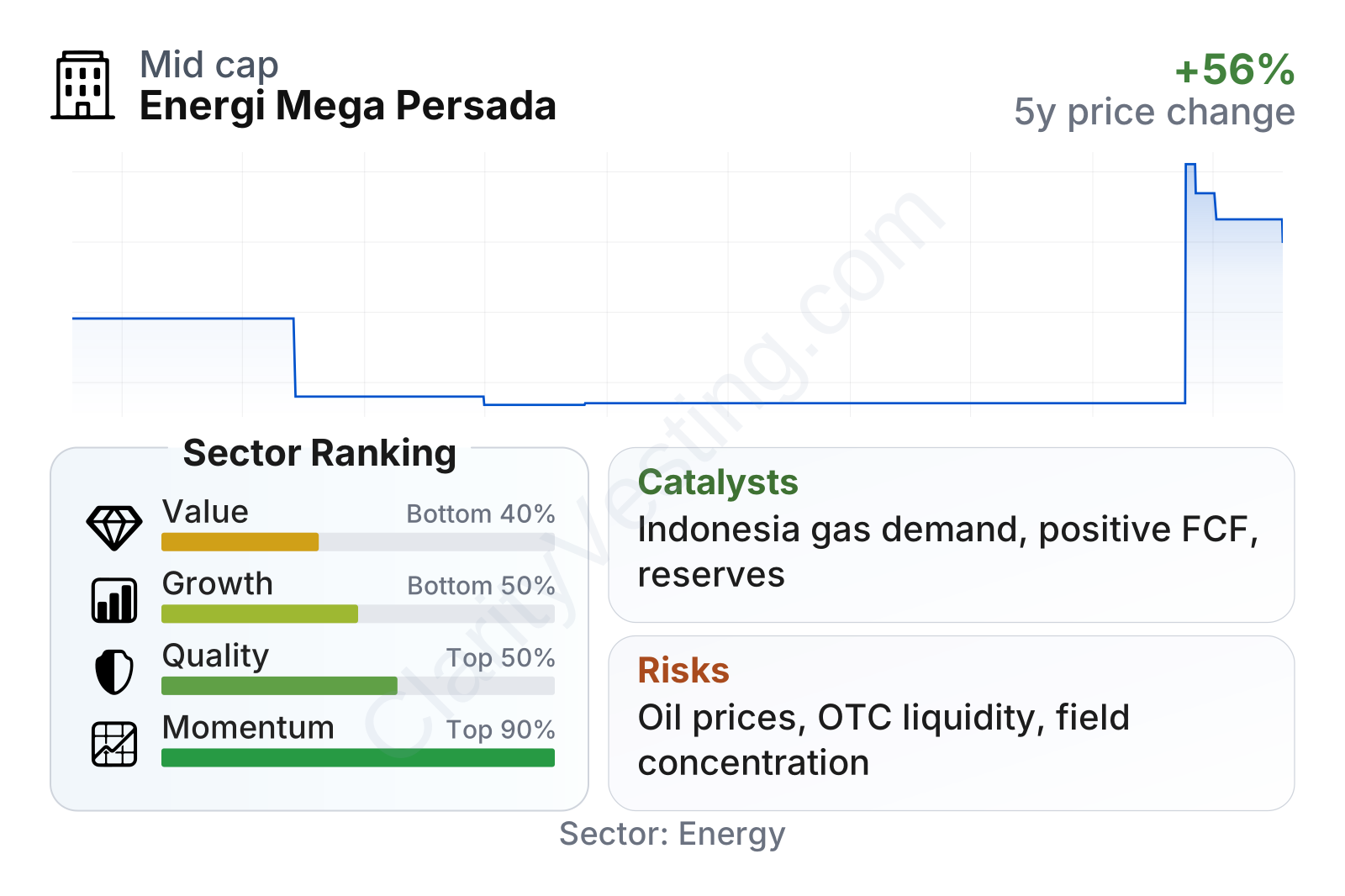
Energi Mega Persada sits in the mid-sized range and currently shows a mixed fundamental profile. Quality metrics are better than many sector peers, helped by operating and profit margins that are clearly above the industry median. Growth metrics are less impressive on a multi-year basis, and valuation measures look less favorable than the sector median after the sharp share-price move. Momentum is exceptionally strong, but that strength has outpaced the company’s value ranking.
The share-price history shows a long flat period followed by a sharp jump in 2026. That kind of move often signals a major re-rating by the market, but it also means that current valuation needs more caution than the operating results alone might suggest.
Growth
Energi Mega Persada operates in a sector that is still economically important, especially in Southeast Asia, where natural gas remains a key transition fuel and domestic energy security is a policy priority. That does not make oil and gas a high-growth industry in the way software or semiconductors can be, but it does create room for disciplined producers with attractive reserves, efficient operations, and access to local demand.
The company’s strategy appears sensible for that environment. It remains centered on extracting more value from existing assets, maintaining production, and developing additional reserves in Indonesia rather than pursuing a highly diversified global expansion. For a company of this size, that focused approach can be more practical than stretching capital across too many projects.
Revenue growth has been uneven quarter to quarter, which is normal in upstream energy because production volumes, commodity prices, and timing of sales can all move sharply. More recently, the trend has turned positive again, with year-over-year growth returning to the high-teens range in the latest periods. That points to an improving operating backdrop, even if the longer five-year record remains less consistent than stronger growth names in the sector.
One encouraging development is the shift in cash generation. Free cash flow was negative in earlier periods, then turned clearly positive in the latest trailing period. For an upstream producer, that matters because accounting profits are useful, but cash ultimately funds debt service, field development, and balance-sheet flexibility. If positive free cash flow continues, it would strengthen the company’s position materially.
A practical catalyst for future growth is Indonesia’s ongoing need for domestic oil and gas supply. Companies already established in the country can benefit if they increase recovery from existing fields, bring new drilling programs online, or secure better commercialization terms for gas output. The company’s public disclosures also show continuing attention to reserve development and production optimization, which are the most relevant growth levers for this type of business.
Risks
This article is for informational purposes only and does not constitute financial advice. Some content is AI-generated. See Disclaimer