Stock Analysis · Cleveland-Cliffs Inc (CLF)
Overview
Cleveland-Cliffs is a North American steel producer with a business model that is more integrated than many traditional steelmakers. The company mines iron ore, produces pelletized ore and hot briquetted iron, melts scrap and metallics, and turns that raw material into flat-rolled steel products used mainly by manufacturers. Its biggest end market is the automotive industry, but it also sells to infrastructure, manufacturing, distributors, and other industrial customers.
After several acquisitions in recent years, Cleveland-Cliffs shifted from being known mainly as an iron ore supplier into a large flat-rolled steel producer. That matters because it gives the company more control over raw materials and internal supply, but it also means results are now closely tied to steel prices, factory demand, and conditions in U.S. manufacturing.
Based on company reporting, revenue is primarily generated from steelmaking and steel products, while a smaller share comes from direct sales of raw materials and related items. The broad revenue mix can be summarized as follows:
- Steel products: approximately 85% to 90% of revenue. This includes flat-rolled steel sold to automakers, service centers, construction and industrial customers, as well as coated, stainless, electrical, plate, and specialty steel products.
- Tubular and downstream products: approximately 5% to 10% of revenue. This includes value-added steel processing and specialized products serving industrial uses.
- Iron ore, pellets, metallics, and other: approximately 5% to less than 10% of revenue. This includes sales tied to mined ore, pellets, and metallic inputs, although a meaningful part of these materials is used internally rather than sold externally.
The business is therefore best understood as a vertically integrated U.S. steel company rather than a pure mining company. That structure can help with supply security and cost control, but it does not eliminate the normal ups and downs of the steel cycle.
The long-term earnings picture has changed sharply. Revenue stayed near the high teens to low twenties of billions of dollars over the last several years, but profitability fell from very strong levels in 2021 and 2022 to losses in 2024 and 2025. That suggests the issue has not been scale alone; margins have been squeezed by weaker pricing, costs, and cyclical pressure.
Key Figures
| Metric | Value | Sector ⓘ |
|---|---|---|
| Date | Oct 23, 2026 | |
| Context | ||
| Sector | Basic Materials | |
| Industry | Steel | |
| Market Cap ⓘ | $7.45B | |
| Beta ⓘ | 2.09 | |
Value (Cheapness) | ||
| P/E Ratio ⓘ | N/A | 16.92 |
| P/B Ratio ⓘ | 1.34 | 1.66 |
| FCF Yield ⓘ | -6.51% | 5.83% |
| Dividend Yield ⓘ | N/A | 2.07% |
| EBIT / EV ⓘ | -0.45% | 6.38% |
| PEG ⓘ | 0.43 | |
Growth (Business expansion) | ||
| Revenue Growth ⓘ | 18.50% | 11.25% |
| RPS Growth (5Y CAGR) ⓘ | 0.79% | 4.49% |
| EPS Growth (5Y CAGR) ⓘ | N/A | -15.24% |
| BVPS Growth (5Y CAGR) ⓘ | 5.10% | 5.49% |
| Margin Growth (5Y Trend) ⓘ | -27.83% | -1.54% |
| FCF Growth (5Y CAGR) ⓘ | N/A | 0.37% |
| DPS Growth (5Y CAGR) ⓘ | 188.31% | 5.91% |
Quality (Business durability) | ||
| ROIC (Latest) ⓘ | -3.10% | 9.59% |
| ROA (Latest) ⓘ | -2.34% | 4.92% |
| ROIC (5Y Median) ⓘ | 8.73% | 7.91% |
| ROA (5Y Median) ⓘ | 2.20% | 3.92% |
| Net Debt / EBIT (Latest) ⓘ | N/A | 1.36 |
| Net Debt / EBIT (5Y Median) ⓘ | 2.04 | 1.69 |
| Net Debt / EBITDA (Latest) ⓘ | 7.68 | 0.93 |
| Net Debt / Assets ⓘ | 37.20% | 13.69% |
| EBITDA / Interest ⓘ | 1.63 | 12.38 |
| Operating Margin (Latest) ⓘ | -0.33% | 13.24% |
| Operating Margin (5Y Median) ⓘ | 4.03% | 11.82% |
| Debt to Equity (Latest) ⓘ | 134.43% | 40.30% |
| Profit Margin (Latest) ⓘ | -2.36% | 6.38% |
| Free Cash Flow (Latest) ⓘ | -$485.00M | |
Momentum (Price trend) | ||
| 3Y Return ⓘ | -9.19% | +73.47% |
| 12M Return (excl. last month) ⓘ | +6.64% | +27.59% |
| 6M Return ⓘ | +37.37% | -4.02% |
| Price vs. 200-Day MA ⓘ | +15.08% | -0.65% |
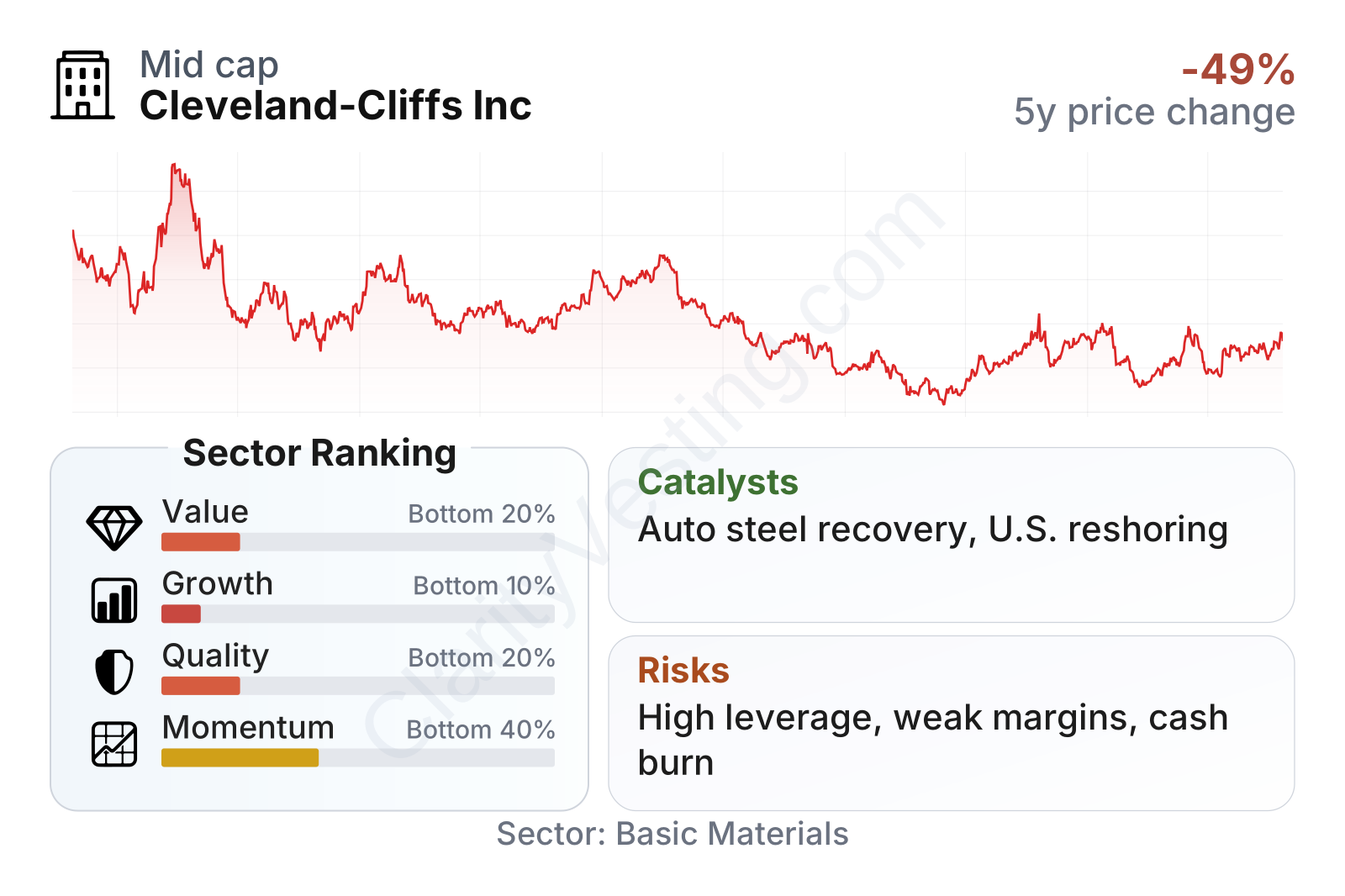
Cleveland-Cliffs is a mid-to-large steel producer with a stock that has been highly volatile, which is consistent with its beta above 2. The broader metric profile is weak relative to much of the sector: value, growth, and quality all rank in the lower end, mainly because recent profitability and cash generation turned negative. Momentum has improved somewhat over the last six months, but the longer stock history still shows a business the market treats as cyclical and uncertain rather than consistently compounding.
Growth
Steel is not a high-growth industry in the same way as software or semiconductors, but it remains strategically important. Cleveland-Cliffs operates in parts of the market that can benefit from long-term themes such as U.S. industrial reshoring, vehicle production, electrical steel demand, grid investment, and public infrastructure spending. Those trends support demand for domestic flat-rolled steel, especially when customers want local supply and shorter logistics chains.
The company’s strategy has a clear industrial logic. By controlling iron ore mining, metallics, and steel production, Cleveland-Cliffs can reduce dependence on third parties and offer customers a more secure domestic supply base. Its strong presence in automotive steel is particularly important because carmakers need large, reliable volumes and often maintain long commercial relationships with qualified suppliers. That creates a business with real operating relevance even when near-term financial performance is under pressure.
Recent sales trends show some stabilization after a difficult period. Revenue contracted through much of 2024 and parts of 2025, then returned to positive year-over-year growth in 2026, with the latest readings improving into the high single digits and then the high teens. That does not prove a full-cycle recovery, but it does indicate that demand and pricing conditions may be finding firmer ground after a prolonged downturn.
Cash generation is the bigger challenge. Free cash flow was strongly positive earlier in the cycle, then moved deeply negative more recently. For a capital-intensive company, this matters because a recovery in reported revenue is more convincing when it also starts to rebuild cash flow. A durable improvement would likely need better steel pricing, stronger plant utilization, and tighter cost control rather than volume growth alone.
Potential catalysts are tied mostly to industry conditions and product mix. Stronger U.S. manufacturing activity, a healthier automotive production environment, and a better pricing backdrop for flat-rolled steel could all help. The company has also emphasized higher-value products such as electrical steel and automotive-grade steel, which can be strategically attractive if volumes and spreads improve.
Risks
This article is for informational purposes only and does not constitute financial advice. Some content is AI-generated. See Disclaimer


