Stock Analysis · Phillips Edison & Co Inc (PECO)
Overview
Phillips Edison & Co. is a retail real estate investment trust, or REIT. It owns and operates grocery-anchored shopping centers across the United States. In simple terms, the company buys neighborhood retail properties, leases space to tenants, collects rent, and tries to grow cash flow by keeping occupancy high, renewing leases, and acquiring additional centers in markets where management believes demand is durable.
The company focuses on necessity-based retail. That matters because grocery stores, pharmacies, discount chains, restaurants, fitness centers, and service providers tend to attract repeat local traffic even when the economy weakens. PECO’s strategy is built around centers where a grocery store acts as the main anchor tenant and smaller shops benefit from that steady customer flow.
Its revenue base is concentrated in property income, with smaller contributions from ancillary items and investment management-related activities where applicable. Based on recent annual reporting structure, the mix is approximately:
- Rental revenue: about 93% to 96% — base rent from tenants, percentage rent, and recoveries tied to operating costs.
- Other property revenue: about 3% to 5% — items such as parking, signage, temporary leasing, and other tenant-related charges.
- Fees and other revenue: about 1% to 2% — management or service-related income and miscellaneous sources.
Over the last several years, the business has shown a fairly clear pattern: revenue has climbed steadily, operating income has expanded, and net income has also improved, although interest expense has moved higher as debt costs and financing needs increased. That is a typical trade-off for a property owner growing through acquisitions and redevelopment.
The long-term picture is one of gradually rising revenue and operating profit. One caution is that 2025 line items appear unusually distorted compared with prior years, which may reflect accounting reclassifications or property-related items rather than a simple deterioration in core leasing operations, so the broader multi-year trend is more informative than any single year anomaly.
Key Figures
| Metric | Value | Sector ⓘ |
|---|---|---|
| Date | Oct 17, 2026 | |
| Context | ||
| Sector | Real Estate | |
| Industry | REIT - Retail | |
| Market Cap ⓘ | $5.32B | |
| Beta ⓘ | 0.52 | |
Value (Cheapness) | ||
| P/E Ratio ⓘ | 32.96 | 17.38 |
| P/B Ratio ⓘ | 2.28 | 0.85 |
| FCF Yield ⓘ | 4.47% | 7.38% |
| Dividend Yield ⓘ | 3.42% | 4.85% |
| EBIT / EV ⓘ | 3.78% | 3.78% |
| PEG ⓘ | N/A | |
Growth (Business expansion) | ||
| Revenue Growth ⓘ | 6.70% | 5.30% |
| RPS Growth (5Y CAGR) ⓘ | 3.65% | 6.02% |
| EPS Growth (5Y CAGR) ⓘ | 29.12% | -11.37% |
| BVPS Growth (5Y CAGR) ⓘ | -2.22% | 0.45% |
| Margin Growth (5Y Trend) ⓘ | 13.11% | -0.22% |
| FCF Growth (5Y CAGR) ⓘ | 3.07% | 5.40% |
| DPS Growth (5Y CAGR) ⓘ | 5.49% | 5.02% |
Quality (Business durability) | ||
| ROIC (Latest) ⓘ | 5.51% | 5.69% |
| ROE (Latest) ⓘ | 7.08% | 7.56% |
| ROA (Latest) ⓘ | 2.69% | 2.85% |
| ROIC (5Y Median) ⓘ | 3.64% | 4.22% |
| ROE (5Y Median) ⓘ | 2.96% | 6.03% |
| ROA (5Y Median) ⓘ | 1.18% | 2.44% |
| Net Debt / EBIT (Latest) ⓘ | 9.35 | 7.59 |
| Net Debt / EBIT (5Y Median) ⓘ | 13.44 | 8.40 |
| Net Debt / EBITDA (Latest) ⓘ | 4.83 | 5.27 |
| Net Debt / Assets ⓘ | 47.41% | 37.76% |
| EBITDA / Interest ⓘ | 4.55 | 4.10 |
| Operating Margin (Latest) ⓘ | 36.71% | 35.29% |
| Operating Margin (5Y Median) ⓘ | 25.27% | 37.31% |
| Debt to Equity (Latest) ⓘ | 108.87% | 88.87% |
| Profit Margin (Latest) ⓘ | 19.14% | 19.61% |
| Free Cash Flow (Latest) ⓘ | $237.81M | |
Momentum (Price trend) | ||
| 3Y Return ⓘ | +21.55% | +30.75% |
| 12M Return (excl. last month) ⓘ | +10.69% | +4.36% |
| 6M Return ⓘ | -0.58% | -2.52% |
| Price vs. 200-Day MA ⓘ | -1.35% | -2.34% |
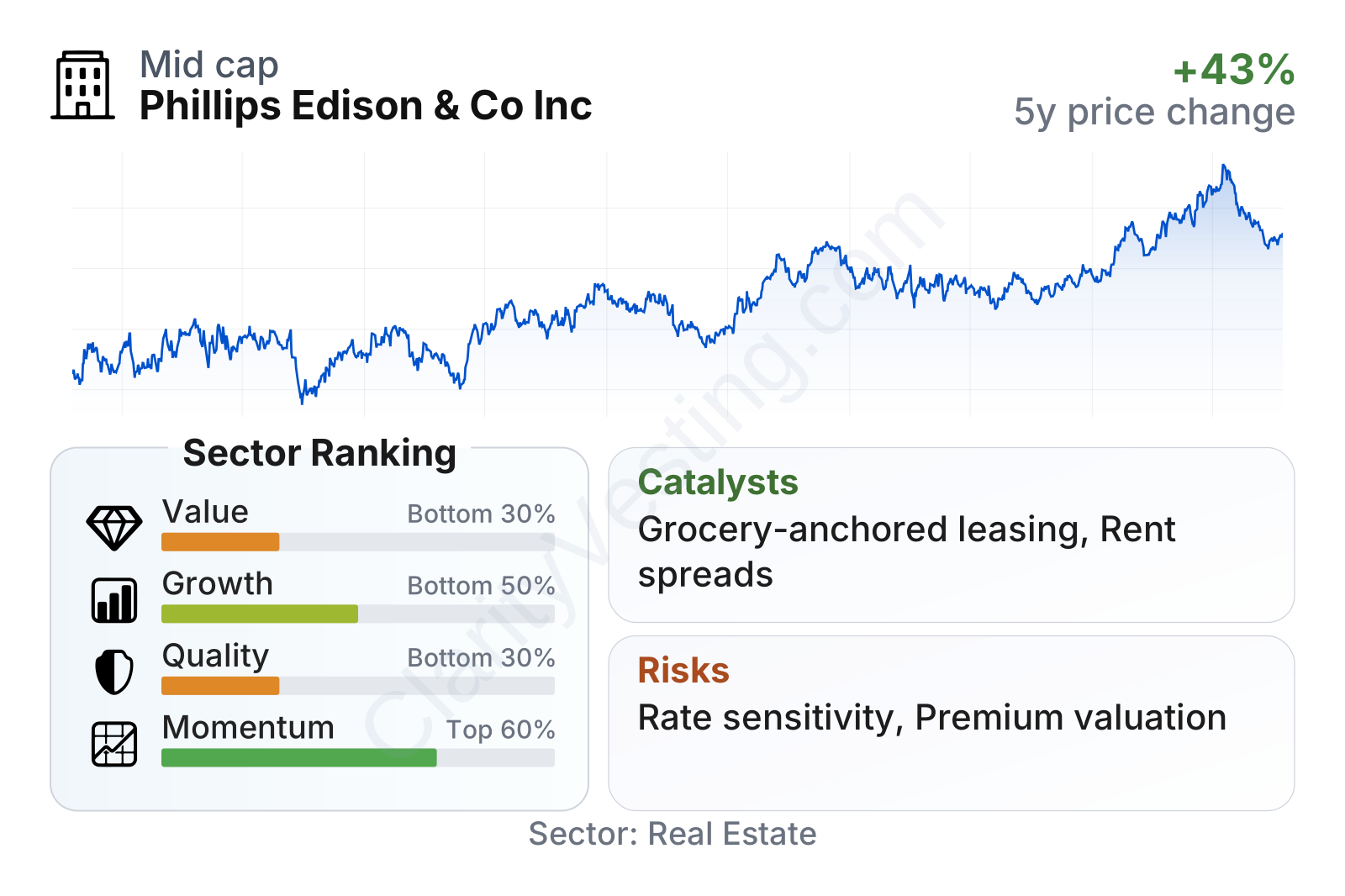
PECO is a mid-sized REIT with a relatively low share-price volatility, shown by a beta near 0.5. The current profile is mixed. Valuation measures sit on the expensive side versus the real estate sector, while quality and growth metrics are closer to the lower-middle part of the group. On the positive side, recent revenue growth is slightly ahead of the sector median, margins are healthy, and share-price momentum over the last year has been better than many peers.
The stock has also trended upward meaningfully since late 2021, with especially strong gains into 2026. That suggests the market has been assigning a higher value to PECO’s grocery-anchored model, balance-sheet progress, and operating consistency.
Growth
PECO operates in a part of retail real estate that has held up better than many other shopping center formats. Grocery-anchored centers benefit from repeat visits and from tenants that are tied to everyday needs rather than discretionary purchases. This does not make the sector immune to downturns, but it does make cash flow generally more resilient than apparel-heavy malls or more volatile retail categories.
The company’s strategy is sensible for long-term expansion. It concentrates on neighborhood centers, works to maintain high occupancy, raises rents on renewals when market conditions allow, and adds properties through acquisitions. Because these centers are tied to local daily traffic, the model can produce incremental growth without needing dramatic changes in consumer behavior.
Revenue per share has moved upward over the last few years, though not at a particularly fast pace. That is an important detail for a REIT: growth is present, but it looks more steady than explosive. This fits the company’s business model, which is based on rent collection and property optimization rather than rapid disruption-driven expansion.
Dividend per share has also risen over the five-year period, despite some fluctuation in 2024. That points to improving distributable capacity over time and suggests that management has been able to translate property income growth into shareholder distributions, which is a central part of the REIT model.
A meaningful catalyst is the company’s focus on necessity-based tenants in a market where many retailers are shrinking footprints but grocers and service-oriented tenants still need physical locations close to consumers. Another support is redevelopment and leasing spreads: when expiring leases are replaced at higher rents, cash flow can rise without a major increase in operating costs.
More recently, the company has benefited from a market backdrop that has become more favorable for defensive real estate formats. If financing conditions stabilize and transaction markets improve, PECO could have more room to acquire assets at returns that strengthen future earnings. Its rising stock price in 2026 suggests the market has started to recognize that possibility.
Risks
This article is for informational purposes only and does not constitute financial advice. Some content is AI-generated. See Disclaimer


