Stock Analysis · Peoples Bancorp Inc (PEBO)
Overview
Peoples Bancorp Inc. is a regional bank headquartered in Ohio. Through Peoples Bank and related subsidiaries, it provides traditional banking services to consumers, small businesses, commercial clients, and municipalities across the Midwest and nearby markets. Its activities include taking deposits, making commercial and consumer loans, residential mortgage lending, wealth management, insurance, and equipment leasing.
Like most regional banks, the company makes most of its money from the spread between what it earns on loans and securities and what it pays on deposits and other funding. A smaller but still meaningful share comes from fees tied to non-lending services.
Based on recent annual reporting structure, Peoples Bancorp’s revenue mix is approximately as follows:
- Net interest income: about 70% to 80% — income from commercial real estate loans, commercial and industrial loans, consumer lending, residential mortgages, and investment securities, after funding costs.
- Noninterest income: about 20% to 30% — includes deposit account service charges, wealth management and trust fees, insurance commissions, mortgage banking revenue, electronic banking fees, capital markets-related fees, and equipment leasing-related income.
The business model is relatively straightforward: gather deposits locally, lend into communities and businesses, and add fee income through advisory, insurance, and service businesses. That mix gives the company more diversification than a plain-vanilla community bank, although banking remains the clear core engine.
Over the last several years, total revenue expanded sharply, but profit did not rise at the same pace. The main reason is that funding costs and operating expenses moved up materially, which reduced part of the benefit from higher revenue.
Key Figures
| Metric | Value | Sector ⓘ |
|---|---|---|
| Date | Oct 03, 2026 | |
| Context | ||
| Sector | Financial Services | |
| Industry | Banks - Regional | |
| Market Cap ⓘ | $1.32B | |
| Beta ⓘ | 0.58 | |
Value (Cheapness) | ||
| P/E Ratio ⓘ | 10.42 | 12.60 |
| P/B Ratio ⓘ | 1.06 | 1.23 |
| FCF Yield ⓘ | 10.01% | 10.16% |
| Dividend Yield ⓘ | 4.27% | 2.96% |
| EBIT / EV ⓘ | 6.96% | 7.77% |
| PEG ⓘ | 1.45 | |
Growth (Business expansion) | ||
| Revenue Growth ⓘ | 10.80% | 9.50% |
| RPS Growth (5Y CAGR) ⓘ | 11.98% | 12.10% |
| EPS Growth (5Y CAGR) ⓘ | -17.73% | -9.45% |
| BVPS Growth (5Y CAGR) ⓘ | -2.96% | 5.01% |
| Margin Growth (5Y Trend) ⓘ | -1.52% | -4.07% |
| FCF Growth (5Y CAGR) ⓘ | -3.71% | 4.96% |
| DPS Growth (5Y CAGR) ⓘ | 3.88% | 8.79% |
Quality (Business durability) | ||
| ROIC (Latest) ⓘ | 5.40% | 9.60% |
| ROE (Latest) ⓘ | 9.86% | 13.84% |
| ROA (Latest) ⓘ | 1.24% | 1.53% |
| ROIC (5Y Median) ⓘ | 7.41% | 7.86% |
| ROE (5Y Median) ⓘ | 10.83% | 12.20% |
| ROA (5Y Median) ⓘ | 1.27% | 1.29% |
| Net Debt / EBIT (Latest) ⓘ | 4.92 | 0.91 |
| Net Debt / EBIT (5Y Median) ⓘ | 2.12 | 0.74 |
| Net Debt / EBITDA (Latest) ⓘ | 4.64 | 0.97 |
| Operating Margin (Latest) ⓘ | 21.51% | 22.12% |
| Operating Margin (5Y Median) ⓘ | 24.27% | 24.39% |
| Debt to Equity (Latest) ⓘ | 60.24% | 60.37% |
| Profit Margin (Latest) ⓘ | 27.20% | 26.62% |
| Free Cash Flow (Latest) ⓘ | $131.65M | |
Momentum (Price trend) | ||
| 3Y Return ⓘ | +71.28% | +89.23% |
| 12M Return (excl. last month) ⓘ | +32.73% | +17.35% |
| 6M Return ⓘ | +13.25% | +10.00% |
| Price vs. 200-Day MA ⓘ | +5.70% | +3.73% |
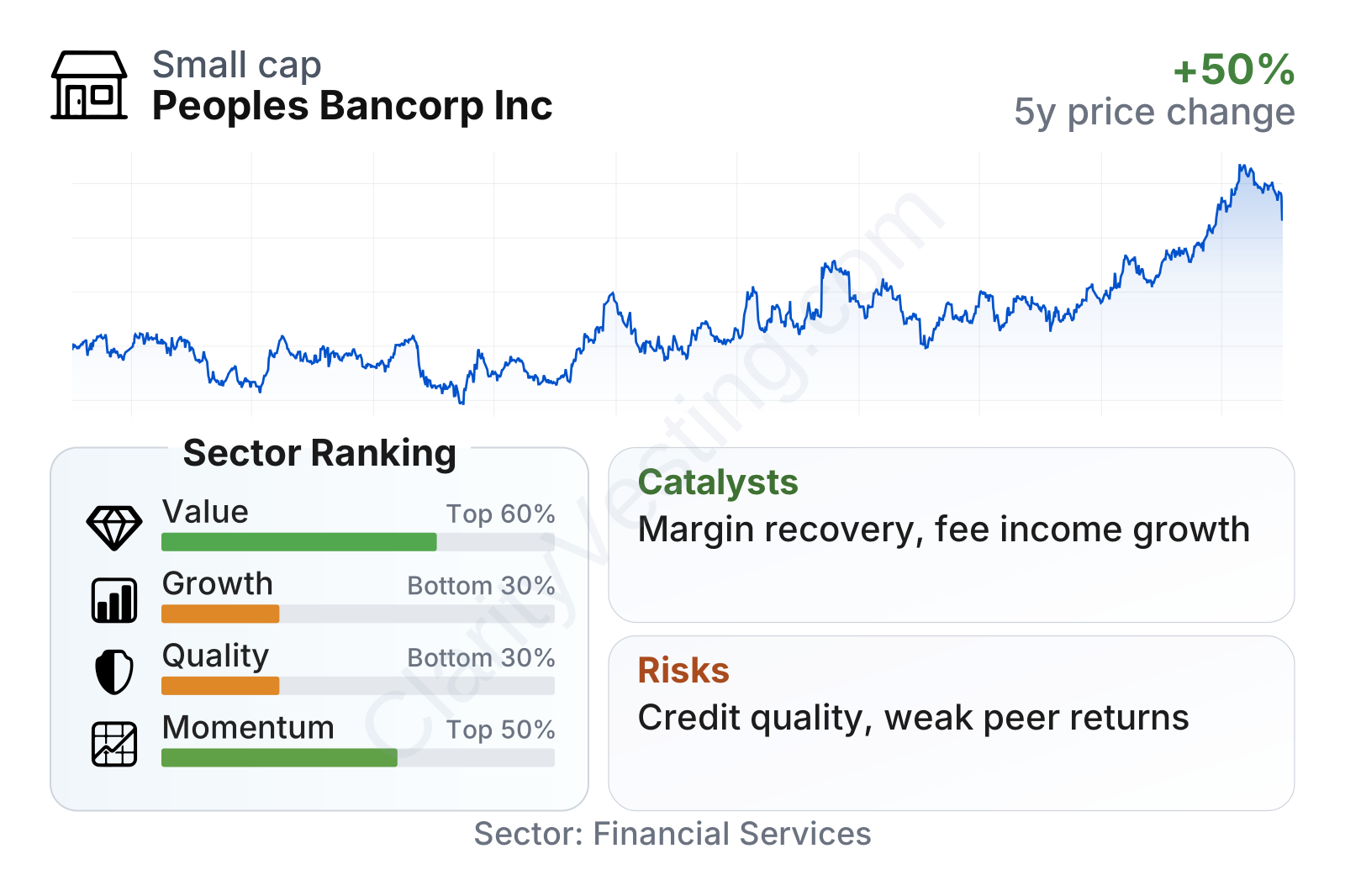
Peoples Bancorp sits in the mid-sized range among regional banks, with a relatively low share-price volatility profile. On valuation, the stock screens slightly below sector medians on earnings and book value multiples, while the dividend yield stands above the sector median. The weaker point is business quality and long-term growth: profitability metrics are below many peers, and multi-year earnings and book value trends have been less favorable than the broader regional bank group. Recent price momentum, however, has been stronger than the sector median.
Growth
Peoples Bancorp operates in a mature sector rather than a fast-growing one. Regional banking generally expands through loan growth, deposit gathering, acquisitions, fee-based services, and margin management rather than through explosive demand. That makes the company’s strategy important: the more it can deepen relationships with businesses and households while adding noninterest income, the more resilient its growth profile can become.
The company’s strategy broadly makes sense for that environment. Peoples Bancorp has built a more diversified platform than many smaller regional banks by combining commercial banking with insurance, wealth management, and leasing activities. That does not transform the business into a high-growth platform, but it can help reduce dependence on any single revenue line and create cross-selling opportunities over time.
Earnings per share rose meaningfully from 2021 through 2023, then softened in 2024 and 2025. That pattern suggests the company benefited from a favorable rate backdrop at first, but later faced the industry-wide pressure of higher deposit costs and a tougher funding environment. For long-term analysis, this matters because it shows that recent earnings power has been positive, yet not consistently compounding.
Book value per share has also been uneven rather than steadily rising. There was a large reset between 2021 and 2022, followed by a partial recovery. For banks, book value is an important anchor because it reflects the capital base supporting future lending and earnings. The recent recovery is constructive, but the longer trend still looks less robust than what many investors would prefer from a compounding regional bank.
A practical catalyst for the company is the interest-rate cycle. If deposit costs stabilize or ease faster than asset yields decline, profitability can improve. Another catalyst is stronger fee income from wealth, insurance, and service businesses, which can help offset the natural cyclicality of net interest income. In addition, a bank of this size can still create growth through selective acquisitions in adjacent community banking markets if execution remains disciplined.
Recent market performance indicates that the company has been benefiting from improving sentiment toward regional banks, especially as fears around deposit instability have faded compared with the banking stress period seen earlier in the decade. That is an opportunity, but it is more a reflection of industry normalization than a company-specific transformation.
Risks
This article is for informational purposes only and does not constitute financial advice. Some content is AI-generated. See Disclaimer