Stock Analysis · Pernod Ricard SA (PDRDF)
Overview
Pernod Ricard is one of the world’s largest spirits and wine groups. The company owns, markets, and distributes a broad portfolio of premium alcoholic beverage brands across whiskey, vodka, cognac, rum, gin, tequila, champagne, liqueurs, and wine. Its best-known labels include Jameson, Absolut, Chivas Regal, Ballantine’s, Martell, Havana Club, Beefeater, Malibu, Kahlúa, Mumm, and Perrier-Jouët.
The business model is relatively simple to understand: Pernod Ricard sells branded alcohol through distributors, retailers, bars, restaurants, travel retail channels, and e-commerce partners. A large part of its value comes from brand strength, pricing power, and its global route-to-market network rather than from commodity-like production alone.
Revenue is mainly split by geography rather than by a single product line, because the group manages a broad portfolio across many categories. Based on recent annual reporting, the main sources of revenue are approximately:
- Americas: about 29% — includes the United States, which is one of the group’s most important profit pools, plus Canada and Latin America.
- Europe: about 28% — includes major Western and Southern European markets and a mix of spirits, champagne, and wine sales.
- Asia/Rest of World: about 25% — includes several Asian markets outside China as well as Africa and the Middle East.
- India: about 12% — a separately highlighted market because of its size and long-term strategic importance.
- China: about 6% — smaller by revenue share than the Americas or Europe, but still important because of premiumization and cognac exposure.
By product family, whiskey is typically the largest contributor, followed by strategic international spirits such as vodka, cognac, rum, gin, tequila, and liqueurs, with champagne and wine contributing a smaller share. The portfolio is diversified, but some brands carry outsized weight, especially Jameson and Martell.
Recent financial flow trends show a company that still converts a large portion of sales into operating profit, but with clear pressure versus the 2023 peak. Revenue, gross profit, and net income have all moved lower over the last two fiscal years, while interest expense has remained elevated, which has reduced earnings.
Key Figures
| Metric | Value | Sector ⓘ |
|---|---|---|
| Date | Oct 17, 2026 | |
| Context | ||
| Sector | Consumer Defensive | |
| Industry | Beverages - Wineries & Distilleries | |
| Market Cap ⓘ | $17.66B | |
| Beta ⓘ | 0.52 | |
Value (Cheapness) | ||
| P/E Ratio ⓘ | 13.26 | 17.88 |
| P/B Ratio ⓘ | 1.29 | 1.29 |
| FCF Yield ⓘ | 13.04% | 12.39% |
| Dividend Yield ⓘ | 7.05% | 2.85% |
| EBIT / EV ⓘ | N/A | 6.43% |
| PEG ⓘ | 1.90 | |
Growth (Business expansion) | ||
| Revenue Growth ⓘ | -13.20% | 4.10% |
| RPS Growth (5Y CAGR) ⓘ | -2.48% | 6.18% |
| EPS Growth (5Y CAGR) ⓘ | -12.95% | -13.59% |
| BVPS Growth (5Y CAGR) ⓘ | -1.71% | 3.20% |
| Margin Growth (5Y Trend) ⓘ | -2.39% | -0.15% |
| FCF Growth (5Y CAGR) ⓘ | -9.72% | 4.10% |
| DPS Growth (5Y CAGR) ⓘ | 10.39% | 6.79% |
Quality (Business durability) | ||
| ROIC (Latest) ⓘ | 13.78% | 12.34% |
| ROA (Latest) ⓘ | 7.34% | 6.30% |
| ROIC (5Y Median) ⓘ | 8.13% | 10.49% |
| ROA (5Y Median) ⓘ | 4.26% | 5.44% |
| Net Debt / EBIT (Latest) ⓘ | 1.99 | 1.96 |
| Net Debt / EBIT (5Y Median) ⓘ | 3.48 | 2.35 |
| Net Debt / EBITDA (Latest) ⓘ | 1.72 | 1.38 |
| Net Debt / Assets ⓘ | 28.65% | 21.51% |
| EBITDA / Interest ⓘ | N/A | 9.46 |
| Operating Margin (Latest) ⓘ | 26.38% | 8.87% |
| Operating Margin (5Y Median) ⓘ | 25.77% | 9.53% |
| Debt to Equity (Latest) ⓘ | 81.79% | 72.35% |
| Profit Margin (Latest) ⓘ | 12.79% | 5.40% |
| Free Cash Flow (Latest) ⓘ | $2.30B | |
Momentum (Price trend) | ||
| 3Y Return ⓘ | -47.92% | +20.92% |
| 12M Return (excl. last month) ⓘ | -27.54% | +2.13% |
| 6M Return ⓘ | +1.71% | +1.26% |
| Price vs. 200-Day MA ⓘ | -2.61% | +1.39% |
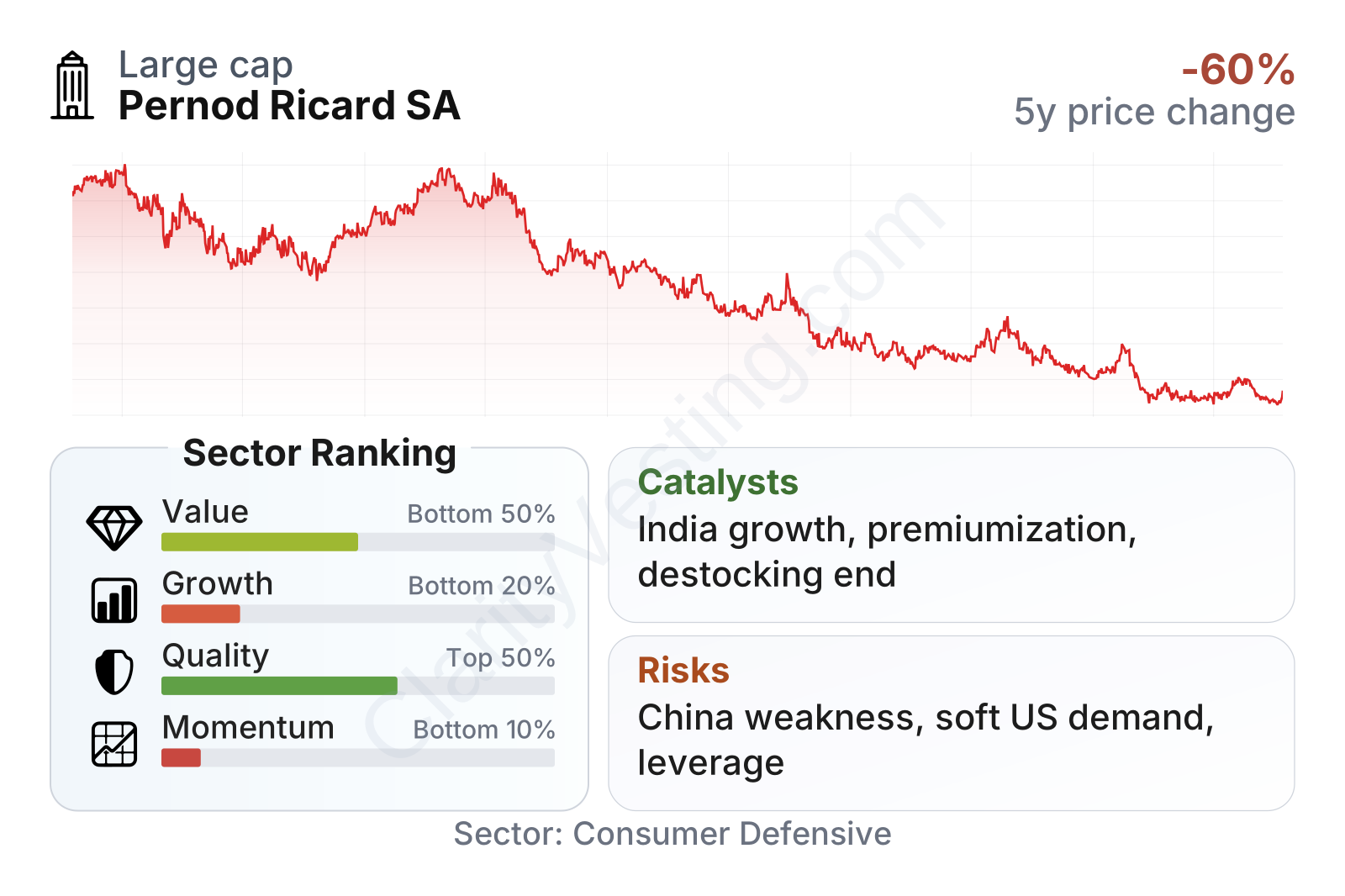
Pernod Ricard remains a large global consumer staples company with relatively low share-price volatility, as shown by its beta well below 1. On profitability and capital efficiency, the business still looks solid versus much of the sector: operating margin is far above the industry median, profit margin is also stronger than peers, and returns on capital remain respectable. The weaker area is growth. Revenue has declined year over year, longer-term sales per share have been soft, and price momentum has been among the weakest in the sector. On valuation measures, the stock trades on a lower earnings multiple than the sector median, while free cash flow yield and dividend yield are both notably higher.
Growth
The alcoholic beverages sector is mature in developed markets, but it still has structural growth drivers. Premium spirits have historically benefited from brand loyalty, rising disposable income in emerging markets, and premiumization, meaning consumers shifting toward higher-value products. Pernod Ricard is well placed in this part of the market because its portfolio is concentrated in established international brands rather than low-margin mass products.
Its strategy for future growth is centered on premiumization, selective price increases, wider distribution, digital tools for route-to-market execution, and stronger exposure to faster-growing countries such as India. That logic makes sense for a long-duration consumer brand company: a premium bottle does not need explosive volume growth to create value if pricing, mix, and brand equity keep improving over time.
India stands out as one of the most important long-term opportunities. The country has a large population, rising middle-class consumption, and a spirits market where international premium brands can still gain penetration. Pernod Ricard has repeatedly highlighted India as a strategic market, and it already represents a meaningful share of group sales.
Another catalyst is portfolio management. The company has been simplifying parts of the business and focusing resources on higher-growth and higher-margin brands. It also continues to invest in brand building, which matters in spirits because strong labels can support pricing for many years.
That said, the near-term picture is clearly weaker than the long-term strategic vision. Sales have been under pressure from softer demand, inventory adjustments in parts of the distribution chain, and weakness in China and travel retail. This is visible in the recent decline in annual revenue and earnings.
The most meaningful recent opportunity is not a single breakthrough event, but the possibility of normalization after a difficult period. If inventories at distributors and retailers stabilize, and if China and travel retail stop deteriorating, Pernod Ricard could see easier comparisons. Combined with its still-strong margin structure, even modest top-line recovery could have a visible effect on earnings.
Risks
This article is for informational purposes only and does not constitute financial advice. Some content is AI-generated. See Disclaimer


