Stock Analysis · Pimco Dynamic Income Opportunities Fund (PDO)
Overview
PIMCO Dynamic Income Opportunities Fund is not an operating company in the usual sense. It is a closed-end investment fund managed by PIMCO, one of the best-known fixed-income managers in the world. Its objective is to generate a high level of current income, and it also has a secondary goal of capital appreciation. In practical terms, the fund invests in a broad mix of income-producing debt securities rather than selling products or services like a traditional business.
The portfolio is built mainly around fixed-income and credit markets. Based on the fund’s recent shareholder reporting, revenue and total return are driven primarily by interest income from bonds and other debt instruments, with additional impact from trading gains or losses, valuation changes, and the use of leverage. Because this is a fund, results can move meaningfully with market prices, credit spreads, and interest rates.
The main economic sources behind the fund’s income are approximately the following:
- Interest income from corporate credit, mortgage-related securities, and other debt holdings: the largest recurring contributor, generally representing the overwhelming majority of investment income.
- Income from structured credit and securitized assets: includes areas such as non-agency mortgages, asset-backed securities, and other structured products that can offer higher yields than traditional government bonds.
- Government-related and other fixed-income securities: a smaller but stabilizing portion of portfolio income, depending on market conditions and portfolio positioning.
- Realized and unrealized gains or losses: these can materially affect reported results from one period to another, but they are not as stable as coupon income.
The fund’s structure matters. A closed-end fund has a fixed share count after issuance, so its market price can trade above or below the value of its underlying assets. That means long-term holders are exposed not only to the portfolio itself, but also to shifts in market sentiment toward the fund.
Recent financial flow trends show why PDO is best understood as a market-sensitive income vehicle. Results were deeply negative during the 2022 bond-market drawdown, improved substantially in 2023, and turned positive again in 2024. That swing says less about a changing business model and more about how strongly performance depends on credit markets, financing costs, and portfolio valuation.
Key Figures
| Metric | Value | Sector ⓘ |
|---|---|---|
| Date | Oct 17, 2026 | |
| Context | ||
| Sector | Financial Services | |
| Industry | Asset Management | |
| Market Cap ⓘ | $1.70B | |
| Beta ⓘ | N/A | |
Value (Cheapness) | ||
| P/E Ratio ⓘ | 8.68 | 12.26 |
| P/B Ratio ⓘ | 0.94 | 1.23 |
| FCF Yield ⓘ | N/A | 10.40% |
| Dividend Yield ⓘ | N/A | 3.02% |
| EBIT / EV ⓘ | N/A | 8.14% |
| PEG ⓘ | N/A | |
Growth (Business expansion) | ||
| Revenue Growth ⓘ | N/A | 9.35% |
| RPS Growth (5Y CAGR) ⓘ | N/A | 12.19% |
| EPS Growth (5Y CAGR) ⓘ | N/A | -9.53% |
| BVPS Growth (5Y CAGR) ⓘ | -12.54% | 4.99% |
| Margin Growth (5Y Trend) ⓘ | N/A | -3.86% |
| FCF Growth (5Y CAGR) ⓘ | 26.51% | 4.81% |
| DPS Growth (5Y CAGR) ⓘ | -14.17% | 8.79% |
Quality (Business durability) | ||
| ROIC (Latest) ⓘ | N/A | 9.49% |
| ROE (Latest) ⓘ | N/A | 13.90% |
| ROA (Latest) ⓘ | N/A | 1.55% |
| ROIC (5Y Median) ⓘ | N/A | 7.86% |
| ROE (5Y Median) ⓘ | -0.91% | 12.17% |
| ROA (5Y Median) ⓘ | -0.47% | 1.30% |
| Net Debt / EBIT (Latest) ⓘ | N/A | 0.96 |
| Net Debt / EBIT (5Y Median) ⓘ | N/A | 0.73 |
| Net Debt / EBITDA (Latest) ⓘ | N/A | 0.92 |
| Operating Margin (Latest) ⓘ | N/A | 22.30% |
| Operating Margin (5Y Median) ⓘ | N/A | 24.63% |
| Debt to Equity (Latest) ⓘ | 69.55% | 58.56% |
| Profit Margin (Latest) ⓘ | N/A | 26.57% |
| Free Cash Flow (Latest) ⓘ | N/A | |
Momentum (Price trend) | ||
| 3Y Return ⓘ | +53.20% | +88.33% |
| 12M Return (excl. last month) ⓘ | -4.32% | +19.38% |
| 6M Return ⓘ | -4.60% | +4.75% |
| Price vs. 200-Day MA ⓘ | -4.03% | +3.50% |
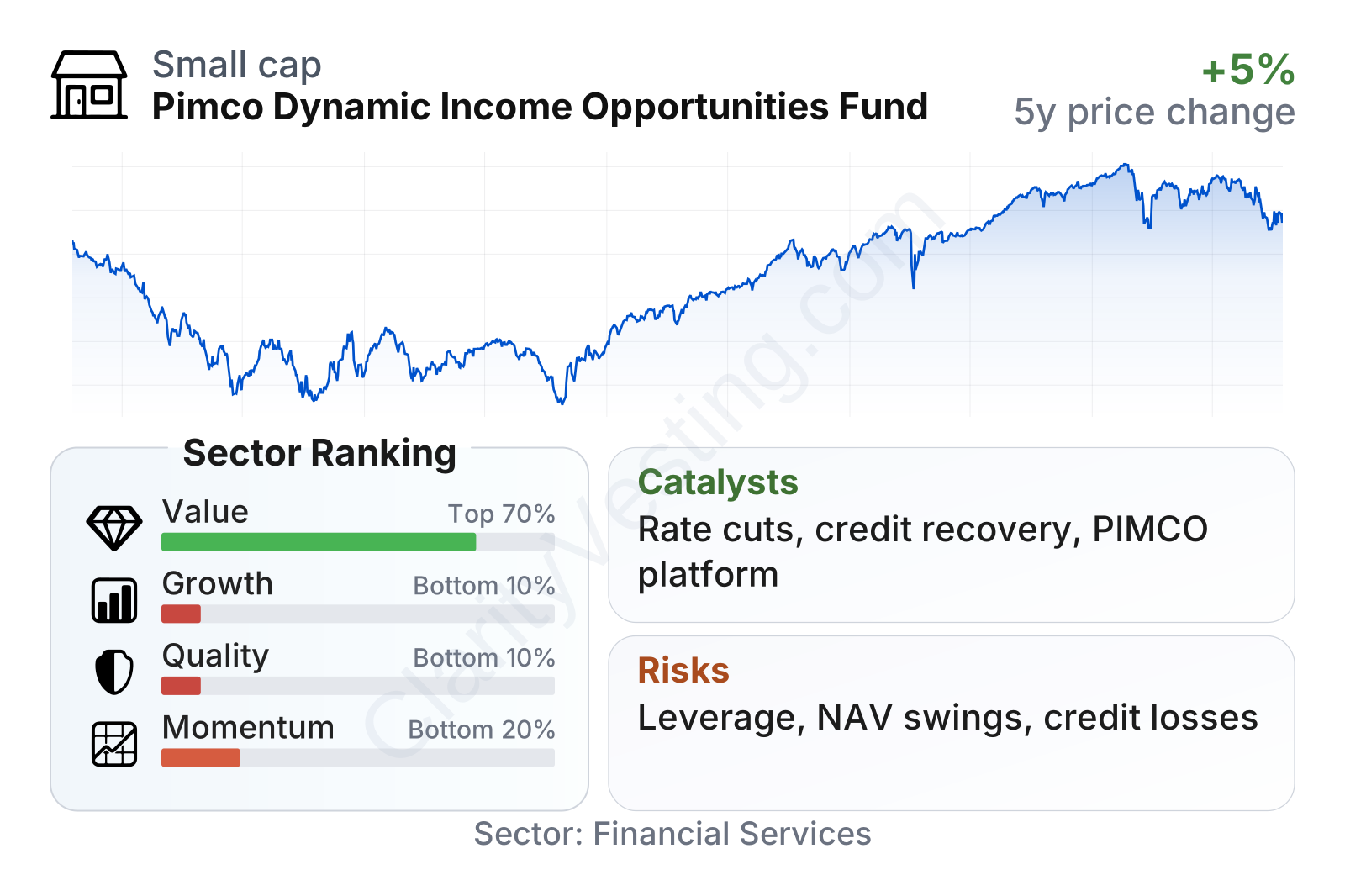
PDO is a mid-sized listed fund within financial services. The share price has recovered strongly from the 2022 lows and is now well above those levels, but recent momentum has been modest compared with the broader sector. In the factor snapshot, valuation looks comparatively inexpensive, with both earnings and book-based multiples below sector medians. By contrast, growth, quality, and momentum rank weakly versus the wider financial universe, which is not surprising for a leveraged income fund whose results are shaped by market cycles rather than steady operating expansion.
The quality measures also need careful interpretation. Traditional profitability ratios such as return on equity or profit margin are less informative for a bond fund than for an operating company, because portfolio mark-to-market changes can dominate reported earnings. Even so, the balance sheet does show meaningful leverage, with debt-to-equity around 70%, slightly above the sector median. That reinforces the idea that PDO is designed to amplify income opportunities, but also amplifies volatility.
Growth
PDO operates in a part of the market that remains relevant for long-term capital allocation: actively managed income and credit investing. Demand for income-producing assets has stayed strong as higher interest rates have reset bond yields well above the levels seen earlier in the decade. That creates a more favorable backdrop for funds that specialize in credit selection and flexible allocation across global fixed-income sectors.
PIMCO’s strategy gives PDO an important growth angle, even if “growth” here does not look like sales expansion at a normal company. The fund can rotate across corporate bonds, mortgage credit, structured products, and other income-oriented securities where management sees better risk-adjusted yields. This flexibility is valuable in a market where rate cuts, refinancing trends, and credit spreads can change the relative appeal of different debt segments.
A key catalyst is the interest-rate cycle. If policy rates gradually ease while the economy avoids a severe downturn, leveraged bond funds can benefit in two ways: borrowing costs may decline, and existing higher-yield bonds may become more valuable. That combination can support net investment income and net asset value over time. Another favorable factor is PIMCO’s platform itself: the manager has broad research resources, trading reach, and long experience in complex fixed-income markets that are hard for smaller competitors to cover with the same depth.
The earnings history highlights the cycle clearly. Reported results were sharply negative during the 2022 reset in bond prices, then stabilized afterward. For a long-term reader, that underscores that PDO’s path is tied to market normalization more than linear growth.
Book value per share, which is close to net asset value in this type of vehicle, fell materially from 2022 and then partially recovered. That is an important sign. It suggests the portfolio has regained some footing as fixed-income markets improved, but it has not fully erased the earlier damage. For a closed-end fund, sustained growth usually comes from preserving and rebuilding asset value while maintaining enough income to support distributions.
As for recent developments, the most meaningful opportunity is not a single headline but the broader setup in credit markets: yields are still relatively elevated, giving managers more income to work with than they had when rates were near zero. That gives PDO more room to earn through coupons rather than relying mainly on price appreciation.
Risks
This article is for informational purposes only and does not constitute financial advice. Some content is AI-generated. See Disclaimer


