Stock Analysis · Piedmont Office Realty Trust Inc (PDM)
Overview
Piedmont Office Realty Trust Inc is a publicly traded real estate investment trust focused on owning, operating, developing, and selectively redeveloping office properties in the United States. Its portfolio is concentrated in Sunbelt markets and other large business hubs, with an emphasis on Class A buildings that target corporate tenants. In simple terms, the company makes money by leasing office space, collecting rent, and providing related building services.
The business is still largely a traditional office landlord model, but management has been trying to improve the portfolio by focusing on newer, better-located properties and by recycling capital out of weaker assets. That matters because the office market has been under pressure since remote and hybrid work changed how much space many companies need.
The main sources of revenue are not usually broken out into many consumer-friendly categories, but the company’s filings show a structure that is fairly typical for an office REIT.
- Rental and tenant-related income: approximately 90% to 95% of revenue. This includes contractual base rent from office leases and recoveries tied to operating expenses.
- Parking, service, and other property income: approximately 3% to 7% of revenue. This can include parking, signage, and other building-level services.
- Management and miscellaneous income: usually a small contribution, generally below 3% of revenue.
Over the last several years, total revenue has stayed in a fairly narrow band around the mid-$500 million range, which suggests the bigger issue has not been top-line collapse but pressure from financing costs and profitability. Operating income and net income have been much more volatile than revenue, showing how sensitive office landlords can be to interest expense, asset values, and leasing conditions.
The long-term pattern is clear: revenue has been relatively stable, but interest expense has risen sharply since 2021, which has weighed on earnings. That gap between steady rent collections and weaker bottom-line results is one of the most important themes for understanding Piedmont today.
Key Figures
| Metric | Value | Sector ⓘ |
|---|---|---|
| Date | Oct 17, 2026 | |
| Context | ||
| Sector | Real Estate | |
| Industry | REIT - Office | |
| Market Cap ⓘ | $1.13B | |
| Beta ⓘ | 1.38 | |
Value (Cheapness) | ||
| P/E Ratio ⓘ | N/A | 17.38 |
| P/B Ratio ⓘ | 0.77 | 0.85 |
| FCF Yield ⓘ | 2.80% | 7.38% |
| Dividend Yield ⓘ | N/A | 4.85% |
| EBIT / EV ⓘ | 1.38% | 3.78% |
| PEG ⓘ | 16.74 | |
Growth (Business expansion) | ||
| Revenue Growth ⓘ | 2.70% | 5.30% |
| RPS Growth (5Y CAGR) ⓘ | 1.58% | 6.02% |
| EPS Growth (5Y CAGR) ⓘ | -32.03% | -11.37% |
| BVPS Growth (5Y CAGR) ⓘ | -4.45% | 0.45% |
| Margin Growth (5Y Trend) ⓘ | -1.62% | -0.22% |
| FCF Growth (5Y CAGR) ⓘ | N/A | 5.40% |
| DPS Growth (5Y CAGR) ⓘ | -26.24% | 5.02% |
Quality (Business durability) | ||
| ROIC (Latest) ⓘ | 0.98% | 5.69% |
| ROE (Latest) ⓘ | -5.37% | 7.56% |
| ROA (Latest) ⓘ | -2.01% | 2.85% |
| ROIC (5Y Median) ⓘ | 1.08% | 4.22% |
| ROE (5Y Median) ⓘ | -2.71% | 6.03% |
| ROA (5Y Median) ⓘ | -1.19% | 2.44% |
| Net Debt / EBIT (Latest) ⓘ | 48.11 | 7.59 |
| Net Debt / EBIT (5Y Median) ⓘ | 39.59 | 8.40 |
| Net Debt / EBITDA (Latest) ⓘ | 8.03 | 5.27 |
| Net Debt / Assets ⓘ | 55.72% | 37.76% |
| EBITDA / Interest ⓘ | 2.20 | 4.10 |
| Operating Margin (Latest) ⓘ | 8.23% | 35.29% |
| Operating Margin (5Y Median) ⓘ | 9.15% | 37.31% |
| Debt to Equity (Latest) ⓘ | 154.04% | 88.87% |
| Profit Margin (Latest) ⓘ | -14.18% | 19.61% |
| Free Cash Flow (Latest) ⓘ | $31.69M | |
Momentum (Price trend) | ||
| 3Y Return ⓘ | +86.18% | +30.75% |
| 12M Return (excl. last month) ⓘ | +7.55% | +4.36% |
| 6M Return ⓘ | +18.04% | -2.52% |
| Price vs. 200-Day MA ⓘ | +5.55% | -2.34% |
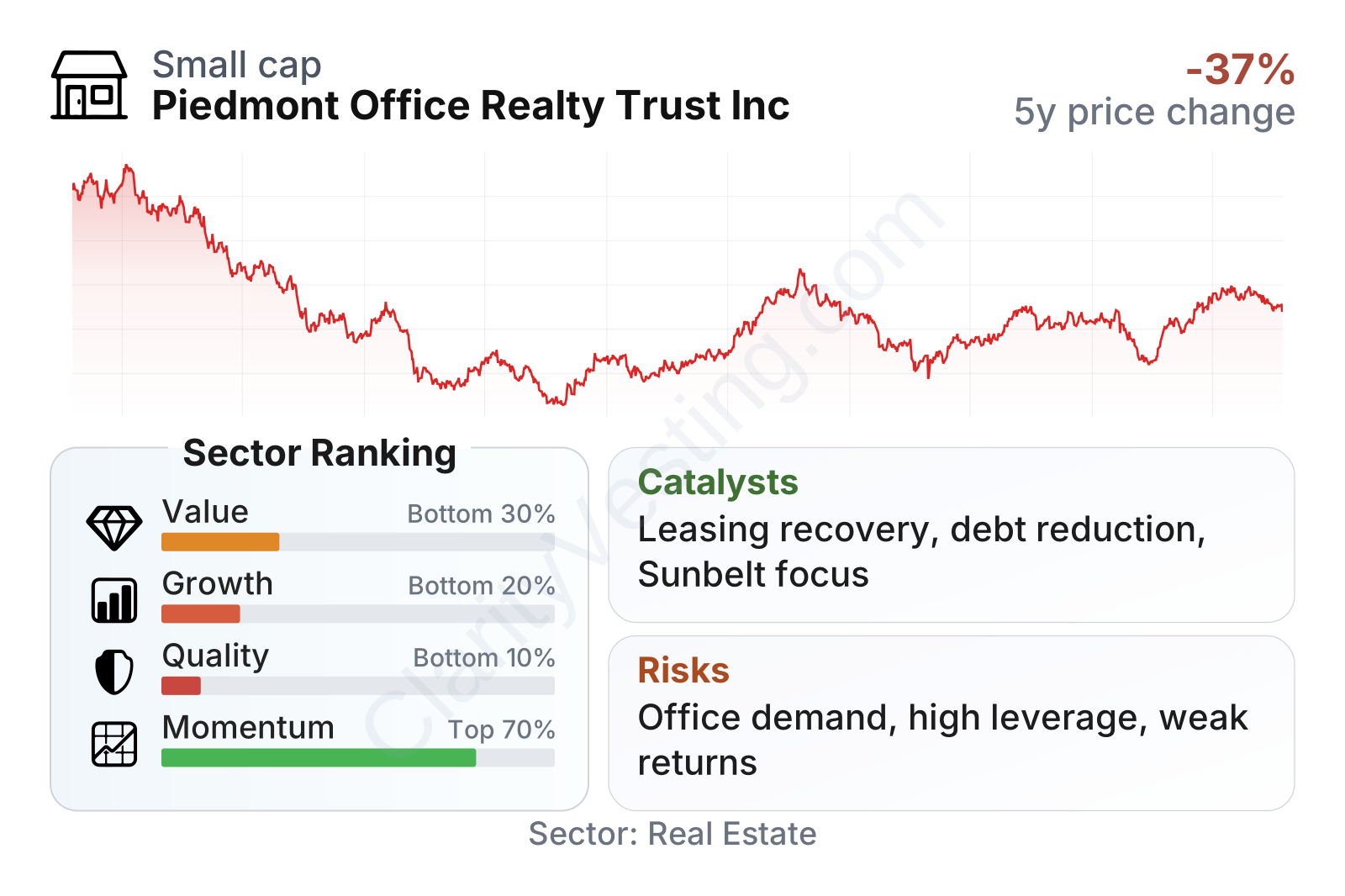
Piedmont is a small-cap REIT with a stock that has been volatile over the last several years. The shares fell heavily during the office-property downturn and later recovered part of that decline, which explains why momentum looks better than some of the company’s underlying fundamentals. The metric table points to a mixed picture: valuation is not high relative to book value, but growth and quality measures are weak versus much of the real estate sector. In particular, profitability and balance-sheet efficiency remain well below sector norms, while recent market performance has improved.
Growth
The office sector is not currently one of the stronger areas of commercial real estate. Demand has been uneven because many tenants continue to rethink office usage, reduce square footage, or seek only top-tier space in the best locations. That creates a split market: commodity office buildings face pressure, while well-located premium assets can still attract tenants. Piedmont’s strategy is built around that second group, which gives it a more realistic path than owners of weaker buildings.
Its future growth depends less on broad office-sector expansion and more on portfolio quality, lease-up execution, redevelopment, and capital recycling. In other words, Piedmont likely needs to grow by improving what it owns rather than relying on a rising tide across the whole industry. That strategy makes sense in the current environment, but it is slower and execution-heavy.
Revenue per share has been fairly stable over the last five years, hovering around the mid-$4 range rather than compounding strongly. That stability shows the company has preserved a meaningful revenue base, but it also highlights the absence of a strong growth engine. Compared with stronger real estate categories such as industrial, data centers, or specialized infrastructure, Piedmont’s growth profile is modest.
The dividend trend also says a lot about the company’s current phase. The payout per share has been reduced significantly over time, which reflects a need to preserve financial flexibility rather than maximize cash distributions. For a REIT, that is a notable signal: management appears to be prioritizing balance-sheet management and portfolio repositioning over a higher cash payout.
Potential catalysts do exist. If return-to-office patterns improve, even gradually, leasing activity in high-quality urban and Sunbelt assets could support occupancy and pricing. The company may also benefit from debt reduction, asset sales at acceptable values, and refinancing progress if credit conditions become easier. Another possible tailwind is that office construction has slowed sharply in many markets, which can eventually help owners of existing, well-located buildings once demand stabilizes.
Recent company updates and filings have continued to emphasize leasing, portfolio concentration in target markets, and capital allocation discipline. Those are sensible priorities, although they do not remove the fact that office real estate remains a recovery situation rather than a clear secular growth market.
Risks
This article is for informational purposes only and does not constitute financial advice. Some content is AI-generated. See Disclaimer


