Stock Analysis · Vaxcyte Inc (PCVX)
Overview
Vaxcyte is a clinical-stage biotechnology company focused on vaccines. Its main objective is to develop newer conjugate and protein-based vaccines designed to prevent serious bacterial infections, with a particular emphasis on pneumococcal disease. The company’s most important programs are VAX-31, a 31-valent pneumococcal conjugate vaccine candidate aimed at adults, VAX-24, an earlier pneumococcal candidate, and VAX-A1, a therapeutic vaccine program for periodontitis. Its platform is built around precise protein engineering and a cell-free manufacturing approach intended to support broader strain coverage and flexible vaccine design.
At this stage, Vaxcyte is still a development company rather than a commercial one. Based on recent SEC filings, it has not yet generated product revenue, so its economic profile is dominated by research spending and capital raised from investors rather than recurring sales.
Main revenue sources are currently very limited:
- Product revenue: 0% — the company does not yet sell approved products.
- Collaboration or licensing revenue: no meaningful recurring contribution disclosed recently — current operations are primarily centered on internal pipeline development.
- Interest and other income: the main reported non-operating inflow — generated from cash, cash equivalents, and marketable securities held on the balance sheet.
The financial profile therefore looks very different from that of a mature pharmaceutical company. Expenses are heavily concentrated in research and development, which has increased sharply as Vaxcyte advances larger and more ambitious clinical programs. Administrative costs have also risen, but R&D remains the clear driver of cash use and operating losses.
The operating structure shows a business still in investment mode: no commercial sales, rapidly rising R&D expense, and widening losses as the pipeline moves into later-stage studies. That is typical for an advanced vaccine developer, but it also means the future value of the company depends mainly on clinical and regulatory progress rather than current revenue.
Key Figures
| Metric | Value | Sector ⓘ |
|---|---|---|
| Date | Oct 17, 2026 | |
| Context | ||
| Sector | Healthcare | |
| Industry | Biotechnology | |
| Market Cap ⓘ | $10.63B | |
| Beta ⓘ | 1.23 | |
Value (Cheapness) | ||
| P/E Ratio ⓘ | N/A | 24.79 |
| P/B Ratio ⓘ | 3.42 | 3.08 |
| FCF Yield ⓘ | -11.31% | 3.15% |
| Dividend Yield ⓘ | N/A | 1.94% |
| EBIT / EV ⓘ | -15.29% | 0.57% |
| PEG ⓘ | N/A | |
Growth (Business expansion) | ||
| Revenue Growth ⓘ | N/A | 7.45% |
| RPS Growth (5Y CAGR) ⓘ | N/A | 8.61% |
| EPS Growth (5Y CAGR) ⓘ | N/A | -17.81% |
| BVPS Growth (5Y CAGR) ⓘ | 37.82% | 3.72% |
| Margin Growth (5Y Trend) ⓘ | N/A | -0.62% |
| FCF Growth (5Y CAGR) ⓘ | N/A | 1.04% |
| DPS Growth (5Y CAGR) ⓘ | N/A | 6.77% |
Quality (Business durability) | ||
| ROIC (Latest) ⓘ | -29.61% | 3.24% |
| ROA (Latest) ⓘ | -33.73% | 3.01% |
| ROIC (5Y Median) ⓘ | -24.78% | 4.60% |
| ROA (5Y Median) ⓘ | -27.91% | 1.89% |
| Net Debt / EBIT (Latest) ⓘ | N/A | 1.34 |
| Net Debt / EBIT (5Y Median) ⓘ | N/A | 1.84 |
| Net Debt / EBITDA (Latest) ⓘ | N/A | 1.00 |
| Net Debt / Assets ⓘ | -2.16% | 5.45% |
| EBITDA / Interest ⓘ | N/A | 9.64 |
| Operating Margin (Latest) ⓘ | N/A | 9.27% |
| Operating Margin (5Y Median) ⓘ | N/A | 7.38% |
| Debt to Equity (Latest) ⓘ | 4.19% | 28.58% |
| Profit Margin (Latest) ⓘ | N/A | 3.59% |
| Free Cash Flow (Latest) ⓘ | -$1.20B | |
Momentum (Price trend) | ||
| 3Y Return ⓘ | +39.23% | +42.80% |
| 12M Return (excl. last month) ⓘ | +91.00% | +18.50% |
| 6M Return ⓘ | +7.97% | +7.57% |
| Price vs. 200-Day MA ⓘ | +16.26% | +5.12% |
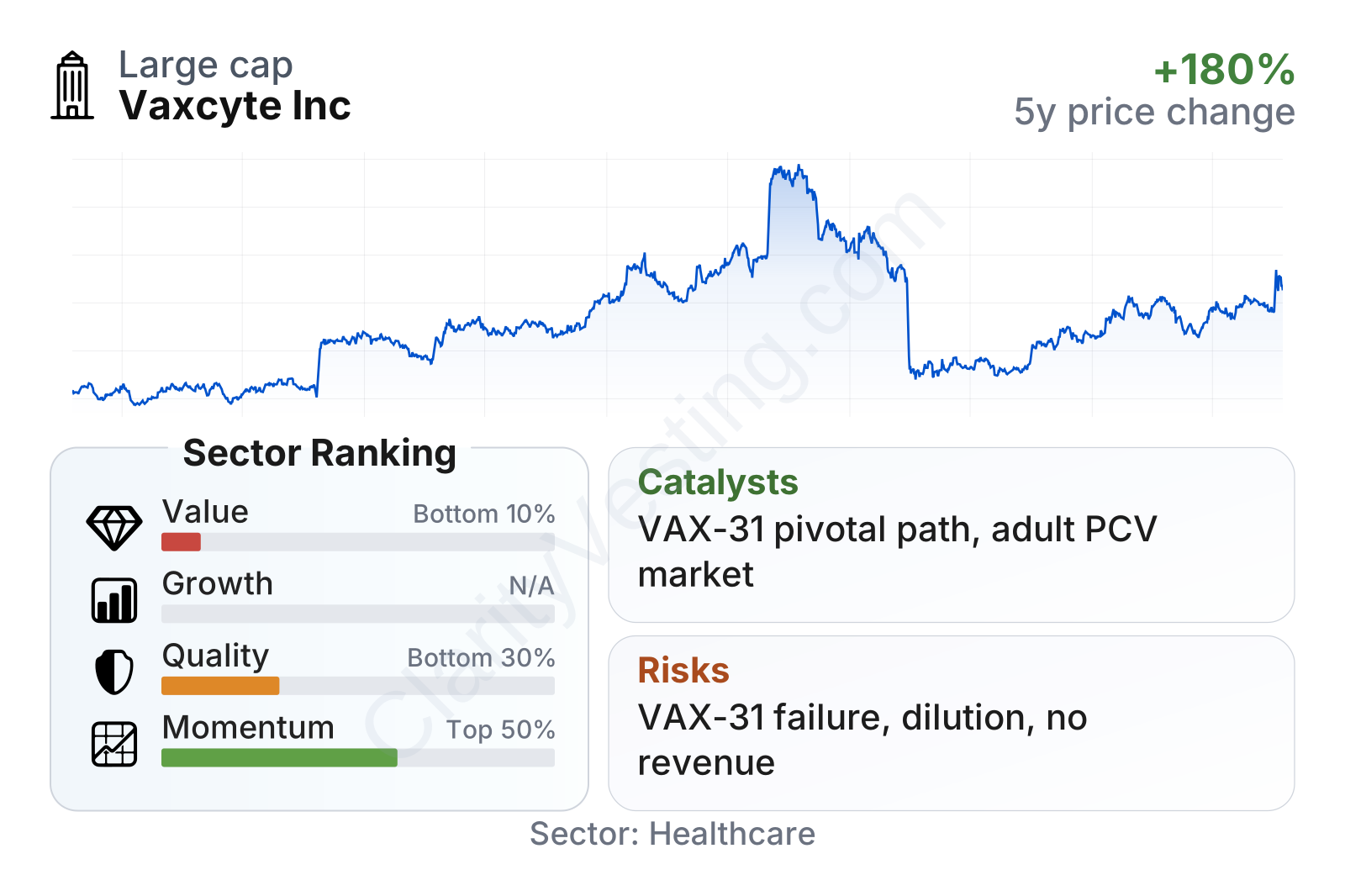
Vaxcyte sits in a difficult spot on traditional valuation and quality measures because those tools are built for companies with established earnings and cash flow. It ranks poorly on value and below average on quality, largely because it is still loss-making and burning cash. At the same time, the balance sheet is unusually clean for biotech, with debt to equity around 4% versus a sector median near 27%. The company’s market performance has been volatile, but the longer-term share move still reflects meaningful market interest in its pipeline despite sharp setbacks along the way.
The company is mid-to-large by biotech development standards, with a market capitalization in the high single-digit billions. That size suggests the market is already assigning substantial value to its vaccine programs before commercialization, which raises the importance of execution over the next few years.
Growth
Vaxcyte operates in a part of healthcare with long-term structural demand. Vaccines address large global disease burdens, and pneumococcal vaccines are especially important because they target infections that can lead to pneumonia, bloodstream infections, and meningitis. This is already a major market, but there is still room for product upgrades because broader strain coverage, stronger immunogenicity, and better convenience can all matter in adult immunization.
That is where Vaxcyte’s strategy becomes relevant. Rather than trying to enter a small niche, the company is pursuing a large established vaccine category with the goal of improving product breadth. VAX-31 is especially important because it aims to cover more serotypes than currently marketed adult pneumococcal vaccines. If that broader coverage is paired with competitive immune responses and acceptable safety, it could create a meaningful commercial opportunity in a market already validated by existing products.
A major catalyst has been the company’s decision to prioritize VAX-31 over VAX-24 after comparative clinical readouts. That choice concentrates resources behind the program with the strongest strategic potential. The next key growth drivers are later-stage clinical development, regulatory alignment, and eventual pivotal data that can clarify whether VAX-31 has a credible path toward approval and commercial relevance.
There is also optional upside beyond the lead program. Vaxcyte has continued work on VAX-A1 and has discussed broader expansion opportunities using the same technology platform. For long-term analysis, however, most of the potential still rests on success in pneumococcal vaccines.
Cash usage has been moving sharply lower in absolute terms, with free cash flow deeply negative and worsening as trials expand. That trend is not surprising for a clinical-stage vaccine company building toward large studies, but it shows that growth is currently being funded by cash reserves rather than by operations. In other words, the growth case is strong on market opportunity and product ambition, not on near-term financial self-sufficiency.
Recent company updates have also reinforced that 2026 and beyond are likely to be data-driven years. For Vaxcyte, meaningful opportunity comes less from short-term sales milestones and more from the possibility that upcoming clinical progress could reposition it as a serious challenger in adult pneumococcal vaccination.
Risks
This article is for informational purposes only and does not constitute financial advice. Some content is AI-generated. See Disclaimer


