Stock Analysis · Pacific Basin Shipping Ltd (PCFBY)
Overview
Pacific Basin Shipping Ltd is a dry bulk shipping company focused on moving essential raw materials by sea. Its fleet mainly serves the minor bulk and handysize/supramax segments, which means it transports smaller cargo lots than the very large iron ore and coal carriers. Typical cargoes include agricultural products, construction materials, steel products, fertilizers, forest products, and other everyday industrial and consumer supply-chain inputs. The company is listed in Hong Kong, and the U.S. ticker PCFBY represents its ADR.
The business earns most of its money from freight income: chartering ships to customers and transporting cargoes along regional and global trade routes. Based on company reporting structure and fleet focus, revenue is primarily generated from dry bulk shipping services, with a small contribution from other activities such as vessel management-related services and occasional vessel disposal gains when they occur. A simple way to think about the revenue mix is:
- Dry bulk freight services: approximately 95%+ — ocean transport of minor bulks and some major bulks using owned and chartered vessels.
- Other shipping-related income: low single share of revenue — ancillary commercial activities, management services, and from time to time gains linked to vessel sales or fleet optimization.
Pacific Basin’s model is built around operating a large, flexible fleet with a combination of owned ships and chartered-in vessels. That approach lets it adjust capacity faster than some shipowners that rely more heavily on owned tonnage alone. Financially, the business is highly tied to freight rates: revenue can remain large while profit swings sharply because fuel, vessel hire, and voyage expenses absorb most of the sales base. Over the last several years, the company’s revenue has stayed above $2.0 billion, but earnings and margins have moved up and down much more dramatically, which is typical in shipping.
The profit structure shows how cyclical this business can be. Revenue remained substantial through 2021–2025, but net income fell sharply from the peak freight-rate years to more normal conditions, indicating that small changes in shipping rates can have an outsized effect on earnings.
Key Figures
| Metric | Value | Sector ⓘ |
|---|---|---|
| Date | Oct 24, 2026 | |
| Context | ||
| Sector | Industrials | |
| Industry | Marine Shipping | |
| Market Cap ⓘ | $2.58B | |
| Beta ⓘ | 1.48 | |
Value (Cheapness) | ||
| P/E Ratio ⓘ | 0.24 | 22.29 |
| P/B Ratio ⓘ | 1.37 | 1.98 |
| FCF Yield ⓘ | 12.70% | 6.26% |
| Dividend Yield ⓘ | 5.47% | 1.92% |
| EBIT / EV ⓘ | 10.12% | 4.83% |
| PEG ⓘ | N/A | |
Growth (Business expansion) | ||
| Revenue Growth ⓘ | 8.50% | 9.30% |
| RPS Growth (5Y CAGR) ⓘ | -7.64% | 7.76% |
| EPS Growth (5Y CAGR) ⓘ | -4.51% | -13.17% |
| BVPS Growth (5Y CAGR) ⓘ | 0.88% | 6.13% |
| Margin Growth (5Y Trend) ⓘ | -26.11% | 0.74% |
| FCF Growth (5Y CAGR) ⓘ | -30.28% | 10.79% |
| DPS Growth (5Y CAGR) ⓘ | -14.66% | 9.41% |
Quality (Business durability) | ||
| ROIC (Latest) ⓘ | 13.21% | 10.75% |
| ROA (Latest) ⓘ | 10.10% | 5.41% |
| ROIC (5Y Median) ⓘ | 7.45% | 9.37% |
| ROA (5Y Median) ⓘ | 5.43% | 4.95% |
| Net Debt / EBIT (Latest) ⓘ | -0.24 | 2.04 |
| Net Debt / EBIT (5Y Median) ⓘ | 0.39 | 2.27 |
| Net Debt / EBITDA (Latest) ⓘ | -0.10 | 1.39 |
| Net Debt / Assets ⓘ | -2.77% | 19.27% |
| EBITDA / Interest ⓘ | 15.01 | 9.58 |
| Operating Margin (Latest) ⓘ | 5.93% | 10.49% |
| Operating Margin (5Y Median) ⓘ | 6.07% | 10.30% |
| Debt to Equity (Latest) ⓘ | 7.61% | 64.82% |
| Profit Margin (Latest) ⓘ | 6.35% | 6.67% |
| Free Cash Flow (Latest) ⓘ | $327.99M | |
Momentum (Price trend) | ||
| 3Y Return ⓘ | +107.10% | +67.77% |
| 12M Return (excl. last month) ⓘ | +63.66% | +12.05% |
| 6M Return ⓘ | +41.46% | 0.00% |
| Price vs. 200-Day MA ⓘ | +31.07% | +0.67% |
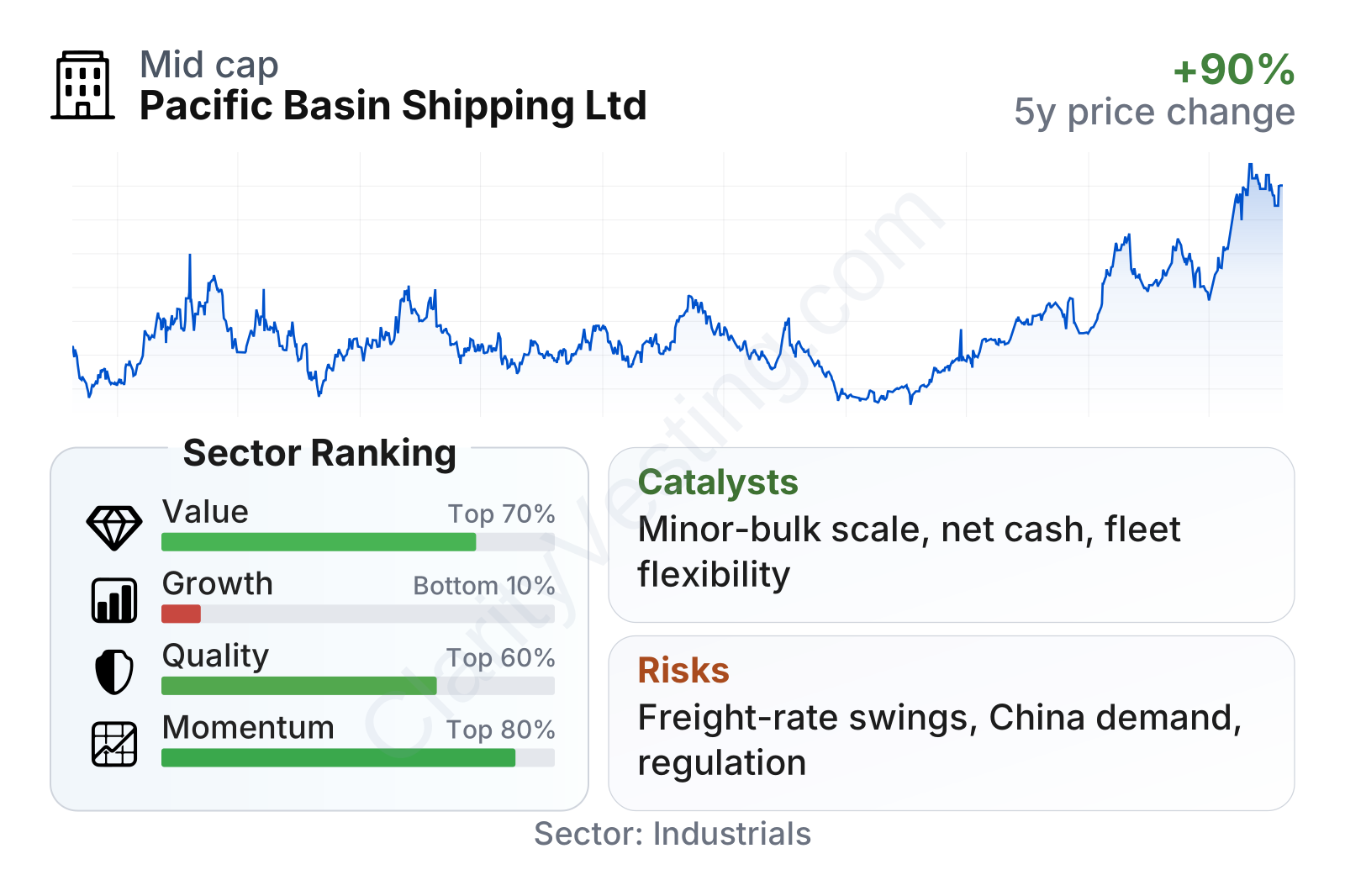
Pacific Basin sits in the mid-cap range and has shown unusually strong share-price momentum versus the broader industrial sector over the last 6 months, 12 months, and 3 years. On valuation and cash generation, it screens attractively: free cash flow yield and dividend yield are well above sector medians, and price-to-book is below the sector median. Balance-sheet quality also stands out, with very low leverage and even a net cash position on some measures. The weak spot is growth: long-term revenue per share, free cash flow, and dividend growth trends remain poor, reflecting the shipping cycle rather than a steadily compounding business model.
Growth
Pacific Basin operates in a sector that is essential rather than structurally fast-growing. Dry bulk shipping depends on global trade volumes, commodity demand, agricultural flows, and regional infrastructure activity. Over long periods, demand tends to grow with population, urbanization, and industrial activity, but year-to-year performance is heavily cyclical. For Pacific Basin, the more relevant question is not whether shipping grows in a straight line, but whether the company can take share, keep vessels employed, and earn acceptable returns across the cycle.
Its strategy is sensible for that environment. The company has built a strong position in minor bulks, a part of dry bulk shipping that is generally more diversified than the major-bulk trades dominated by iron ore and coal. That diversification can reduce dependence on a single commodity. The use of both owned and chartered ships also gives management flexibility to expand exposure when market conditions are favorable and limit fixed commitments when conditions weaken. In a volatile industry, operational flexibility is a meaningful advantage.
A notable medium-term catalyst is fleet and market positioning in the handysize and supramax classes, where Pacific Basin is widely recognized as one of the largest operators globally. Scale can matter here because customers value dependable vessel availability, cargo matching, and route optimization. Another support factor is the company’s balance sheet: low debt creates room to weather weak freight markets and potentially pursue vessel acquisitions or charter opportunities when asset prices become attractive.
Recent operating context also suggests opportunity if freight conditions stay constructive. The stock’s strong momentum over the past year indicates that the market has responded positively to improving earnings expectations and the company’s cash-generation profile. In shipping, recoveries can become visible quickly when vessel supply stays disciplined and cargo demand improves even modestly. Pacific Basin’s current positioning means it is operationally prepared to benefit from that kind of setup.
Risks
This article is for informational purposes only and does not constitute financial advice. Some content is AI-generated. See Disclaimer


