Stock Analysis · Pacific Basin Shipping Limited (PCFBF)
Overview
Pacific Basin Shipping Limited is a dry bulk shipping company focused on moving essential commodities by sea. Its fleet mainly serves the minor bulk and handy-size segments of the market, transporting cargoes such as agricultural products, forest products, construction materials, steel products, and other raw materials used in everyday industrial activity. The company operates globally, with a strong presence in Asia and routes connected to the world’s major commodity flows.
The business model combines owned vessels with chartered ships, which gives Pacific Basin flexibility to adjust fleet size and cargo coverage as market conditions change. This matters in shipping because freight rates can move sharply depending on vessel supply, commodity demand, port congestion, and fuel costs. Compared with larger operators focused on giant Capesize vessels, Pacific Basin is more exposed to the smaller-vessel trades that often serve more ports and a wider range of cargo categories.
Revenue primarily comes from freight income earned by transporting cargo for customers and from operating chartered-in vessels. Based on the company’s reporting structure and business model, the main sources of revenue can be summarized as follows:
- Handysize shipping: approximately 50% to 60% of revenue in a typical year. This segment serves smaller ports and carries diversified minor bulk cargoes such as agricultural goods, fertilizers, cement, steel, and forest products.
- Supramax/Ultramax shipping: approximately 40% to 50% of revenue. These ships are larger than Handysize vessels and carry many of the same commodity types, while also serving broader regional and global trade routes.
- Other shipping-related income: generally a small share of revenue, including vessel chartering optimization, freight contracts, and ancillary operating items tied to the fleet.
One notable pattern in recent years is that revenue stayed in the multi-billion-dollar range, but profit fell sharply from the unusually strong shipping market of 2021 and 2022 to more normalized conditions in 2023 through 2025. That shows how sensitive earnings are to freight rates even when the underlying business remains active.
Key Figures
| Metric | Value | Sector ⓘ |
|---|---|---|
| Date | Oct 17, 2026 | |
| Context | ||
| Sector | Industrials | |
| Industry | Marine Shipping | |
| Market Cap ⓘ | $2.58B | |
| Beta ⓘ | 1.48 | |
Value (Cheapness) | ||
| P/E Ratio ⓘ | 0.24 | 22.10 |
| P/B Ratio ⓘ | 1.37 | 1.97 |
| FCF Yield ⓘ | 12.73% | 6.38% |
| Dividend Yield ⓘ | 5.60% | 1.94% |
| EBIT / EV ⓘ | 10.13% | 4.79% |
| PEG ⓘ | N/A | |
Growth (Business expansion) | ||
| Revenue Growth ⓘ | 8.50% | 9.30% |
| RPS Growth (5Y CAGR) ⓘ | -7.61% | 7.81% |
| EPS Growth (5Y CAGR) ⓘ | 36.00% | -13.06% |
| BVPS Growth (5Y CAGR) ⓘ | 0.88% | 6.14% |
| Margin Growth (5Y Trend) ⓘ | -26.11% | 0.88% |
| FCF Growth (5Y CAGR) ⓘ | -30.26% | 11.01% |
| DPS Growth (5Y CAGR) ⓘ | -14.62% | 9.48% |
Quality (Business durability) | ||
| ROIC (Latest) ⓘ | 13.22% | 10.84% |
| ROA (Latest) ⓘ | 10.11% | 5.41% |
| ROIC (5Y Median) ⓘ | 7.45% | 9.38% |
| ROA (5Y Median) ⓘ | 5.43% | 4.95% |
| Net Debt / EBIT (Latest) ⓘ | -0.24 | 2.08 |
| Net Debt / EBIT (5Y Median) ⓘ | 0.39 | 2.27 |
| Net Debt / EBITDA (Latest) ⓘ | -0.10 | 1.39 |
| Net Debt / Assets ⓘ | -2.77% | 19.28% |
| EBITDA / Interest ⓘ | 15.02 | 9.58 |
| Operating Margin (Latest) ⓘ | 5.93% | 10.50% |
| Operating Margin (5Y Median) ⓘ | 6.07% | 10.29% |
| Debt to Equity (Latest) ⓘ | 7.61% | 65.48% |
| Profit Margin (Latest) ⓘ | 6.35% | 6.67% |
| Free Cash Flow (Latest) ⓘ | $328.08M | |
Momentum (Price trend) | ||
| 3Y Return ⓘ | +105.25% | +61.68% |
| 12M Return (excl. last month) ⓘ | +97.78% | +12.58% |
| 6M Return ⓘ | +41.56% | 0.00% |
| Price vs. 200-Day MA ⓘ | +58.76% | +0.02% |
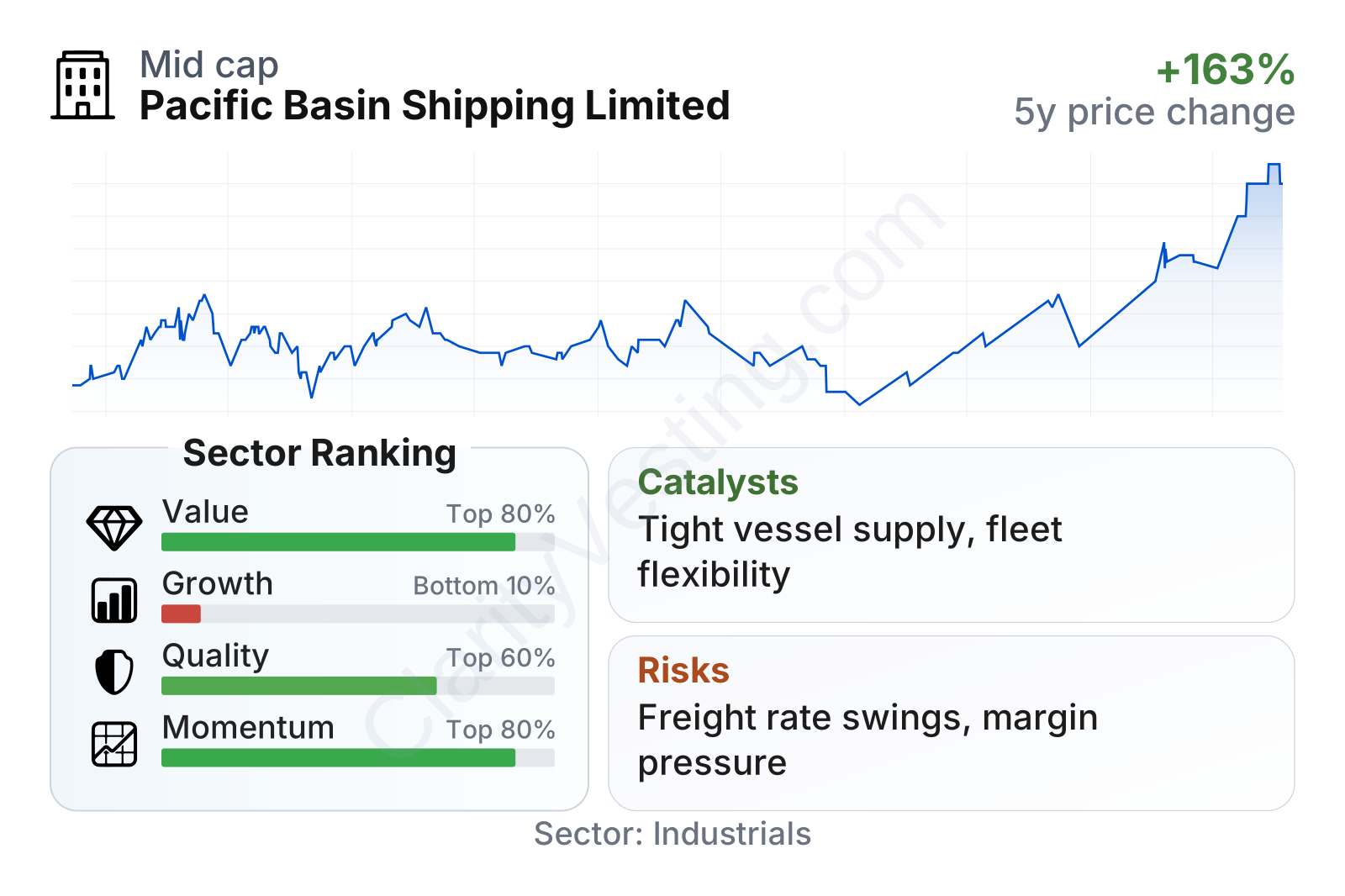
Pacific Basin sits in the mid-cap range and shows a mixed but understandable profile for a cyclical shipping company. On valuation metrics, it screens better than much of the broader industrial sector, helped by a free cash flow yield around the low teens, a dividend yield above 5%, and a price-to-book ratio below the sector median. Balance sheet quality is a clear strength: debt is very low, net cash is present on several measures, and interest coverage is solid. Profitability is decent but not exceptional, with returns on assets and invested capital ahead of sector medians, while operating margin is below the sector median. The weakest area is growth. Recent year-over-year revenue growth is modest, and five-year trends in revenue per share, free cash flow, and dividends are negative, reflecting the shipping cycle rather than a steady compounding pattern. Share-price momentum has been very strong over the last six months, 12 months, and three years, which suggests the market has recently become more constructive on the company despite the uneven earnings backdrop.
Growth
Pacific Basin operates in a sector that is mature rather than structurally high growth, but that does not mean growth opportunities are absent. Dry bulk shipping demand is tied to global trade volumes, industrial production, infrastructure activity, food distribution, and commodity consumption. Within that market, the company’s focus on Handysize and Supramax vessels is strategically important because these ships can access many more ports than larger bulk carriers and are used for a broad mix of cargoes. That diversification can make demand more resilient than in the largest-vessel segments that depend more heavily on a few major commodities.
The company’s strategy makes practical sense for future expansion because it emphasizes fleet efficiency, commercial scale, and operating flexibility rather than aggressive balance-sheet risk. Pacific Basin has long built its network around a large core fleet in the handy-size categories, global cargo coverage, and a mix of owned and chartered vessels. In a volatile shipping market, that approach can help it capture opportunities when freight rates improve without requiring the same level of capital commitment as a purely owned-fleet strategy.
A meaningful catalyst for the wider sector is vessel supply discipline. New ship orders across dry bulk have generally remained more restrained than in past shipping booms, while environmental rules are slowing effective fleet capacity because older ships may sail more slowly or become less economical. If cargo demand stays stable or improves, that supply backdrop can support freight rates. Pacific Basin is also positioned to benefit from fleet renewal and efficiency gains if tighter emissions standards push customers toward operators with better commercial execution and newer tonnage access.
Recent business performance also points to a company that remains active and cash generative even after the exceptional market conditions of earlier years faded. Revenue recovered somewhat in 2024 after a weaker 2023, although earnings remained well below the 2021-2022 peak. That is not unusual in shipping, but it does suggest the company can still produce meaningful cash flow through softer parts of the cycle. For a long-term view, the main opportunity is less about constant annual growth and more about Pacific Basin maintaining a strong balance sheet and being ready when freight markets strengthen again.
Risks
This article is for informational purposes only and does not constitute financial advice. Some content is AI-generated. See Disclaimer


