Stock Analysis · PACCAR Inc (PCAR)
Overview
PACCAR Inc is a major manufacturer of heavy-duty and medium-duty commercial vehicles. The company is best known for its truck brands Kenworth, Peterbilt, and DAF, which are sold mainly in North America, Europe, Australia, and parts of South America. Beyond building trucks, PACCAR also operates a financing arm and a parts business, giving it exposure not only to new truck sales but also to recurring revenue from fleet maintenance and customer financing.
This mix matters because truck manufacturing is cyclical, while replacement parts and financial services can provide steadier earnings across the business cycle. PACCAR also develops diesel powertrains, connected vehicle services, and battery-electric and hydrogen-related technologies through internal engineering and partnerships.
Based on recent annual reporting, PACCAR’s revenue sources can be summarized approximately as follows:
- Truck sales: about 80% to 85% of total revenue. This includes sales of heavy-duty and medium-duty trucks under Kenworth, Peterbilt, and DAF.
- Parts: about 10% to 15%. This business includes aftermarket replacement parts sold through PACCAR’s dealer network and tends to be more resilient than new truck demand.
- Financial Services: about 5% to 10%. This segment provides retail financing, leasing, and dealer inventory financing tied largely to truck purchases.
- Other: a small share, including winches and industrial products through PACCAR Winch.
PACCAR’s business model is relatively straightforward for long-term readers: sell trucks, support them with parts and service, and finance customers through an in-house lending platform. That combination has historically produced solid profitability, especially when freight markets and fleet replacement demand are healthy.
The profit flow over the last several years shows how powerful PACCAR’s earnings expansion was through 2023 and 2024, followed by a notable step-down in 2025 as truck demand cooled. Even so, the company kept research spending fairly steady, suggesting it did not pull back sharply on product development during the downturn.
Key Figures
| Metric | Value | Sector ⓘ |
|---|---|---|
| Date | Oct 24, 2026 | |
| Context | ||
| Sector | Industrials | |
| Industry | Farm & Heavy Construction Machinery | |
| Market Cap ⓘ | $57.94B | |
| Beta ⓘ | 0.99 | |
Value (Cheapness) | ||
| P/E Ratio ⓘ | 23.17 | 22.29 |
| P/B Ratio ⓘ | 2.86 | 1.98 |
| FCF Yield ⓘ | 5.41% | 6.26% |
| Dividend Yield ⓘ | 1.24% | 1.92% |
| EBIT / EV ⓘ | 4.54% | 4.83% |
| PEG ⓘ | 0.83 | |
Growth (Business expansion) | ||
| Revenue Growth ⓘ | 0.50% | 9.30% |
| RPS Growth (5Y CAGR) ⓘ | 4.66% | 7.76% |
| EPS Growth (5Y CAGR) ⓘ | -19.29% | -13.17% |
| BVPS Growth (5Y CAGR) ⓘ | 13.31% | 6.13% |
| Margin Growth (5Y Trend) ⓘ | 1.64% | 0.74% |
| FCF Growth (5Y CAGR) ⓘ | 52.92% | 10.79% |
| DPS Growth (5Y CAGR) ⓘ | 33.50% | 9.41% |
Quality (Business durability) | ||
| ROIC (Latest) ⓘ | 7.04% | 10.75% |
| ROA (Latest) ⓘ | 5.68% | 5.41% |
| ROIC (5Y Median) ⓘ | 12.95% | 9.37% |
| ROA (5Y Median) ⓘ | 9.59% | 4.95% |
| Net Debt / EBIT (Latest) ⓘ | 3.10 | 2.04 |
| Net Debt / EBIT (5Y Median) ⓘ | 1.82 | 2.27 |
| Net Debt / EBITDA (Latest) ⓘ | 2.56 | 1.39 |
| Net Debt / Assets ⓘ | 20.74% | 19.27% |
| EBITDA / Interest ⓘ | N/A | 9.58 |
| Operating Margin (Latest) ⓘ | 10.80% | 10.49% |
| Operating Margin (5Y Median) ⓘ | 13.35% | 10.30% |
| Debt to Equity (Latest) ⓘ | 72.32% | 64.82% |
| Profit Margin (Latest) ⓘ | 9.00% | 6.67% |
| Free Cash Flow (Latest) ⓘ | $3.13B | |
Momentum (Price trend) | ||
| 3Y Return ⓘ | +50.80% | +67.77% |
| 12M Return (excl. last month) ⓘ | +18.19% | +12.05% |
| 6M Return ⓘ | -12.15% | 0.00% |
| Price vs. 200-Day MA ⓘ | -8.26% | +0.67% |
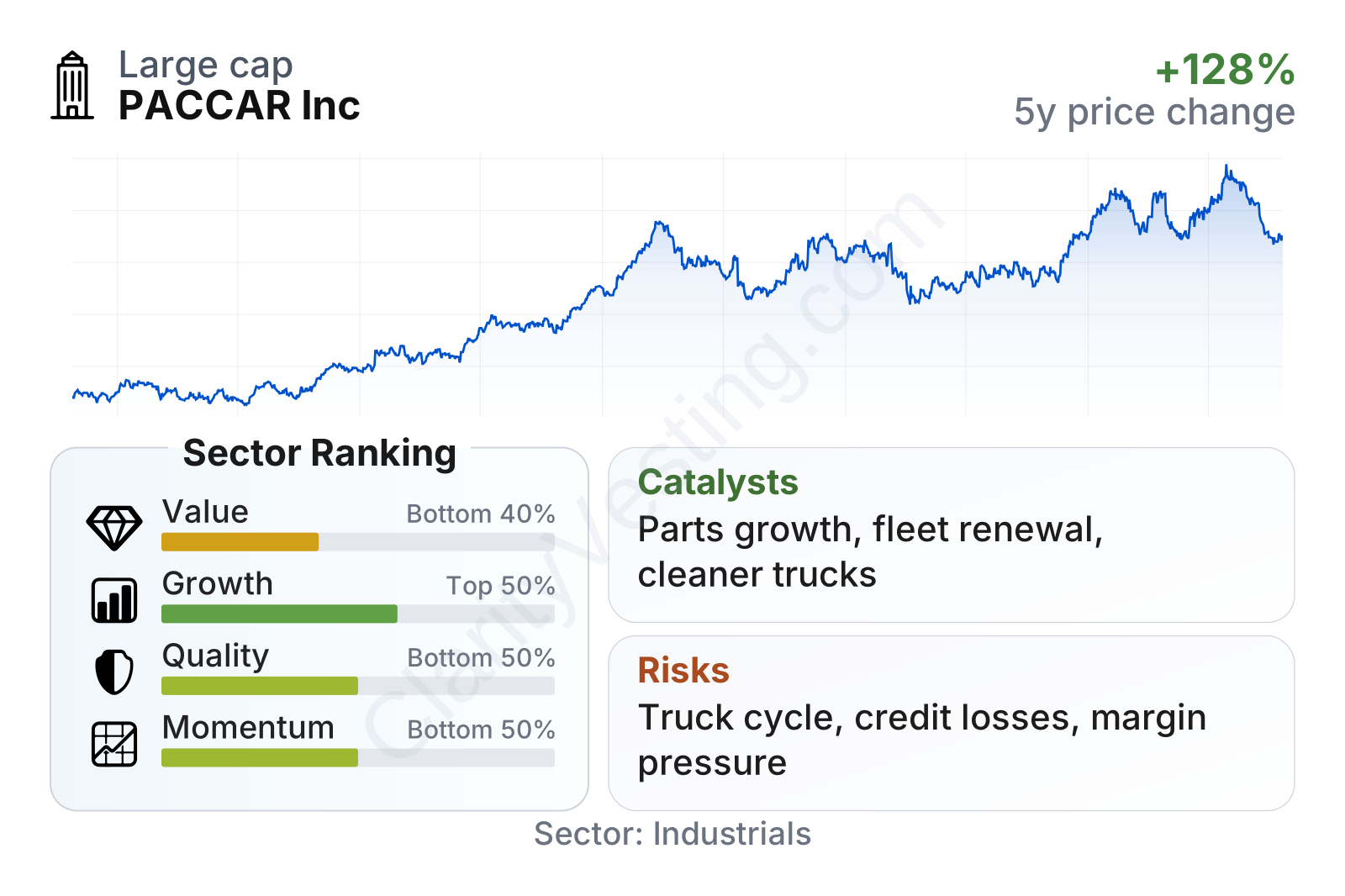
PACCAR is a large industrial company with market volatility close to the broader market. The overall profile is mixed but understandable: valuation metrics sit around the weaker half of the sector, growth measures are in the better half, quality is above average, and recent share-price momentum is softer. In practical terms, the market is recognizing PACCAR’s durable business quality, but it is not assigning a clearly cheap multiple relative to its industrial peers.
Growth
The long-term backdrop for PACCAR remains constructive even though the truck market itself is cyclical. Freight transportation is essential to the economy, and commercial fleets must eventually replace aging vehicles. On top of that, tighter emissions rules, rising fuel-efficiency needs, and increasing demand for connected fleet management can all support replacement demand over time. This does not create smooth year-by-year growth, but it does create a durable industry with recurring product renewal.
PACCAR’s strategy for growth makes sense because it is not relying on a single lever. It is investing in newer powertrains, digital fleet tools, parts distribution, and its financing platform. For a truck maker, the parts business is especially important: once a vehicle is on the road, it can generate years of higher-margin aftermarket revenue. That installed base supports long-term economics beyond the original truck sale.
Revenue growth has clearly cooled after the exceptionally strong period in 2022 and 2023. The recent pattern points to a downcycle rather than a broken business. The latest reading shows stabilization compared with the deeper declines seen through much of 2025 and early 2026, which is an important distinction for a cyclical manufacturer.
Cash generation remains a notable strength. Free cash flow expanded sharply over the last several years and, despite fluctuations, remains at a solid level for a company in a softer demand environment. That supports PACCAR’s ability to keep funding engineering, factory investments, dividends, and buybacks without looking financially stretched.
Several catalysts could shape the next phase. PACCAR continues to benefit from its premium brand positions in heavy trucks, expanding parts distribution, and technology upgrades in its vehicle lineup. Recent company communications have also highlighted continued investment in next-generation trucks, powertrain efficiency, and zero-emission programs. These areas may not transform revenue overnight, but they strengthen the company’s position as fleets modernize.
Risks
This article is for informational purposes only and does not constitute financial advice. Some content is AI-generated. See Disclaimer